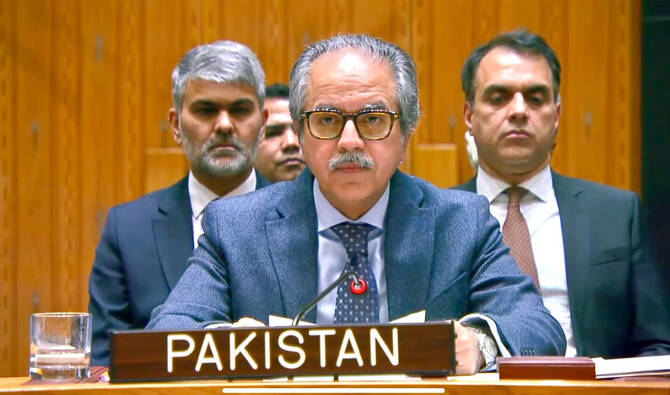

ISLAMABAD: Ambassador Asim Iftikhar Ahmad, Pakistan’s permanent representative to the United Nations (UN), on Tuesday called for the “security” and “safe passage” of ships through the Strait of Hormuz, amid the United States and Israeli war on Iran.
US-Israeli strikes on Iran, which began on Feb. 28, and Tehran’s counterattacks against US interests as well as oil and other infrastructure in the Gulf has disrupted shipping through the Strait, a key route for about one-fifth of the world’s oil supply.
On Tuesday, Russia and China vetoed a UN Security Council resolution sponsored by Bahrain aimed at safeguarding navigation through the waterway, dealing a blow to international efforts to address rising tensions linked to Iran’s obstruction of the vital waterway.
Speaking at the UNSC session, Ambassador Ahmad, whose country abstained from voting on the resolution, said Islamabad supported the sovereignty, territorial integrity, political independence and security of all brotherly countries in the region.
“The situation in the Strait of Hormuz is adversely impacting countries around the world, including Pakistan. The consequences for regional and global economy are evidently harsh, and ordinary Pakistanis are also suffering,” he said.
“Pakistan calls for the security of ships and crew members, and the swift and safe passage of civilian ships, and restoration of normal passage through the Strait.”
The draft resolution received 11 votes in favor, with two against — Russia and China — and two abstentions, falling short due to the vetoes by the two permanent members.
Disruptions in energy and cargo supplies through waterway have led to global fuel price hikes, with Oxford Economics, a global economic advisory firm, warning the war posed the most threat to economies that combined high energy vulnerability with weak sovereign fundamentals.
“Asian economies rank as the most exposed, including Thailand, Singapore, the Philippines, as well as South Korea and Japan,” the firm quoted senior economist Evghenia Sleptsova as saying in a report this month. “These economies have high dependence on imported energy, strong reliance on Middle Eastern supply routes and limited domestic energy buffers.”
“Pakistan and Sri Lanka also screen as highly vulnerable due to energy dependence layered on top of already weak macroeconomic conditions,” she added.