

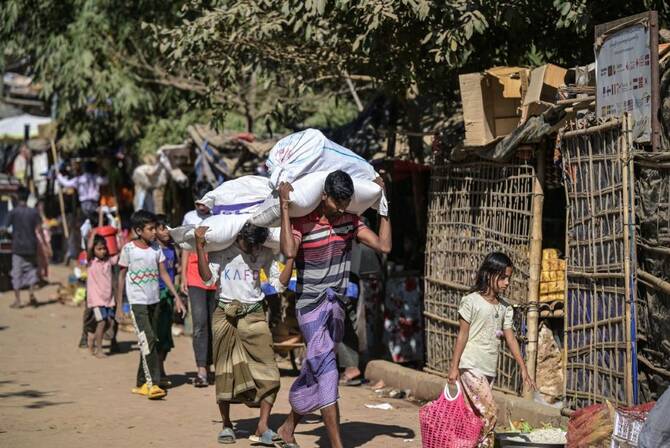

DHAKA: Bangladeshi authorities warned on Wednesday that the UN’s decision to cut food rations for Rohingya is expected to heighten security risks in the overcrowded refugee camps, where hundreds of thousands of people are already struggling to survive.
Nearly 1.3 million Rohingya are currently cramped inside 33 camps in Bangladesh’s coastal Cox’s Bazar district, where they have limited access to job opportunities and education.
With international aid for the refugee community dropping since 2021, aid agencies and the Bangladeshi government have been facing difficulties in covering the costs of education, healthcare and food.
Since last year, the UN’s food agency, the World Food Programme, has been distributing food assistance worth $12 a month to the refugees.
From Wednesday, the entire Rohingya population will be categorized into three groups as highly vulnerable, vulnerable and moderately vulnerable based on the severity of their family’s needs.
The first group — about a third of the refugees — will continue receiving $12, while the other will receive $10 and $7, respectively. More than 200,000 people fall into the last category.
Mizanur Rahman, refugee relief and repatriation commissioner in Cox’s Bazar, told Arab News that the reductions will impact both the refugees and the host community, as $12 was already insufficient and decreasing the rations will further compromise the health situation in the camps.
“Rohingya will desperately try to come out of the camps in search of work and food. The law-and-order situation will deteriorate,” he said.
“Any rationing in food support impacts all other areas of life. Incidents of drug peddling and human trafficking are feared to increase. This will also obviously impact the host community.”
It is not the first time that funding shortages have forced the WFP to cut food rations for the Rohingya. In early 2023, they were reduced to $8 a month, and most of the refugees could not afford an adequate diet. According to WFP data, the number of children with acute malnutrition rose to 15 percent — the highest ever.
In 2024, rations were eventually increased to $12 a month.
“During the earlier reduction of food aid, the situation was indeed very bad in the camps. The nutrition level was severely compromised. There was also a rise in criminal incidents, robbery, kidnapping, etc. So, this time also these sorts of crime may increase,” Rahman said.
A predominantly Muslim ethnic minority, the Rohingya have lived for centuries in Myanmar’s western Rakhine State but were stripped of their citizenship in the 1980s.
Since then, many have fled to neighboring Bangladesh, with about 700,000 arriving in 2017 alone, after a military crackdown in their native state.
Despite multiple attempts from Bangladeshi authorities, a UN-backed repatriation and resettlement process of the Rohingya has been failing to take off for the past few years.
“The fact is that these Rohingya are not living a normal life here in the camps,” said Abu Saleh Mohammad Obaidullah, additional refugee relief and repatriation commissioner.
“We want them to return. They are industrious and capable of doing anything. They will repatriate to Myanmar and lead a normal life — that is our hope. Until that happens, we appeal to the international community to continue providing funding to ensure a minimally dignified life for them.”


