

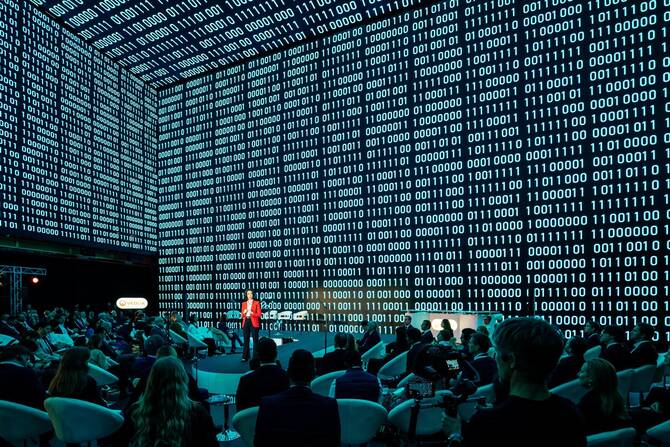
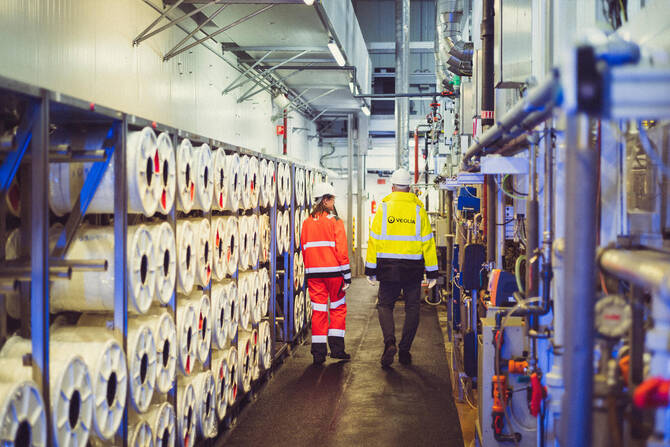

LONDON: Veolia has taken a further step in its environmental strategy by unveiling Data Center Resource 360, a global offering designed to address a growing challenge: reconciling the rapid expansion of digital infrastructure with environment and society imperatives.
In a world where access to information has become essential, data is now established as a strategic resource.
However, this transformation comes with a significant but often invisible cost: data centers, the backbone of the digital economy, require ever-increasing volumes of water, energy, and infrastructure.
Their rapid growth - estimated at more than 11 percent annually - intensifies pressure on resources, particularly in urban areas where they are located.
Against this backdrop, Veolia is proposing a holistic and integrated approach.
FASTFACT
Key points
- Veolia launches a global integrated offering dedicated to data centers
- Fast-growing market (+11% per year through 2034), with increasing environmental pressure
- Integrated-solutions market could reach around $5 billion annually by 2030
- Objective: transform data centers into circular, sustainable hubs
- Up to 20% energy reuse, -75% water footprint, 95% waste recycling and reuse
- A model aimed at improving territorial resilience and resource security.
The Data Center Resource 360 offering aims to transform these infrastructures into models of sustainability. It is based on full lifecycle resource management, enabling up to a 75 percent reduction in its water footprint, 95 percent recycling and reuse of waste, and up to 20 percent energy reuse.
Already deployed across more than 100 sites worldwide, including with leading industry operators, this offering draws on the group’s combined expertise in water, waste, and energy management.
“This is a strategic market at the crossroads of the digital and ecological revolutions,” said Estelle Brachlianoff, CEO of Veolia, at the launch event recently.
“As pressure on resources intensifies, transforming data centers into assets for local communities is becoming a necessity,” she added.
Brachlianoff also emphasized the group’s innovation DNA, built over more than 170 years of history.
“Today, data is the next generation of resources,” she said. “We are the innovation lab for essential services.”
This vision reflects a forward-looking approach: for Veolia, innovation is above all about securing what societies cannot do without - water, energy, and health.

Estelle Brachlianoff, CEO of Veolia, at the launch of Data Center Resource 360 in London. (Supplied)
This ambition takes on particular significance in a context marked by the rise of artificial intelligence. AI industries, which are highly resource-intensive, are increasing pressure on water, energy, and land.
In some regions of the world, such as the Middle East - where up to 85 percent of water comes from desalination plants - these issues take on a geopolitical dimension. Water, like oil, is becoming a strategic lever for stability and development.
Veolia aims to address these challenges by leveraging its proprietary technologies and ability to operate across all levels - from national governments to local authorities.
The solution presented in London relies on advanced digital tools capable of optimizing plant performance in real time, anticipating risks, and maximizing operational efficiency.
The strategy is also based on a decentralized model, allowing solutions to be adapted to local specificities while benefiting from global expertise.
“Our global scale is a competitive advantage that drives local growth,” Brachlianoff noted.
This ability to “think globally, act locally” enables the group to deliver tailored solutions closely aligned with territorial needs.
During the event, a panel discussion on innovation in AI industries highlighted the key role of infrastructure in the digital transformation.
Data centers are no longer merely technical facilities: they are becoming strategic nodes at the intersection of industrial, environmental, and societal challenges.
Emmanuelle Menning, deputy CEO in charge of finance, stressed the importance of combining innovation with large-scale deployment. “Innovation only has value if it can be implemented efficiently and at controlled cost,” she said.
She said Veolia currently supplies water to more than 110 million people, illustrating the group’s ability to operate complex solutions at scale.

Emmanuelle Menning, deputy CEO in charge of finance at Veolia, at the launch of Data Center Resource 360 in London. (Supplied)
Menning also highlighted the growing role of AI in the group’s operations, whether in leak detection, energy optimization, or predictive maintenance. “AI and design innovation are generating significant operational gains for our clients, partners, and teams,” she added.
Beyond environmental performance, the economic opportunity is also significant.
In a market estimated at several billion dollars, integrated data center solutions are growing rapidly. Veolia aims to position itself as a leading player by leveraging its expertise in water, waste, and energy management.
With Data Center Resource 360, the group is not merely addressing a technical challenge: it is proposing a new vision for digital infrastructure.
One in which data centers not only reduce their footprint but also create value for territories, notably through waste-heat recovery and better integration into local energy networks.
At a time when the ecological transition has become a global priority, Veolia is betting that innovation, combined with a systemic approach, can turn constraints into opportunities and make data centers a key driver of sustainable development.


