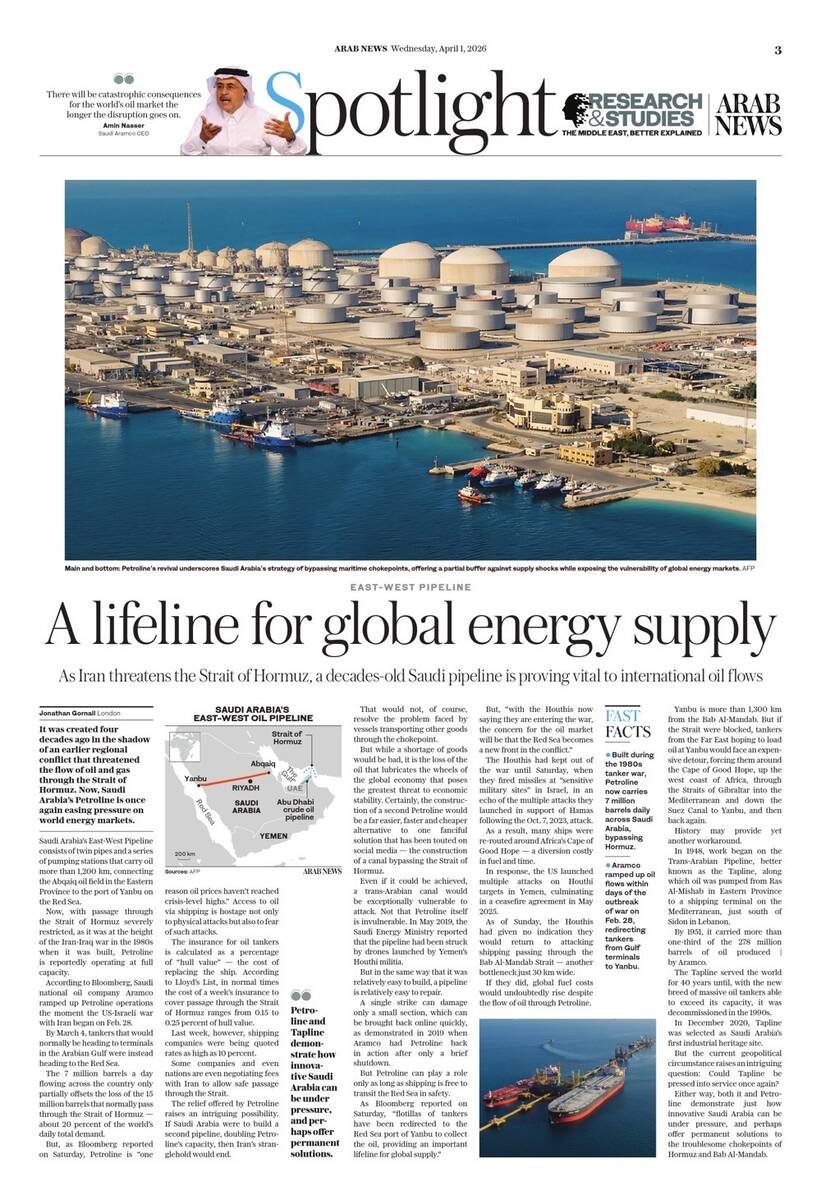

LONDON: It was created four decades ago in the shadow of an earlier regional conflict that threatened the flow of oil and gas through the Strait of Hormuz. Now, Saudi Arabia’s Petroline is back in the headlines and easing pressure on world energy markets once again.
Saudi Arabia’s East-West Pipeline consists of twin pipes and a series of pumping stations that carry oil more than 1,200 km across often challenging terrain, connecting the Abqaiq oil field in the Eastern Province to the port of Yanbu on the Red Sea.
Now, with passage through the Strait of Hormuz severely restricted, the 40-year-old Petroline is reported to be operating at full capacity.
According to reports by Bloomberg, Saudi national oil company Aramco triggered plans to ramp up Petroline operations the moment the US-Israeli war with Iran began on Feb. 28.
By March 4, it was already operating at close to full capacity, and tankers that would normally be heading to terminals in the Arabian Gulf were instead heading to the Red Sea.

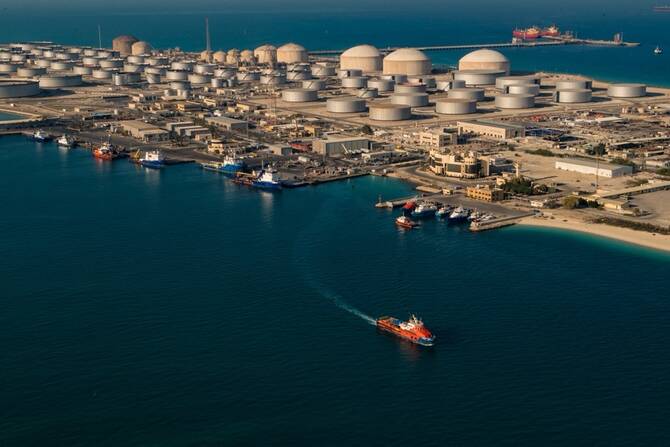
Dhahran oil plants, in eastern Saudi Arabia. (Saudi Aramco/AFP)
The 7 million barrels a day flowing across the country from the Eastern Province to Yanbu only partially offsets the loss of the 15 million barrels that normally pass through the Strait of Hormuz — about 20 percent of the world’s daily total demand.
But, as Bloomberg reported on Saturday, Petroline is “one reason oil prices haven’t reached crisis-level highs.”
Access to oil via shipping is hostage not only to physical attacks by Iran, but also to fear of such attacks, compounded by prohibitive insurance hikes.
The insurance for oil tankers is calculated as a percentage of “hull value” — the cost of replacing the ship. According to Lloyd’s List, in normal times the cost of a week’s insurance to cover passage through the Strait of Hormuz ranges from 0.15 to 0.25 percent of hull value.
Last week, however, Lloyd’s reported that shipping companies were being quoted rates as high as 10 percent.
Reports suggest that some companies and even nations are succumbing to Iranian blackmail, negotiating fees with Iran to allow safe passage through the Strait. Last week Thailand confirmed that a Thai-flagged tanker, owned by the Bangchak Corporation, had passed through with Iran’s permission.
The relief delivered to world energy markets by Petroline during the crisis raises an intriguing possibility. If Saudi Arabia were to build a second pipeline, doubling Petroline’s capacity, then Iran’s stranglehold on the flow of oil through the Strait of Hormuz would end.
That would not, of course, resolve the problem faced by the world’s fleet of containerships and bulk carriers transporting other vital goods and materials through the chokepoint.
On Friday it was reported that two large container ships belonging to China’s Costco executed sudden U-turns while attempting passage through the Strait close to Iran’s Qeshm Island, just off the Iranian mainland.
According to maritime tracking services, the CSCL Indian Ocean and CSCL Arctic Ocean had clearly signaled their Chinese ownership before being forced to turn back.
But while a shortage of material goods would be bad for companies and consumers, it is the loss of the oil that lubricates the wheels of the global economy that poses the greatest threat to economic stability.
Certainly, the construction of a second Petroline would be a far easier, faster and cheaper alternative to one fanciful solution that has been touted on social media — the construction of a canal bypassing the Strait of Hormuz.
This would be a herculean engineering task, taking decades to build and requiring the construction of hundreds of locks to lift ships up and over the Hajar Mountains en route from the Arabian Gulf coast of the UAE to the Gulf of Oman.
Even if it could be achieved, a trans-Arabian canal would be exceptionally vulnerable to military action. Disabling a single ship could shut down the entire canal.

Safaniya and Tanajib onshore plants in Fadhili, located 30 km west of the city of Jubail in the Eastern Province of Saudi Arabia. (Saudi Aramco/AFP)
Not that Petroline itself is invulnerable. In May 2019, the Saudi energy ministry reported that the pipeline had been struck by drones launched by Yemen’s Houthi militia.
The drones hit two pumping stations along the route, located in Al-Duwadimi and Afif, about 200 km and 400 km west of Riyadh, respectively.
But in the same way that it was relatively easy to build, so the pipeline is relatively easy to repair.
A single strike can damage only a small section, which can be brought back online quickly, as demonstrated in 2019 when Aramco had Petroline back in action after only a brief shutdown.
Plus, a second, shadow pipeline could be constructed parallel to but at a safe distance from the original, ensuring that at least some oil could continue to flow even if one pipeline were temporarily disabled.
But Petroline can play a role only as long as shipping is free to transit the Red Sea in safety. The threat of Houthi attacks continues to occupy the minds of Aramco planners, shipping companies and maritime insurance firms.
As Bloomberg reported on Saturday, “flotillas of tankers have been redirected to the Red Sea port of Yanbu to collect the oil, providing an important lifeline for global supply.”
But, “with the Houthis now saying they are entering the war, the concern for the oil market will be that the Red Sea becomes a new front in the conflict.”
The Houthis had kept out of the war until Saturday, when they fired missiles at “sensitive military sites” in Israel, in an echo of the multiple attacks they launched against the country in support of Hamas following the Oct. 7, 2023, attack.

The historical Trans-Arabian Pipeline close to Arar, Saudi Arabia. (Creative Commons)
The Houthis also attacked or seized more than 170 ships sailing under many different flags in the Red Sea. As a result, many ships were re-routed around Africa’s Cape of Good Hope — a diversion costly in fuel and time and a blow to Egypt’s income from the Suez Canal.
In response, the US launched multiple attacks on Houthi sites and leadership in Yemen, which culminated in a ceasefire agreement, brokered by Oman, in May 2025.
Last year, however, Houthi attacks on shipping briefly resumed. On June 6 and 7, two cargo ships were attacked near the Houthi-controlled port of Hodeidah, and three crew members on board the Liberian-flagged Eternity C were killed.
As of Sunday, despite resuming missile attacks on Israel, the Houthis have so far given no indication that they would return to attacking shipping passing through the narrow Bab Al-Mandab Strait — at just 30 km wide, a bottleneck every bit as vulnerable as Hormuz.
If they did, global fuel costs would undoubtedly rise despite the flow of oil through Petroline.
Yanbu, where the oil line ends on the Red Sea, is more than 1,300 km from the Bab Al-Mandab and far from the scene of previous Houthi attacks on shipping in the southern Red Sea.
But if the Strait were blocked, tankers from the Far East hoping to load oil at Yanbu would face an incredibly lengthy and prohibitively expensive detour, forcing them around the Cape of Good Hope, up the west coast of Africa, through the Straits of Gibraltar into the Mediterranean and down the Suez Canal to Yanbu, and then back again with their cargo.
For a tanker coming from the east, this would add a 40,000 km round-trip to their voyage.

The Suez Canal is another potential chokepoint.
When Egyptian President Gamal Abdel Nasser nationalized the waterway in 1956, Britain and France, secretly assisted by Israel, attempted to depose Nasser and take back the Canal Zone by force of arms.
The canal was closed to shipping from October 1956 to March 1957, but the plan was thwarted by pressure from the US and the Soviet Union.
The canal was again closed by Egypt in 1967 at the start of the Six-Day War, and remained closed until June 1975.
Regardless of the vulnerability of the Bab Al-Mandab and the Suez, Petroline remains the world’s best hope for capping energy costs during the current crisis.
Petroline was a child of conflict, built in the 1980s during the “tanker war” that erupted amid the Iran-Iraq conflict. Between 1984 and 1988 more than 450 ships were attacked in or near the Arabian Gulf, by both Iraq and Iran.
Foreshadowing one aspect of the current crisis, the tit-for-tat began when Iraq attacked shipping using the Iranian oil terminal at Kharg Island, which is now a possible target for the thousands of US Marines and other ground forces en route to the Gulf.
Not all solutions have proved as resilient as Petroline.
In March 1987, Kuwait attempted to protect its tankers from attack by persuading the US to allow it to reflag its ships as American, but the plan backfired with disastrous consequences for the US.
Two months later, an Iraqi aircraft attacked the USS Stark, a guided-missile frigate, with two missiles, killing 37 crew. The Iraqis claimed to have mistaken the warship for an Iranian tanker.
There is another pipeline proposal which, under the current circumstances, might seem unworkable, or even unthinkable: to bypass Hormuz by building a new set of oil and gas pipelines from the Gulf producing states to the Mediterranean via Israel.
This, wrote Hal Brands, a senior fellow at the American Enterprise Institute, on Thursday, was a “likely scenario” that “fuses pressure with self-protection.”
But in light of Israel’s activities in Gaza, the West Bank and Lebanon, such a plan would require an enormous measure of pragmatism on the part of the Gulf states.
For his part, however, Israeli Prime Minister Benjamin Netanyahu has made clear that such a plan is on his post-war agenda.
“Just have oil pipelines, gas pipelines, going west through the Arabian Peninsula, right up to Israel, right up to our Mediterranean ports and you’ve just done away with the choke points forever,” he said during a speech on March 19.
“I see that as a real change that will follow this war.”
In fact, there is nothing new about this plan, apart from the proposed transit through Israel.
Work began in 1948 on the Trans-Arabian Pipeline, better known as the Tapline, along which oil was pumped from Ras Al-Mishab in the Eastern Province to a shipping terminal on the Mediterranean, just south of Sidon in Lebanon — a distance of 1,664 km.

Welding together pipe sections. Started in 1947 and completed in 1950, Tapline stretched for 1068 miles from Abqaiq to Sidon in Lebanon - its total volumetric content was 5,747,000 barrels. (John C. Tarvin Saudi Aramco)
By November 1950, the work was complete and oil was flowing.
In a sense, this was another innovation that was triggered by conflict, although on this occasion not one in the region.
In the immediate aftermath of the Second World War, there was an enormous demand for oil in Europe, which was being rebuilt economically and industrially under the terms of the US Marshall Plan.
There was no issue at the time with the Strait of Hormuz, or the Suez Canal, but the tankers of the time were simply not big enough, or sufficiently numerous, to slake Europe’s thirst for oil.
The Tapline, as it became known, served the world for 40 years until, with the new breed of massive oil tankers easily able to exceed its capacity, it was finally decommissioned in the 1990s.
In 1951, the year when the Tapline became fully operational, it carried more than one-third of the 278 million barrels of oil produced by Aramco. But as Aramco’s history of the project recounts, Tapline was more than just an artery for oil.
“The Tapline forever changed Saudi Arabia’s northern region, bringing facilities and prosperity along its route,” it read.
Around the line’s six pumping stations, “new communities sprang up, each with homes, schools and dining halls built for the families of people working on the Tapline.”
By the mid-1960s, “these communities had expanded to include mosques, shops, leisure facilities, theaters, playgrounds — and together had become home to more than 5,000 people.”
Tapline’s pumping stations have been out of service for decades, but “the towns they sparked still thrive today — Turaif, which did not exist in 1945, is now a port of entry into Saudi Arabia.”
The pipeline also created an investment boom. Between 1947 and 1952, Aramco and the Tapline Company paid out more than $46.8 million to more than 10,000 independent contractors, creating new skills and training as part of the project.

This handout satellite image taken by 2026 Planet Labs PBC shows the oil infrastructure at Saudi Arabia's western Red Sea port of Yanbu on March 4, 2026. (Planet Labs PBC/AFP)
In December 2020, Tapline was selected as Saudi Arabia’s first industrial heritage site, and surveys are under way to propose it as a UNESCO World Heritage site.
Today, although the pumping stations have been dismantled, the Tapline itself remains, running parallel to the appropriately named Tapline Road.
The Tapline was saved for posterity after an initiative by Prince Badr bin Farhan, chairman of the Board of Directors of the Heritage Authority, in December 2020.
But the current geopolitical circumstance raises an intriguing question: could Saudi Arabia’s first industrial heritage site be relieved of its museum status, taken out of mothballs and pressed into service once again?
Tapline itself was, of course, not immune to regional conflicts.
The pumping of oil to the port of Sidon experienced several interruptions, starting with the Six-Day War in 1967. Operations were stopped again in 1975 following the outbreak of the Lebanese Civil War. Then in 1983, pumping to the port ended for good.
For seven years the pipeline was diverted to the Jordanian refinery Zarqa, for shipping from the Red Sea port of Aqaba, until 1990 when the Gulf War saw the Tapline fully retired.
During its four decades of service, the Tapline carried billions of barrels of oil from Abqaiq to Sidon.
Whether or not the Tapline could realistically be pressed back into service, both it and the Petroline demonstrate just how innovative Saudi Arabia can be under pressure, and perhaps offer permanent solutions to the troublesome chokepoints of Hormuz and Bab Al-Mandab.