

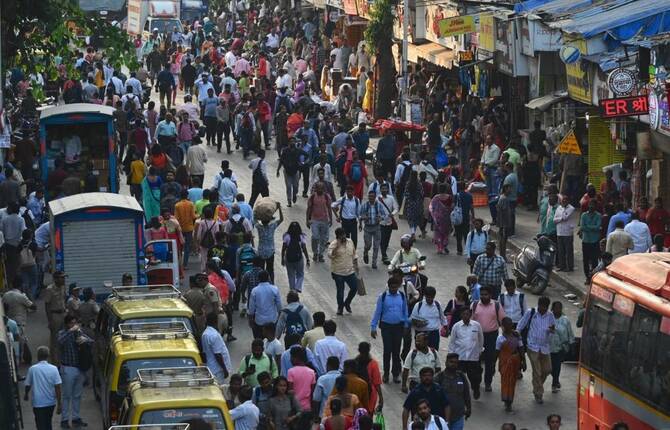

NEW DELHI: India, the world’s most populous country, will start on Wednesday the exact count of its population in one of the world’s largest administrative undertakings.
India’s last census took place in 2011. The next was scheduled for 2021, but has faced multiple delays — mainly due to the COVID pandemic.
The UN Population Fund estimates that India overtook China in 2023 with a population of more than 1.4 billion people. The exact numbers are expected to be known when the census concludes in March 2027.
“More than 3 million enumerators, supervisors, and other officials will be involved in Census 2027 across the country,” the Ministry of Home Affairs said in a statement, after Census Commissioner Mritunjay Kumar Narayan presented the operation’s details on Monday.
“The Union Government has approved an outlay of 11,718.24 crore rupees ($1.4 billion) for Census 2027, making adequate provisions for payment of honorarium and training to Census functionaries, IT infrastructures, logistics, etc.”
The count will be rolled out in two, door-to-door survey phases, with the first focusing on creating a detailed inventory of households — including living conditions, assets, and amenities such as access to water, sanitation, and electricity.
In the second phase, conducted mainly in early 2027, census workers will gather data on every person such as age, gender, education, occupation, migration, and socio-economic details, including caste.
The census will be India’s first fully digital count, with officials using tablets and smartphones to collect data. According to the ministry, a mobile app and a self-enumeration portal will be available in 16 languages, including Hindi and English.
“I read that this is a historic milestone for India. This is the first fully digital census and it also includes the caste aspect — since 1931, we have not been enumerating caste dynamics in the census,” Prof. Afroz Alam, head of the Department of Political Science, Maulana Azad National Urdu University, told Arab News.
India’s caste system, rooted in Hinduism, has long structured society into a rigid hierarchy that shapes people’s occupations, living conditions, and marriage prospects. Many non-Hindu communities in India also identify with caste distinctions.
For centuries, those at the bottom of this hierarchy have faced persistent marginalization and social exclusion. After gaining independence from Britain in 1947, India formally outlawed caste-based discrimination and introduced specific caste categories to support affirmative action policies.
The census will provide data to adjust policy decisions with real-time data.
“You can make a corrective decision so that we can ensure social justice. We can also have data on different yardsticks — demographic yardsticks — such as which region and which socio-economic class of people are performing at what level, so that we can make very relevant policy decisions with regard to them and uplift them,” Alam said.
Besides providing critical data for planning welfare schemes and allocating federal funds, census data will also be used in drawing electoral boundaries to reflect population changes.
Parliamentary seats will be decided in accordance with these boundaries.
“Also women’s reservation — because the parliament has passed 33 percent reservation for women — that will also be decided in accordance with the data collected through the census,” Alam said.
“So we will have the idea of seat redistribution. I guess the 2026 data will be the basis for the delimitation exercise.”


