

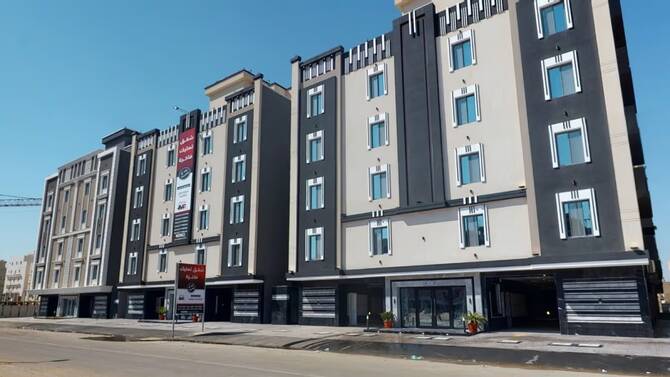

RIYADH: Major Saudi cities are witnessing a growing shift toward homeownership apartments as a preferred housing option for families, supported by price ranges between SR500,000 ($133,000) and SR1 million, making them relatively accessible to smaller households, according to industry professionals speaking to Al-Eqtisadiah.
Price differences are determined by location, size, and design quality, in addition to the availability of services and facilities, amid current price fluctuations, as the market awaits the impact of real estate market balancing decisions.
Real estate sector specialists told Al-Eqtisadiah that the current phase is marked by caution among companies and developers, who are reassessing the feasibility of their projects on more conservative bases to manage cash flows and adopt more flexible models for managing exits and liquidity.
This includes restructuring sales mechanisms, such as phased sales or entering into investment partnerships with funds or institutional investors, with the aim of recycling capital.
Khaled Al-Mohsen, CEO of Ufuq Al-Ula Real Estate, said that any regulatory or financial decisions affect buying appetite in their early stages, with caution becoming more apparent, especially amid rising financing costs, which temporarily slows sales without stopping the market.
He said: “Developers and companies are in a phase of adaptation rather than retreat. In such cycles, profit margins decline, requiring feasibility to be recalculated on more conservative bases, cash flows to be managed, and costs to be reviewed carefully.”
He noted that those who manage financial and administrative flexibility will continue to expand, but at a measured pace aligned with current market conditions, adding that in periods of slowdown, smart management is more important than boldness, and financial discipline is more important than rapid expansion.
No noticeable impact on rental prices in cities
Real estate expert Khaled Al-Humaid said that growth in the homeownership apartment segment cannot currently be described as strong, given intense competition and the wide range of available housing units.
He noted that the availability of homeownership apartments has not affected rental prices in Saudi cities, except in Riyadh, where residential and commercial rents have been frozen for five years, and they have remained stable.
He emphasized that it is still too early to assess the impact of real estate market balancing measures on lowering prices, suggesting that a period of three to four months may be needed to observe actual outcomes.
Echoing this view, Turki Al-Mutairi explained that rental prices have not been affected by the increase in for-sale apartments, as some owners are opting to use their units for daily and monthly rentals through tourism apps, thereby removing them from the pool of supply allocated for annual leases.
South and west Riyadh are the cheapest, with prices starting from SR550,000
Regarding prices in Riyadh, Al-Humaid noted that they vary depending on location and services, as prices start at SR700,000 in the eastern part of the city for apartments with a minimum area of 150 sq. meters and exceed SR1 million as the size increases.
In the southern areas, prices start at SR550,000 for the same size, which he attributed to lower demand in those districts.
Abu Abdulaziz, another real estate marketer, supported this view, explaining that the abundance of residential units combined with weak current purchasing power has contributed to a slowdown in sales activity, noting that prices in western Riyadh start at SR650,000 for units measuring 180 sq. meters.
Cheap land in smaller cities suppresses demand
In a related context, most marketers interviewed by Al-Eqtisadiah agreed that demand is concentrated in major cities such as Riyadh and Jeddah, given the availability of land at affordable prices in outlying provinces and smaller cities, which dampens demand for apartments in those areas.
Al-Mutairi noted that prices in the outskirts of the city start from SR500,000 for 120 sq. meters, while in central, northern, and eastern Riyadh they reach up to SR1 million. He stressed that prime locations give smaller apartments higher value than larger units in distant areas.
The market is rebalancing supply and demand
Real estate expert Abdullah Al-Mosa said: With the gradual implementation of real estate market balancing measures, caution has become a clear feature of buyer behavior.
He added that this is natural in phases where the relationship between supply and demand is being rebalanced, adding that this anticipation has directly affected the pace of sales in residential and commercial projects.
Al-Mosa further said that purchasing decisions have become more calculated, and sales are no longer as fast as in previous periods characterized by strong liquidity and high demand. However, he noted that companies and developers have not stopped expanding.
Instead, he emphasized, they have begun adopting more flexible models for managing exits and liquidity by restructuring sales mechanisms, such as phased sales or entering into partnerships with funds or institutional investors, with the aim of recycling capital and sustaining development cycles without relying entirely on immediate sales.
According to Al-Mosa, some developers are also restructuring their real estate portfolios through partial exits from certain projects or assets, enhancing their ability to direct liquidity toward new projects that better align with actual market demand.
“This phase reflects the real estate market’s transition to a higher level of maturity, where success is no longer tied solely to the speed of sales, but to the developer’s ability to efficiently manage cash flows and offer real estate products that align with the end user’s actual purchasing power,” Al-Mosa said.
Northern neighborhoods are the most in demand and fastest selling
Neighborhoods in northern Riyadh, such as Al-Narjis, Al-Arid, and Al-Yasmin, as well as Al-Malqa, in addition to Qurtubah and Al-Yarmouk in the east, top the list of the most in-demand and fastest-selling locations.
Mutairi concluded that real estate market balancing measures have helped calm the market and forced developers to reassess their strategies and begin correcting their course, noting that some developers’ persistence in maintaining high prices that do not align with the size of the units, based on expectations of continued post-pandemic market growth, is the main reason behind the slowdown in sales of some units.
What do apartment owners say?
Apartment owners believe that homeownership units have become a pressing need for many families in major cities, which increasingly prefer them over villas and larger spaces, in line with changing social trends and rapid urban development in the region.
In this context, homeowner Abdulrahman Al-Otaibi said his main motivation for purchasing was the ease of furnishing and lower operating costs.
He stressed that such apartments are ideal for small families of up to five members, helping eliminate rental burdens and financial waste while serving as a future investment.
Al-Otaibi, who purchased his 127 sq. meter-apartment in western Riyadh for SR470,000 about three years ago, noted that property value is closely tied to size and location, pointing out significant price variation.
Rakan Al-Harthi, another homeowner, said homeownership apartments are the most suitable option given current financial capacity and rising population density, especially as Riyadh is experiencing major urban expansion alongside increasing prices of villas and larger residential units.
Al-Harithi drew attention to the fact that some newly developed neighborhoods still lack healthcare and educational facilities, which, he strongly believes, poses a concern and a barrier to making purchase decisions in those areas.
He concluded by referring to his personal experience, noting that he purchased his apartment in western Riyadh, with an area of 270 sq. meters, for SR720,000.
Property prices in Riyadh continue declining for the third quarter
Real estate prices in Saudi Arabia fell in the fourth quarter of 2025 for the first time in four years, the period for which data is available from the General Authority for Statistics, declining by 0.7 percent year on year.
Prices in Riyadh continued to decline on a quarterly basis for the third consecutive quarter, falling by 0.9 percent in the fourth quarter.
According to the Al-Eqtisadiah’s Financial Analysis Unit, the annual decline in Saudi Arabia was driven by falling residential real estate prices, which carry the largest weight in the index (72.2 percent), down 2.2 percent in the second consecutive quarterly decline, due to falling land prices for the second quarter in a row.
Land prices have a significant impact, accounting for nearly half of the index, while prices of villas, apartments, and floors also declined at varying rates.
The price declines follow government directives issued about a year earlier, specifically in March 2025, to balance the real estate market through a set of measures aimed at addressing rising property prices in the capital.


