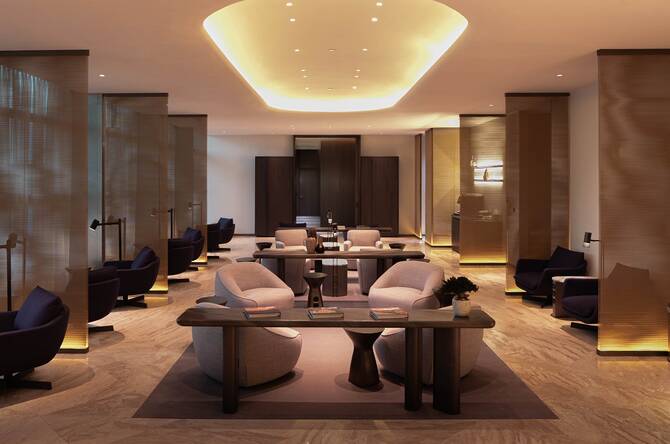

DUBAI: Visitors can expect something a little different at the newly launched Riyadh Air Hafawa Lounge at King Khalid International Airport.
The project was carried out in collaboration with design studio Yabu Pushelberg, based in Toronto and New York, and features a residential-inspired setting.

The Hafawa Lounge spans nearly 2,000 sq. meters and can host up to 370 guests. (Supplied)
“Airport lounges tend to lead with scale and spectacle. We went the other way,” co-founder Glenn Pushelberg told Arab News. “Smaller rooms, personal attention, choices based on mood.”
“Guests feel like they are being looked after in someone's home, not walking into a branding moment for an airline,” added George Yabu.
The Hafawa Lounge spans nearly 2,000 sq. meters and can host up to 370 guests. A series of interconnected rooms includes The Pantry, designed for informal dining, the Balcony Cafe, quieter spaces such as The Study and The Parlor, and social spaces such as The Cabinet and The Cellar. Private sleeping pods and garden-facing seating are also featured.

A palette of limestone, oak and textured plaster is used throughout. (Supplied)
A palette of limestone, oak and textured plaster is used throughout. Yabu said: “(The) choices draw from the Saudi landscape. But the way they are used, the proportions, the layering, that is contemporary and comes from decades of understanding how materials make people feel.”
The lounge also places emphasis on the power of light, with a circadian system that evolves throughout the day — warm at dawn, cooler through midday, and warm again at dusk.

Pushelberg said: “Most lounges treat lighting as decoration. We designed the lounge for how someone feels at six in the morning versus ten at night.” (Supplied)
“Modern airplanes already use circadian lighting to acclimate passengers to new time zones. In the evening the color of light changes, in the morning it shifts again. Because the lounge is part of the travel experience, circadian lighting is a natural progression to carry into the interiors,” Yabu explained. “It mirrors the natural rhythms of desert light, with subtle tones of peach, lavender, and indigo.”
Pushelberg said: “Most lounges treat lighting as decoration. We designed the lounge for how someone feels at six in the morning versus ten at night.”