

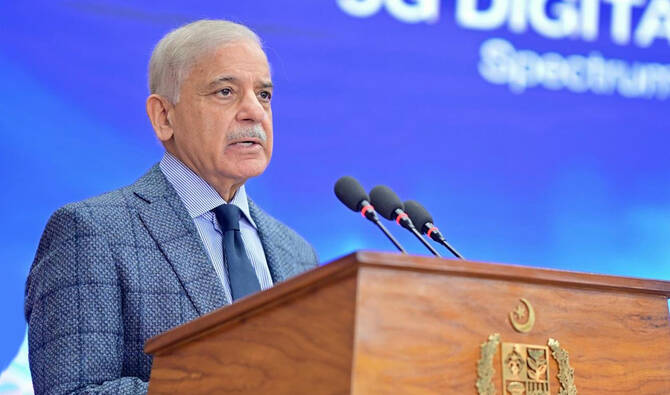

ISLAMABAD: Pakistan’s Prime Minister Shehbaz Sharif said on Tuesday that Islamabad was “ready” to host negotiations to end the US-Israeli war with Iran, following international media reports that Islamabad could act as a mediator.
Sharif’s statement came a day after President Donald Trump said the US and Iran had held “very good and productive” conversations about a “complete and total resolution of hostilities in the Middle East.” He said talks had begun on Sunday and continued into Monday, with Special Envoy Steve Witkoff and his son-in-law Jared Kushner involved.
The Pakistani foreign ministry said on Tuesday Islamabad was willing to host talks between the US and Iran after international media widely reported that a US delegation was due in Islamabad to hold negotiations with Iranian officials.
“Pakistan welcomes and fully supports ongoing efforts to pursue dialogue to end the WAR in Middle East, in the interest of peace and stability in region and beyond,” Sharif said on X.
“Subject to concurrence by the US and Iran, Pakistan stands ready and honored to be the host to facilitate meaningful and conclusive talks for a comprehensive settlement of the ongoing conflict.”
The US and Israel launched strikes on Iran on Feb. 28 after saying they had failed to make enough headway in talks aimed at ending Iran’s nuclear program although mediator Oman said significant progress had been made.
Since then, Iran has attacked countries that host US bases, struck Gulf energy infrastructure and effectively closed the Strait of Hormuz, conduit for a fifth of the world’s oil and liquefied natural gas.
Islamabad has urged all sides to exercise restraint and resort to dialogue to end the crisis since it began last month.
According to a report by the Financial Times, Pakistan’s military chief, Field Marshal Syed Asim Munir, held a telephonic conversation with Trump on Sunday. This was followed by Sharif’s conversation with Iranian President Masoud Pezeshkian on Monday, during which the former underscored the “urgent need” for collective efforts to settle differences through diplomacy, particularly as the conflict begins to threaten regional energy and water security.
While Washington maintains that back-channel discussions are proceeding in a “positive direction,” Tehran has officially dismissed these reports as “psychological warfare” intended to manipulate oil prices.


