Russia to free two Hungarian-Ukrainian POWs, Putin says

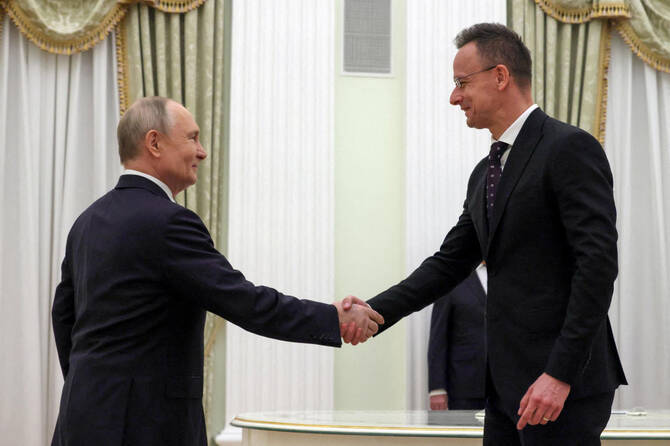
Russian President Vladimir Putin shakes hands with Hungarian Foreign Minister Peter Szijjarto during a meeting in Moscow, Mar. 4, 2026. (Reuters)
Short Url
Updated 04 March 2026
Follow

Russia to free two Hungarian-Ukrainian POWs, Putin says

  • Ukraine accused the two countries of having “manipulated the sensitive issue of prisoners of war“
  • “You will be able to take them with you on the plane you arrived on and the plane you will return to Budapest on,” Putin told Szijjarto

MOSCOW: Russia will free two Ukrainian-Hungarian nationals captured while fighting for Ukraine, President Vladimir Putin said Wednesday, after Hungarian Prime Minister Viktor Orban appealed for their release in a phone call.
Ukraine accused the two countries of having “manipulated the sensitive issue of prisoners of war” and of staging the release as a PR stunt ahead of parliamentary elections in Hungary in April.
In a meeting with Hungarian Foreign Minister Peter Szijjarto in Moscow, Putin said the two soldiers were “forcibly conscripted” by Ukraine and that he personally made the decision to release them.
“As the prime minister requested, you will be able to take them with you on the plane you arrived on and the plane you will return to Budapest on,” Putin told Szijjarto.
Hungary is one of the few European countries to maintain close ties with Russia amid its Ukraine offensive and has consistently opposed military aid for Kyiv.
Ukraine is home to a large Hungarian minority, most of whom live in the western Zakarpattia region and hold dual citizenship.
The Russian defense ministry published a video last week purporting to show a dual Hungarian-Ukrainian citizen prisoner of war, alleging he had been forced to enlist in the Ukrainian army.
During their meeting, Szijjarto also urged Moscow not to raise energy prices, after fighting in the Middle East spurred by joint US-Israeli strikes on Iran sent markets into turmoil.
“I came here... to be assured and obtain a guarantee that even in the midst of the current crisis, the quantities of natural gas and crude oil necessary for Hungary’s energy security will be available, and that they will be delivered to Hungary from Russia at the same price,” Szijjarto said.
Putin said Russia was happy to discuss the issue of energy.
“Not everything depends on us, but, I repeat, we have always been reliable suppliers,” Putin told Szijjarto.
Hungary is the European Union’s biggest importer of Russian fossil fuels, having maintained purchases and secured exemptions from sanctions despite pressure from Brussels amid the Ukraine war.
Budapest was already facing disruption from the closure of the Druzhba pipeline, which transports Russian oil to Hungary and which Ukraine says was damaged in a Russian strike in January.
Both Hungary and Slovakia, as well as the Kremlin, accuse Kyiv of deliberately stalling its reopening. Kyiv says the threat of another attack is holding up repairs.


Trump says Australia will grant asylum to Iran women footballers

Team Iran listens to the national anthem before the AFC Women’s Asian Cup Australia 2026 football match.
Updated 57 min 43 sec ago
Follow

Trump says Australia will grant asylum to Iran women footballers

  • Presenter on Iranian state TV had branded the players “wartime traitors” after they stood motionless during the anthem

MIAMI: US President Donald Trump said Monday that Australia had agreed to grant asylum to some of Iran’s visiting women’s football team, amid fears they could face retaliation back home for not singing the national anthem before a match.
The gesture ahead of the team’s Asian Cup match against South Korea last week was seen by many as an act of defiance against the Islamic republic just two days after the United States and Israel attacked it.
“I just spoke to Prime Minister Anthony Albanese, of Australia, concerning the Iranian National Women’s Soccer Team. He’s on it! Five have already been taken care of,” Trump said Monday on his Truth Social network, less than two hours after an initial post urging Australia to take them in.
Trump added that “some, however, feel they must go back because they are worried about the safety of their families, including threats to those family members if they don’t return.”
There was no immediate comment from the Australian government, which has so far declined to say whether it could offer the players asylum.
Asked about their case on Sunday, Foreign Minister Penny Wong said Australia “stands in solidarity” with the people of Iran.
The son of Iran’s late shah, US-based Reza Pahlavi, warned on Monday that the refusal to sing the anthem could have “dire consequences,” and urged Australia to offer the team protection.
Trump then weighed in, pressing Albanese to “give ASYLUM” to the team and adding: “The US will take them if you won’t.”
“Australia is making a terrible humanitarian mistake by allowing the Iran National Woman’s Soccer team to be forced back to Iran, where they will most likely be killed,” the US leader said on Truth Social.
Pahlavi, who has not returned to Iran since before the 1979 Islamic revolution that ousted the monarchy, has billed himself as the man to lead a democratic transition to a secular Iran as the theocratic regime fights to survive.
Politicians, human rights activists and even “Harry Potter” author J.K. Rowling have also called for the team to be offered official protection.
“Please, protect these young women,” Rowling said in a post on social media.

‘Save our girls’ 

A presenter on Iranian state TV had branded the players “wartime traitors” after they stood motionless during the anthem before their match against South Korea.
In subsequent games, the players saluted and sang.
Crowds gathered outside the Gold Coast stadium where the side played their last match over the weekend, banging drums and shouting “regime change for Iran.”
They then surrounded the Iranian team bus, chanting “let them go” and “save our girls.”
On Monday, an AFP journalist saw members of the team speaking on phones from their balcony of their hotel.
Asked about the possibility of granted asylum, a spokesperson for Australia’s Home Affairs department told AFP earlier it “cannot comment on the circumstances of individuals.”
Amnesty International campaigner Zaki Haidari said they faced persecution, or worse, if they were sent home.
“Some of these team members probably have had their families already threatened,” Haidari told AFP.
“Them going back... who knows what sort of punishment they will receive?“
Despite being heavily monitored, the side would have a “small window of opportunity” to seek asylum at the airport, he said.
Iran’s embassy in Australia did not respond to a request for comment.