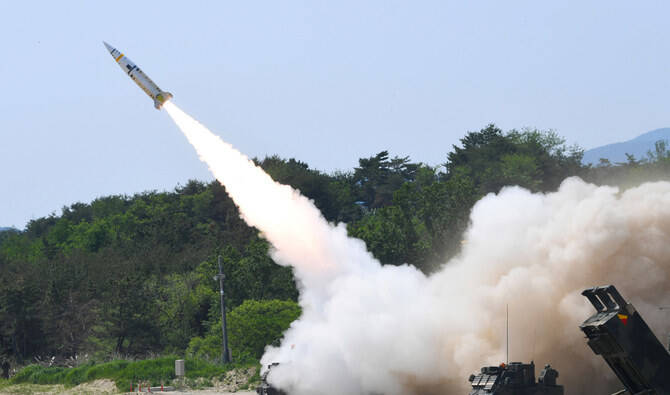
KYIV: Ukraine is considering forming consortia with its allies to build air defenses capable of downing ballistic missiles and overcome a critical deficit of munitions for US-made Patriot systems, its defense minister said.
Patriot systems have been an important part of Ukraine’s efforts to defend its skies against Russian ballistic missiles, which fly faster than the speed of sound and cannot be intercepted by Ukraine’s other air defense systems.
Stocks of the Patriot system’s PAC-3 missiles have been running “critically” low, Defense Minister Mykhailo Fedorov said.
“Ukraine has significant potential to independently produce counter-ballistic systems and missiles,” Fedorov told reporters this week, adding that air defenses had been his main focus since he took office in mid-January. President Volodymyr Zelensky has repeatedly criticized delays by Ukraine’s allies in providing Patriot missiles and other air defenses since Russia’s 2022 invasion, and said that at one point in January several systems had run out of ammunition.
Fedorov said he had discussed the idea of creating joint air defense ventures with Zelensky. Reuters could not determine whether discussions have already taken place with allies or which of its allies Kyiv has in mind.
“This requires a dedicated project — the mathematics is complex and requires time. But Ukraine must develop its own capabilities,” Fedorov said.
STARLINK CUT-OFF
Fedorov touted an early success in his tenure last month after Elon Musk’s SpaceX agreed to cut off Russian forces from thousands of its Starlink satellite Internet terminals which were not on a Kyiv-approved whitelist.
He said that since the cut-off, the number of Russian livestream connections on the battlefield had dropped elevenfold.
“We effectively cut Russia off from this connectivity,” he said.
The terminals are resistant to electronic jamming and thus an invaluable means to communicate on the battlefield and to pilot drones.
Fedorov said intercepts of radio frequencies, which can be disrupted more easily, had increased significantly after the cut-off.


![]()

Ukraine may form joint ventures with allies to boost defenses against ballistic missiles
Short Url
https://arab.news/2h8rf
Ukraine may form joint ventures with allies to boost defenses against ballistic missiles
- Patriot systems have been an important part of Ukraine’s efforts to defend its skies
- Stocks of the Patriot system’s PAC-3 missiles have been running “critically” low, Fedorov said

Latest updates


© 2026 SAUDI RESEARCH & PUBLISHING COMPANY, All Rights Reserved And subject to Terms of Use Agreement.