

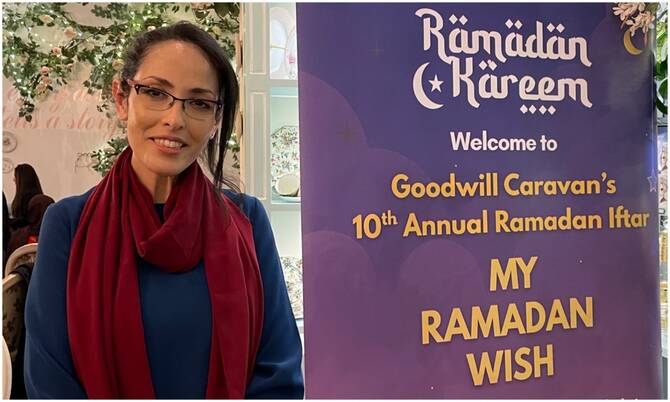

LONDON: Goodwill Caravan, a humanitarian charity based in the UK, celebrated 10 years of providing thousands of refugees with food, education, medical care and legal support in the Middle East and Europe, as well as campaigning against human trafficking, with a fundraising iftar event in London.
Founder and CEO Hanan Ashegh told Arab News that since the organization was registered in 2015, it has focused on two main goals: assisting people forcibly displaced by armed conflicts in Palestine, Sudan and Syria, and, more recently, advocating in North America against the trafficking of children. It also helps refugees find shelter and integrate safely with host communities in Europe, Libya and Egypt.
The iftar hosted by Goodwill Caravan in London this weekend raised more than £10,000 ($13,400) in donations to support families in Gaza, as well as the charity’s Sallam Center in 6th of October, a city in Egypt’s Giza Governorate, that helps displaced Palestinians and Sudanese. A selection of artworks created by children from Gaza that use the center, depicting their hopes and fears, was sold during the fundraising event.
Goodwill Caravan is a nonpolitical and nonreligious organization but most of its donors tend to be Muslim, Ashegh said. A study conducted by the think tank Equi in December found that British Muslims, who account for less than 6.5 percent of the population in the UK, donate four times as much as the average British adult. In 2023-2024, they contributed £2.2 million to a variety of causes, domestic and international.
The Islamic holy month of Ramadan, which began two weeks ago, is a crucial period for British charities to raise funds because it is when many Muslims traditionally honor their annual obligations for zakat, a form of charitable giving that is one of the five pillars of Islam.
Every time I went to a refugee camp, I couldn’t focus with my patients when I got back and I couldn’t focus with my lab work. I just couldn’t, because there were too many urgent cases that needed my help
Hanan Ashegh, Founder and CEO
Goodwill Caravan said it has helped 350,000 refugees in the past 10 years, including assistance for 3,750 families and legal support in more than 55,000 cases. Last year, it provided more than 30,000 people with food, supported more than 4,500 mothers and children with psychosocial assistance, and arranged vocational training for more than 600 refugees.
Ashegh, a trained psychologist, became involved in humanitarian work in 2015 when she volunteered with a group of lawyers in France to help reunite refugee children with their families after a fire at a refugee camp in Calais.
“I’m a cognitive behavioral practitioner,” she said. “I worked and trained in the NHS (the UK’s National Health Service) for 15 years before this. I was also doing my academic studies. I was working at the Institute of Neurology at UCL (University College London), and I was finalizing my master’s (degree) there, and I was working on neurodegenerative diseases.”
A photograph of the body of two-year-old Syrian refugee Alan Kurdi washed up on a beach in the Turkish town of Bodrum in September 2015 marked a turning point for Ashegh. He was one of 14 people, including his mother and brother, who died while attempting reach Greece on a small, overcrowded boat as his family fled the civil war in Syria.
“Every time I went to a refugee camp, I couldn’t focus with my patients when I got back and I couldn’t focus with my lab work,” Ashegh said. “I just couldn’t, because there were too many urgent cases that needed my help. Many of them were unaccompanied children on their own: no mother, no father, nothing.”
The charity she founded began by assisting Syrian refugees in Greece. Though the civil war in Syria ended in December 2024 with the fall of the Assad regime, and there is now relative calm in the country, Goodwill Caravan continues to help Syrian migrants through training and job placements in Greece.

Goodwill Caravan raised funds during an Iftar event in London, selling a selection of artworks created by children from Gaza who benefit from the charity’s services in Egypt. (AN Photo / Mustafa Abu Sneineh)
Ashegh also established the Sallam Center in Egypt, named in honor of Sarrah Sallam, a family friend and dedicated volunteer who joined the charity in its early days and helped to set up a center in Greece, and coordinate aid deliveries to Syria, before losing her life to breast cancer in October 2018.
The center employs about 30 workers in Egypt and provides food, shelter, legal aid and medical assistance to people displaced from war-torn places such as Sudan and Gaza. It also helps child refugees integrate into host communities through sports days, and provides a minibus for transportation.
In 2018 the charity opened a similar center in Tripoli, Libya, which has 15 workers who distribute food and provide other humanitarian services, including assistance after the flooding that followed catastrophic dam collapses in Derna in 2023.
Goodwill Caravan has also been registered to operate in the US since 2024 and raise funds for advocacy against child trafficking. It plans to launch an online platform to combat human trafficking, Ashegh said, by providing a safe primary point of contact for refugees arriving in a new country that will help them avoid isolation and gain access to legal aid, language support, food and medical care.
“The only people who were on the phone with the refugees, from when they left their village until they crossed the border, were the smugglers and the traffickers,” she said.
“I'm calling (the new platform) the ‘light web,’ as opposed to the dark web, because people go to the dark web to get the information. So we’re calling it the ‘light web’ and it’s, in one sentence, an online information platform for forcibly displaced people.”


