

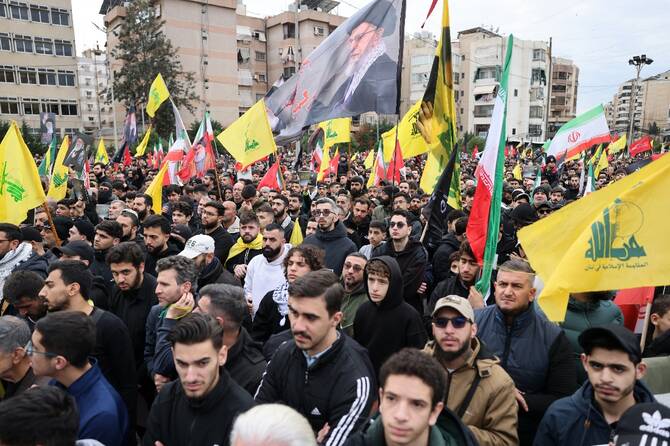
Lebanese government imposes immediate ban on Hezbollah’s military activities

The move comes after Iran-backed Hezbollah launched rockets at Israel, provoking retaliatory Israeli strikes. (AFP)
Short Url
Updated 02 March 2026
Follow

Lebanese government imposes immediate ban on Hezbollah’s military activities

  • Lebanese Prime Minister Nawaf Salam said only the state could decide whether to go to war
  • Salam called on the Lebanese military to prevent the firing of projectiles and detain anyone involved

BEIRUT: Lebanon’s government said Hezbollah’s overnight attack against Israel were “illegal” and imposed an immediate ban on the group’s military activities, while also demanding its hand over its weapons.

Lebanese Prime Minister Nawaf Salam said only the state could decide whether to go to war and called on the Lebanese military to prevent the firing of projectiles and detain anyone involved.

The move comes after Iran-backed Hezbollah launched rockets at Israel, provoking retaliatory Israeli strikes. The government convened for five hours and 15 minutes in an early morning meeting on Monday before reaching its decision.

The Lebanese cabinet meeting, chaired by President Joseph Aoun, started at 8am with ministers discussing the repercussions Hezbollah's launching of missiles from southern Lebanon into Israel and the Israeli attacks on Lebanon.

Sources initially told Arab News that ministers were “pushing for a decisive response to Hezbollah’s recklessness, regardless of the consequences.”

Lebanese MP Melhem Khalaf said the priority was to “shelter people that are evacuating their homes in relatively safe places. What happened at dawn on Monday has taken us from one stage to another, and we don't know where they've taken us.”

As US-Israeli attacks on Iran continued, Hezbollah said it fired missiles from Lebanon into Israel early Monday in response to the killing of Iranian Supreme Leader Ali Khamenei and “repeated Israeli aggressions.”

There were no reports of injuries or damage, and Israel said it had intercepted one projectile, while several fell in open areas.

Israel retaliated with strikes on Lebanon, killing at least 31 people and wounding 149 others, according to Lebanon's Health Ministry. Around two thirds of the dead were in the south of the country.

Lebanon’s government said it was holding an emergency meeting after Hezbollah’s attack triggered the Israeli airstrikes.

Iran has been firing missiles at Israel and Arab states in a counter-offensive since the joint America-Israeli attack Saturday that killed Khamenei and other top Iranian officials. The war has quickly expanded to proxy forces, including Hezbollah firing out of Lebanon.

MP Bilal Abdullah told Arab News: “All the appeals issued by officials in Lebanon not to embroil us in this destructive war seem to have been in vain. We were supposed to protect Lebanon.

“Whoever launched the missiles and drones from Lebanon has slaughtered Lebanon. Displacing people is a major tragedy. We are in the winter season, and the cold is severe.”


Purim parties shift to bomb shelters as Israelis celebrate under Iran war threat

Updated 6 sec ago
Follow

Purim parties shift to bomb shelters as Israelis celebrate under Iran war threat

  • Many cities had canceled or scaled down their Purim celebrations for the past two years due to the Israel-Hamas war
  • Purim, a holiday beloved by both religious and secular Jews, takes place in most of the Jewish world starting on Monday night

TEL AVIV: The Purim holiday is usually marked with boisterous street parades and costume parties to celebrate the Jewish victory over an ancient Persian ruler. This year, the celebrations moved into fortified bomb shelters as the country wages war against Iran’s modern-day leaders.
In Tel Aviv on Monday, people of all ages wearing sequined suits, bunny ears, pirate costumes and peacock feathers streamed into a mall’s underground parking lot that also functions as a bomb shelter for the traditional reading of the Purim story followed by a live band with dancing.
“It’s all about choosing happiness, choosing to be joyful, no matter what else is going on,” said Mariel Margulis, a Tel Aviv resident who had set up a tent in the parking garage and lived there for the past few days with her husband and 6-month old son. They dressed up as people having a bath, complete with bath robes, and their son, Amichai, as a rubber ducky, and created a bathtub play area for him next to their tent.
The story of Purim, told in the Book of Esther, follows Haman, an adviser to King Ahashverosh, as he plans to exterminate the Jews of the kingdom. The plan is foiled by Queen Esther and her cousin Mordechai. The story takes place in Shushan, Persia, in what is modern-day Iran.
“It feels biblical in proportions, what’s happening right now, and we’re doing the little bit we can, staying calm, staying joyful,” said Mariel. Nearby, Amichai slept through the loud “boos” from the crowd to drown out the name of Haman, the villain of the story, during a reading from the Book of Esther.
“It’s like the same plot of Purim with a different cast,” said Daniel Margulis, Mariel’s husband.
Purim, a holiday beloved by both religious and secular Jews, takes place in most of the Jewish world starting on Monday night. The holiday starts a day later in ancient walled cities, including Jerusalem.
In quiet times, families in colorful costumes throng downtown stretches, children eat copious amounts of traditional triangle cookies. It’s customary to dress up in costumes and drink large amounts of alcohol.
In Jerusalem, musicians set up on balconies overlooking the main drag and street parties in the stone alleys stretch into the evening.
Massive parties were planned this year after a two-year break. Many cities had canceled or scaled down their Purim celebrations for the past two years due to the Israel-Hamas war.
But celebrations were once again disrupted by war, after Israel and the US launched an attack against Iran on Saturday
“We came because the kids didn’t want to miss out on Purim, they were really excited to get dressed up,” said Elysa Rapoport, a Tel Aviv resident who works in investments. Her daughters dressed up as Barbie Cowgirl and Rumi from K-pop Demon Hunters.
With most Purim celebrations canceled, the family planned their walk to the Purim event to hopscotch between easy access to shelters. Iranian missiles have sent Israelis scurrying for shelters multiple times a day and night.
“This just feels surreal,” Rapoport said, looking over the celebrations, as hundreds of people gathered and danced under the parking lot’s fluorescent lights. Nearby, people and their dogs who had moved into the shelter for the duration of the war lounged on air mattresses, scrolling through their phones.
“It’s not the most optimal conditions, we’re used to our synagogue, but we’re here together with all of the nation of Israel,” said Gabi Grinshtain, a 39-year-old environmental consultant. “These are important days, and the setting is less important.”