

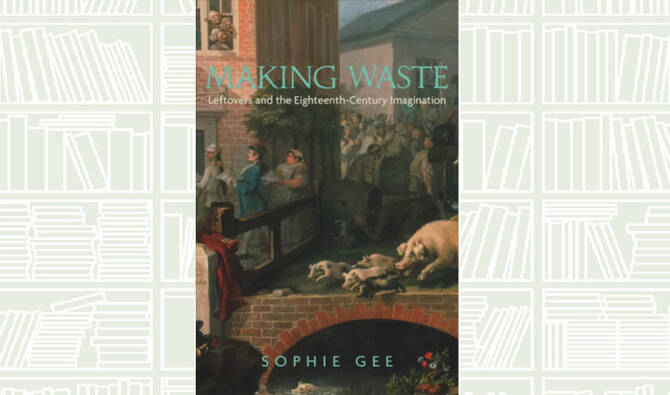
What We Are Reading Today: Making Waste by Sophie Gee

Short Url
Updated 02 March 2026
Follow

What We Are Reading Today: Making Waste by Sophie Gee

Why was 18th-century English culture so fascinated with the things its society discarded? Why did Restoration and Augustan writers such as Milton, Dryden, Swift, and Pope describe, catalog, and memorialize the waste matter that their social and political worlds wanted to get rid of—from the theological dregs in “Paradise Lost” to the excrements in “The Lady’s Dressing Room” and the corpses of “A Journal of the Plague Year?” In “Making Waste,” the first book about refuse and its place in Enlightenment literature and culture, Sophie Gee examines the meaning of waste at the moment when the early modern world was turning modern.

Gee explains how English writers used contemporary theological and philosophical texts about unwanted and leftover matter to explore secular, literary relationships between waste and value. She finds that, in the 18th century, waste was as culturally valuable as it was practically worthless—and that waste paradoxically revealed the things that the culture cherished most.

What We Are Reading Today: The Political Economy of Security by Stephen G. Brooks

Updated 04 March 2026
Follow

What We Are Reading Today: The Political Economy of Security by Stephen G. Brooks

In this book, Stephen Brooks provides a systematic empirical and theoretical examination of how economic factors influence security affairs. Empirically, he analyzes how economic variables of all kinds affect interstate war, terrorism, and civil war; in total, 16 pathways are examined.

Brooks shows that the relationship between economic factors and conflict is complex and multifaceted; discrete economic factors—such as international trade, economic development, and globalized manufacturing, to name a few—are sometimes helpful for promoting peace and stability, but at other times are detrimental.

Brooks also develops a stronger theoretical foundation for guiding future research on the economics-security interaction. 

Drawing on Adam Smith, he provides a more complete range of answers to the three key conceptual questions analysts must consider: how economic goals relate to security goals; what economic factors to focus on; and how economic actors influence security policies.

Combining an innovative theoretical understanding with empirical rigor, Brooks’s account will reshape our understanding of the political economy of security.