

South Korea outclass Iran in Asian Women’s Cup opener

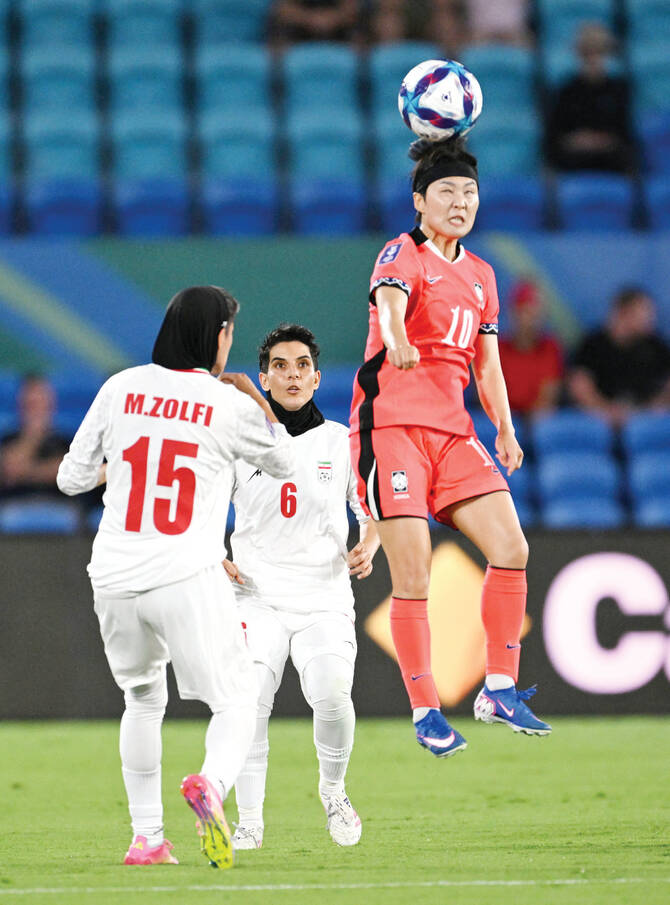
Ji Soyun of South Korea during the AFC Women’s Asian Cup Group A match between South Korea and Iran at Robina Stadium on the Gold Coast, Australia, on Monday. (Reuters)
Short Url
Updated 02 March 2026
Follow

South Korea outclass Iran in Asian Women’s Cup opener

  • South Korea next play the Philippines, while Australia take on Iran in a doubleheader Thursday

GOLD COAST, Australia: South Korea went to the top of Pool A in the Asian Women’s Cup after overcoming a dogged Iran 3-0 in their tournament opener on Queensland’s Gold Coast on Monday.

The Koreans, runners-up to China in the 2022 edition, totally dominated a brave but outclassed Iran, who showed no signs of being affected by the war raging at home, while some supporters waved shah-era flags.

South Korea’s Casey Phair, who came on as a second-half substitute, said her side had plenty of room for improvement.

“We worked really hard and performed really well but we could have scored a few more goals and we missed a couple of chances,” Phair said.

“That’s something we can work on in training but I think it was a really good starting point for the tournament.”

South Korea now head their pool on goal difference after Australia only managed a 1-0 win over the Philippines on Sunday.

The Koreans dominated from the outset as Iran sat back in defense, trying to limit the damage rather than take the attack to their opponents.

For most of the first half the tactic was successful despite the Koreans having 81 percent possession and 20 shots at goal.

However, the relentless attack eventually told in the 37th minute when a shot from Jang Sel-gi rebounded off the upright to Choe Yu-ri, who slotted home off her left boot, giving South Korea a 1-0 lead at the break.

Iran made three substitutions at halftime and came out in the second with a more attacking mindset.

They had a rare chance in the 56th minute, but Zahra Ghanbari’s shot went straight to keeper Kim Min-jung.

But the game was as good as over four minutes later when Korea’s Lee Eun-young was brought down in the box by Melika Motevalli and Kim Hye-ri slotted the penalty.

South Korean captain Ko Yoo-jin put the icing on the cake when she headed in from a 75th-minute Kim Hye-ri free kick to score her first goal for her country.

South Korea next play the Philippines, while Australia take on Iran in a doubleheader on the Gold Coast on Thursday.

The top two sides from each of the three groups, along with the two best third-placed teams, progress to the quarterfinals. At stake for the top six finishers is qualification for the 2027 World Cup in Brazil.


Middle East war puts Asian Football Confederation in a tricky situation

Updated 6 sec ago
Follow

Middle East war puts Asian Football Confederation in a tricky situation

  • Asian football has long been structured around regions, with competitions split between East and West
  • With conflict in the Middle East escalating on Feb. 28, the AFC was forced into emergency mode as the knockout stages of its club competitions approach

DAMMAM: Football in Asia has never been an easy task to manage. Long flights, numerous time zones, conflicting calendars, vastly different football cultures and — perhaps more than any other confederation in the world — politics.
While the war in the Middle East falls under the AFC’s umbrella, its direct effects have so far been limited to the clubs in West Asia. Asian football has long been structured around regions, with competitions split between East and West, although for a period, the second-tier AFC Cup operated in five separate regions.
As a result, AFC club competitions in East Asia continued uninterrupted in the first week of March. A crowd of 31,225 watched Johor Darul Ta’zim’s historic 3-1 victory over Sanfrecce Hiroshima in the AFC Champions League Elite round of 16. Bangkok United defeated Tampines Rovers in the AFC Champions League Two quarter-final, and an all-Cambodian clash between Phnom Penh Crown and PKR Svay Rieng in the AFC Challenge League ended in a 4-1 victory for the visitors.
The situation in West Asia, however, is vastly different.
With the conflict in the Middle East escalating on Feb. 28, the AFC was forced into emergency mode as the knockout stages of its club competitions approach.
Within 24 hours, the confederation announced that all first-leg matches involving West Asian clubs in AFC competitions would be rescheduled until further notice. The same decision was taken for the second-leg matches fixtures just 48 hours later.
Domestic football has also been heavily disrupted. Leagues in Qatar, Bahrain, Kuwait and Lebanon have been postponed indefinitely, with matches continuing behind closed doors in Jordan.
Leagues in Saudi Arabia, Oman, Iraq and Syria continue to operate, but flights in the region are limited.
With the season already compressed by the FIFA Arab Cup, FIFA Intercontinental playoffs and the upcoming FIFA World Cup, member associations throughout the Middle East now find themselves scrambling alongside the AFC to solve a problem that ultimately lies outside their control.
Another issue looms on the horizon. The AFC Champions League final stage will be hosted in Saudi Arabia next month for the second year in a row. While football has not halted in the Kingdom and the security situation is stable, it remains to be seen whether East Asian clubs will be willing to travel if the conflict continues.
What is the real solution, fans ask?
One proposal that has been circulated is to centralize the knockout rounds from the Round of 16 stage instead of the quarter-finals. That option, however, presents its own challenges. East Asian clubs have already begun their journey in the round of 16, and the idea of centralized hosting has historically not been popular across the continent.
When Saudi Arabia and Qatar were selected to host the AFC World Cup Qualifiers fourth round last year, the decision sparked backlash from Indonesia, Iraq, Oman and the UAE. More recently, journalist Ali Al-Marshoud claimed on Saudi sports program “In the 90” that the UAE’s Al-Wasl rejected a proposal for their AFC Champions League Two quarter-final against Al-Nassr as a single-leg match in Jeddah.
The AFC therefore finds itself in a difficult position. It cannot control regional geopolitics, nor can it influence government policies. At the same time, there is no guarantee that East Asian clubs will travel to the region, or that West Asian clubs will agree to surrender their right to play matches at home.
The conflict has also begun to affect international football.
With the FIFA World Cup intercontinental playoffs scheduled for later this month and Iraq facing a crucial qualifier in Mexico on March 31, uncertainty continues to grow.
In a statement released by the Iraqi Football Association, officials confirmed they were in constant contact with FIFA and the AFC regarding potential travel complications.
Head coach Graham Arnold is currently unable to leave the UAE, while several players and staff have struggled to obtain visas to Mexico due to embassy closures. All the while flights through Iraqi airspace have been suspended.
Political complications are not new to Asian football. For years, Saudi and Iranian clubs played each other at neutral grounds. Conflicts in Syria, Palestine, Iraq and Lebanon also forced the AFC to adopt special arrangements at various times. And of course, the COVID-19 pandemic, which fundamentally reshaped the state of football in Asia.
Yet the current situation presents a different scale of challenge.
For the first time in modern history, the AFC must navigate a regional conflict that touches nearly every part of the confederation. With the season entering its decisive stages and the largest World Cup in history approaching, solutions must be found quickly, or Asian football risks a crisis that could reshape the continental game.