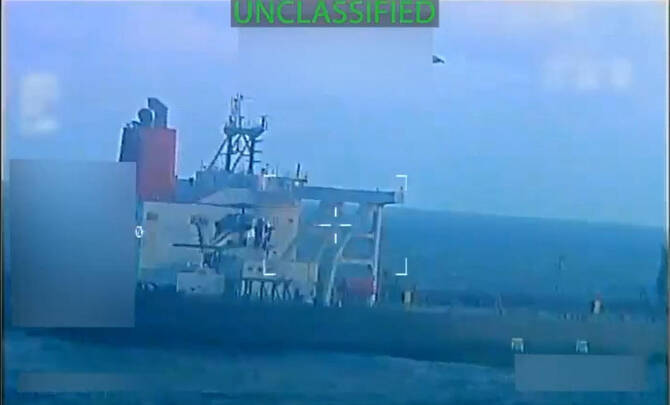
WASHINGTON: The Justice Department has filed a complaint to legally take ownership of a sanctioned tanker and nearly 2 million barrels of petroleum seized off the coast of Venezuela in December, another step by President Donald Trump’s administration to assert power over the country’s oil sector after capturing leader Nicolás Maduro.
It’s the first complaint filed by the US to start the legal process to formally take control of one of at least 10 oil tankers intercepted by American authorities since late last year. The US has accused Venezuela of using a shadow fleet of falsely flagged vessels to smuggle illicit crude into global supply chains.
“Under President Trump’s leadership, the era of secretly bankrolling regimes that pose clear threats to the United States is over,” Attorney General Pam Bondi said in an emailed statement.
“This Department of Justice will deploy every legal authority at our disposal to completely dismantle and permanently shutter any operation that defies our laws and fuels chaos across the globe.”
The seizure of the vessel, named the Skipper, in December was the Republican administration’s first in a series of similar actions and marked a dramatic escalation in Trump’s campaign to pressure Maduro by cutting off access to oil revenue that has long been the lifeblood of Venezuela’s economy.
Maduro was arrested in a US raid last month and was taken to New York to face drug trafficking charges. He has pleaded not guilty, protesting his capture and declaring himself “the president of my country.” Following his ouster, several vessels fled the coast of Venezuela in spite of Trump’s quarantine on sanctioned oil tankers, and US forces have tracked and interdicted some of them as far away as the Indian Ocean.
The Trump administration has set out to control the production, refining and global distribution of Venezuela’s oil and oversee where the revenue flows. The US has begun lifting broad sanctions to allow foreign companies to operate in Venezuela in a bid to revitalize the ailing oil industry.
A judge in Washington’s federal court must sign off on the US government’s bid to permanently take ownership of the Skipper and its cargo so the oil can potentially be sold.
The Justice Department alleges the tanker moved oil from Iran and Venezuela throughout the world, flying false flags to hide its illegal activities while providing revenue for Iran’s paramilitary Revolutionary Guard, which the US has deemed a foreign terrorist organization.
“Because of the coordinated efforts of our prosecutors and law enforcement partners, a ghost tanker that for years secretly moved illicit oil from Iran and Venezuela around the globe has been taken off the seas,” Assistant Attorney General A. Tysen Duva, who leads the Justice Department’s Criminal Division, said in a statement.
“Today’s actions are an important step in making America and the world safer by disrupting the flow of millions of dollars to foreign terrorist organizations,” he said.


![]()

US moves to legally control tanker and 2M barrels of oil seized off Venezuela’s coast in December
Short Url
https://arab.news/2ydse
US moves to legally control tanker and 2M barrels of oil seized off Venezuela’s coast in December
- “The era of secretly bankrolling regimes that pose clear threats to the United States is over,” Bondi said
- The Trump administration has set out to control the production, refining and global distribution of Venezuela’s oil


Latest updates


© 2026 SAUDI RESEARCH & PUBLISHING COMPANY, All Rights Reserved And subject to Terms of Use Agreement.