Pakistan warns of heightened glacial lake flood risk as temperatures rise

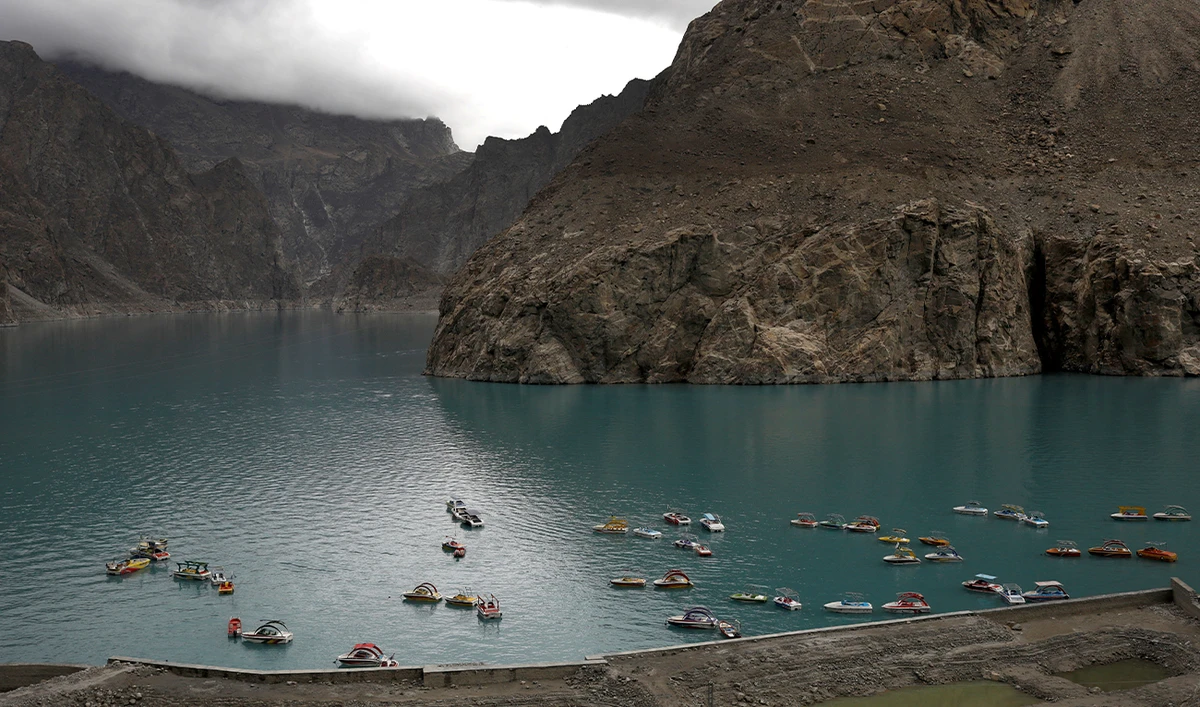
Boats gather on Attabad lake, which was formed due to a landslide in Attabad, in the Karakoram mountain range in the Gilgit-Baltistan region of Pakistan, October 8, 2023. (AFP/File)
Short Url
Updated 26 February 2026
Follow

Pakistan warns of heightened glacial lake flood risk as temperatures rise

  • NDMA says early heatwave conditions could accelerate glacier melt in northern Pakistan
  • Authorities urge contingency planning, early warnings and evacuations in at-risk areas

PESHAWAR: Pakistan’s disaster management authority warned on Thursday of an elevated risk of glacial lake outburst floods (GLOFs) starting next month as rising temperatures threaten to accelerate snow and glacier melt in the country’s northern regions.

The National Disaster Management Authority (NDMA) said seasonal forecasts point to higher-than-normal temperatures and possible early heatwave conditions that could destabilize glacial lakes in Gilgit-Baltistan and upper Khyber Pakhtunkhwa.

GLOFs occur when water from melting glaciers breaches natural barriers and is suddenly released, triggering fast-moving floods downstream.

“Increasing temperatures during March to June 2026 may accelerate snow and glacier melt in Gilgit Baltistan and Upper Khyber Pakhtunkhwa, heightening the risk of GLOF incidents,” the NDMA said in a statement. “Such events can trigger flash floods, causing damage to homes, infrastructure, agriculture, communication networks and may result in human casualties in vulnerable downstream communities.”

The advisory identified several potentially exposed areas, including valleys in Gilgit-Baltistan such as Ishkoman, Gulkin and Gulmit, as well as parts of Chitral and Upper Dir in Khyber Pakhtunkhwa.

The NDMA urged provincial and local authorities to review contingency plans, strengthen early warning systems and prepare evacuation arrangements where necessary.

Communities living near glacial streams were advised to remain vigilant, avoid unnecessary movement in high-risk zones and follow official instructions.

Climate change has become a major concern for Pakistan, which is frequently ranked among the world’s most vulnerable countries to global warming despite contributing less than 1 percent of global greenhouse gas emissions.

In recent years, the country has endured devastating floods, prolonged droughts and record-breaking heatwaves that have killed thousands of people, damaged critical infrastructure and deepened food security challenges.
Pakistan beefs up security in Karachi, Islamabad and Skardu as Khamenei protests kill 24

Updated 8 sec ago
Follow

Pakistan beefs up security in Karachi, Islamabad and Skardu as Khamenei protests kill 24

  • At least 14 killed in northern Gilgit-Baltistan region, 10 in Karachi during Sunday’s clashes between protesters, law enforcers
  • Police close off roads leading to key government buildings in Islamabad, US consulate in Karachi with army deployed in Skardu

ISLAMABAD/GILGIT: Authorities beefed up security by deploying additional police contingents and sealing off most roads leading to government buildings in Islamabad, Karachi and Skardu on Monday after violent protests in the aftermath of Iranian Supreme Leader Ayatollah Ali Khamenei’s killing led to the deaths of at least 24 people in Pakistan. 

At least 10 people were killed and 73 others sustained injuries on Sunday in clashes with law enforcement outside the US consulate in Karachi. Hundreds of protesters had gathered outside the consulate, with videos showing angry crowds armed with sticks as they smashed doors and windows.

In Islamabad, protesters entered the Red Zone which houses key government and diplomatic offices in the capital, prompting authorities to fire tear gas to disperse them. Similarly, people gathered outside the press club in the northwestern city of Peshawar to protest Khamenei’s killing as well.

Skardu in Pakistan’s northern Gilgit-Baltistan (GB) region saw violent clashes on Sunday as well, as protesters set fire to and vandalized several buildings, including United Nations (UN) regional offices. Clashes with law enforcers caused the deaths of at least 14 people in the region, among them a soldier, a senior official told Arab News.

“Seven protesters were killed in Gilgit and seven in Skardu,” GB Caretaker Information Minister Ghulam Abbas confirmed. “One was soldier martyred in Skardu while the injured there were around 50.”

The minister said the station house officer and deputy superintendent of police in Skardu were also injured, along with two soldiers, while 10 properties were damaged in the clashes. He said police have registered complaints against the culprits for the violence. 

“Schools are closed on Monday and courts’ activities will also be closed,” Abbas said. “A curfew has also been imposed for three days initially in Skardu and Gilgit cities from Mar. 2 to Mar. 4.”

The flare-up also prompted authorities to call in the army in Skardu under Article 245 of the Pakistani constitution, state media reported on Sunday.

Meanwhile, Islamabad Traffic Police said entry into the Red Zone area will remain open for people only through the Margalla Road and another route through Marriott Hotel.

“All other entry points leading toward the Red Zone will remain closed,” it said in its advisory. 

A spokesperson for the Karachi Traffic Police said in a press release that the MT Khan Road, from PIDC road to the Mai Kolachi Road railway crossing, will remain closed on Monday for general traffic due to security reasons.

The US consulate, which was the scene of clashes between protesters and police, is located on Mai Kolachi Road near MT Khan and PIDC. 

“The general public is requested to cooperate with law enforcement agencies and traffic police to avoid inconvenience and difficulties,” the Karachi Traffic Police spokesperson said. 

MIDDLE EAST TENSIONS

The violence on Sunday came hours after Iranian authorities confirmed Khamenei was killed in coordinated strikes carried out by the US and Israel, dramatically escalating tensions in the Middle East and triggering protests in several countries.

According to US officials, the operation targeted Revolutionary Guard command facilities, air defense systems, missile and drone launch sites, and military airfields. The US military said it suffered no casualties and reported minimal damage to its bases despite what it described as “hundreds of Iranian missile and drone attacks.”

Iran retaliated by launching missiles and drones toward Israel and targeting US military installations in Bahrain, Kuwait, Qatar and the UAE. The Emirati government said its air defense systems intercepted dozens of Iranian missiles and drones, but debris from the interceptions caused material damage in Abu Dhabi and Dubai, and at least one civilian, a Pakistani national, was killed. It issued rare emergency alerts urging residents to seek shelter, underscoring how the conflict has rippled far beyond Iran’s borders.

The Israeli military said dozens of Iranian missiles were fired toward Israeli territory, many of which were intercepted. Israel’s Magen David Adom rescue service said a woman in the Tel Aviv area died after being wounded in a missile strike.