

Pakistan non-bank financial sector assets rose 21% in second half of 2025 — SECP

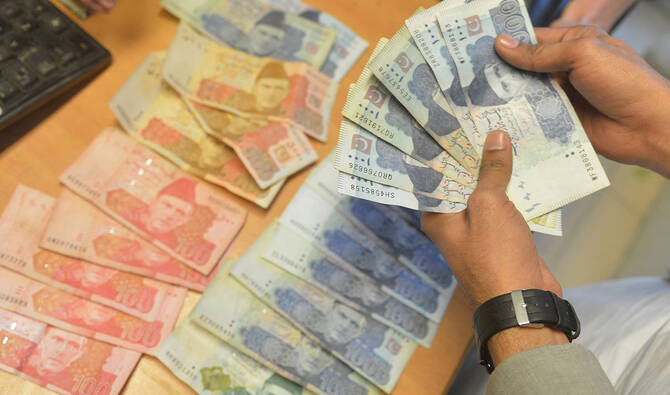
A money changer counts Pakistan's currency at a market in Karachi on January 6, 2023. (AFP/File)
Short Url
Updated 25 February 2026
Follow

Pakistan non-bank financial sector assets rose 21% in second half of 2025 — SECP

  • Mutual fund assets reached $16.1 billion, accounting for 66% of total industry assets
  • NBFC lending assets jumped 65% as Shariah-compliant assets grew to 36% of the sector

ISLAMABAD: Pakistan’s non-bank financial sector expanded in the second half of 2025, with total assets rising 21% to Rs6.84 trillion ($24.4 billion) by Dec. 31, the Securities and Exchange Commission of Pakistan (SECP) said on Wednesday.

The growth, up from Rs5.635 trillion ($20.1 billion) in June 2025, was driven by strong performance in fund management and lending segments, according to the regulator’s latest report, reflecting increased investor participation and expansion of Shariah-compliant assets.

“The fund management sector recorded solid growth of 17% during the period,” the SECP said in the statement.

“Mutual funds remained the largest sub-sector, managing assets of Rs. 4.5 trillion [$16.1 billion], which account for 66.3% of total industry assets.”

“The number of funds and plans increased from 369 to 409,” it continued. “Mutual fund investments remained well diversified, with 44% allocated to money market funds, 23% to income funds, and 14% to equity funds.”

The statement said investor participation also witnessed an increase, with mutual fund investor accounts reaching 845,000 by the end of December, an 8 percent rise since June 2025 and double the level recorded in December 2022.

Participation in voluntary pension schemes rose to 143,154 accounts, marking a 30% increase over six months and a 170% rise compared with December 2022.

The lending segment of non-bank financial companies (NBFCs) posted particularly strong growth, with assets climbing 65% over the six-month period to Rs824 billion ($2.9 billion).

Shariah-compliant assets totaled Rs2.47 trillion ($8.8 billion), accounting for 36% of overall industry assets, the report said.

The number of registered NBFCs and Modaraba entities rose to 185 from 174 in June 2025, underscoring continued sector expansion.

Pakistan’s non-bank financial sector plays a growing role in capital formation and savings mobilization, complementing the banking system in a country where financial inclusion remains a policy priority.


Pakistan PM calls for faster CPEC implementation, pledges security for Chinese workers

Updated 27 February 2026
Follow

Pakistan PM calls for faster CPEC implementation, pledges security for Chinese workers

  • Shehbaz Sharif pushes expanded cooperation in agriculture, IT and mining under CPEC phase two
  • Chinese envoy reaffirms Beijing’s support for Pakistan’s sovereignty and economic development

ISLAMABAD: Prime Minister Shehbaz Sharif on Friday called for speeding up projects under the China-Pakistan Economic Corridor (CPEC) and pledged stronger security guarantees for Chinese workers and investments, during a meeting with China’s ambassador in Islamabad.

Sharif made the remarks as the two countries strive to launch the second phase of CPEC, a multibillion-dollar infrastructure and energy initiative launched in 2015 as part of China’s Belt and Road Initiative (BRI).

CPEC’s first phase focused largely on power generation and transport infrastructure aimed at easing Pakistan’s chronic energy shortages and improving connectivity. The second phase seeks to expand cooperation into industrial development, with an emphasis on special economic zones and export-oriented growth.

“While highlighting the importance of accelerating ongoing CPEC projects, the Prime Minister stressed on the need to enhance cooperation in agriculture and IT and mining & minerals,” said a statement circulated by the PM Office after the meeting.

“He also underscored Pakistan’s resolve to provide a secure and conducive environment for Chinese personnel, investments, and institutions in Pakistan,” it added.

Chinese nationals and projects in Pakistan have faced security threats in the past, including attacks by militant groups targeting infrastructure sites and convoys. Islamabad has repeatedly vowed to tighten security and has deployed special protection units for Chinese workers.

China is Pakistan’s closest ally in the region and a key economic partner, with CPEC widely regarded by Islamabad as central to long-term economic growth.

During the meeting, the prime minister conveyed greetings to Chinese President Xi Jinping and Premier Li Qiang, particularly on the occasion of the Chinese New Year.

China’s Ambassador to Pakistan, Jiang Zaidong, reiterated Beijing’s support for Pakistan’s sovereignty and socioeconomic development, according to the statement. Both sides also exchanged views on regional and international issues and agreed to maintain close coordination.