

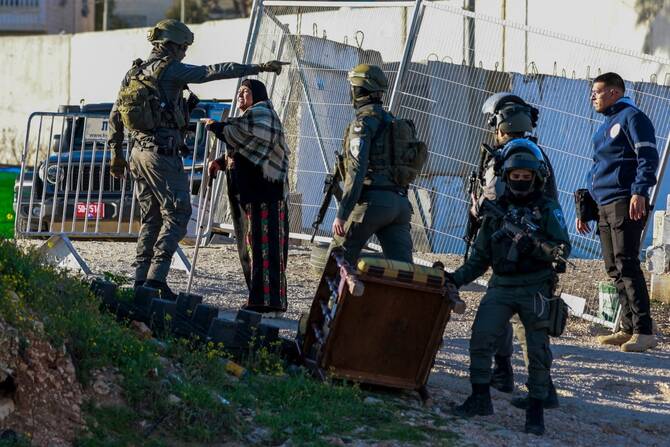

RIYADH: Saudi Arabia and several other countries condemned on Monday a series of recent Israeli decisions that have sought to initiate sweeping extensions to its unlawful control over the West Bank.
In a statement, the foreign ministers of Saudi Arabia, Palestine, Qatar, Egypt, Jordan, Turkiye, Brazil, France, Denmark, Finland, Iceland, Indonesia, Ireland, Luxembourg, Norway, Portugal, Slovenia, Spain, and Sweden, and the secretary-generals of the Arab League and the Organisation of Islamic Cooperation, condemned the changes that “reclassify Palestinian land as so-called Israeli ‘state land,’ accelerating illegal settlement activity, and further entrenching Israeli administration.”
The statement said: “We are clear that Israel’s illegal settlements, and decisions designed to further them, are a flagrant violation of international law, including previous United Nations Security Council resolutions and the 2024 advisory opinion of the International Court of Justice.
“These latest decisions are part of a clear trajectory that aims to change the reality on the ground and to advance unacceptable de facto annexation. They also undermine the ongoing efforts for peace and stability in the region, including the 20-point plan for Gaza, and threaten any meaningful prospect of regional integration.”
The foreign ministers called on Israel to reverse the decisions immediately, respect its international obligations, and refrain from actions that would result in permanent changes to the legal and administrative status of the territory.
“These decisions follow the unprecedented acceleration of Israel’s settlement policy, with the approval of the E1 project and the publication of its tender. Such actions are a deliberate and direct attack on the viability of the Palestinian state and the implementation of the two-state solution,” the foreign ministers said.
They reiterated their rejection of all measures aimed at altering the demographic composition, character and status of the Palestinian territory occupied since 1967, including East Jerusalem.
“We oppose any form of annexation,” they said. The foreign ministers also called on Israel to put an end to settler violence against Palestinians, including by holding those responsible accountable. They described the escalation in the West Bank as “alarming.”
They added: “We reaffirm our commitment to taking concrete steps, in accordance with international law, to counter the expansion of illegal settlements in Palestinian territory and policies and threats of forcible displacement and annexation.
“In the holy month of Ramadan we also stress the importance of preserving the historic and legal status quo in Jerusalem and its holy sites, recognizing the special role of the historic Hashemite custodianship in this regard. We condemn repeated violations of the status quo in Jerusalem, which constitute a threat to regional stability.
“We reaffirm our unwavering commitment to achieving a just, comprehensive, and lasting peace in the Middle East on the basis of the two-state solution, in line with the Arab Peace Initiative and relevant UN resolutions, based on the June 4, 1967, lines. As reflected in the New York Declaration, the end of the Israeli-Palestinian conflict is imperative for regional peace, stability, and integration. Only by realizing an independent, sovereign and democratic Palestinian state can coexistence among the region’s peoples and states be achieved.”
The ministers called for the immediate release by Israel of withheld tax revenues due to the Palestinian Authority.
Those revenues must be transferred to the Palestinian Authority, according to the Paris Protocol, and they are vital for the provision of basic services for the Palestinian population in Gaza and in the West Bank, they added.


