Israeli settlers torch West Bank mosque

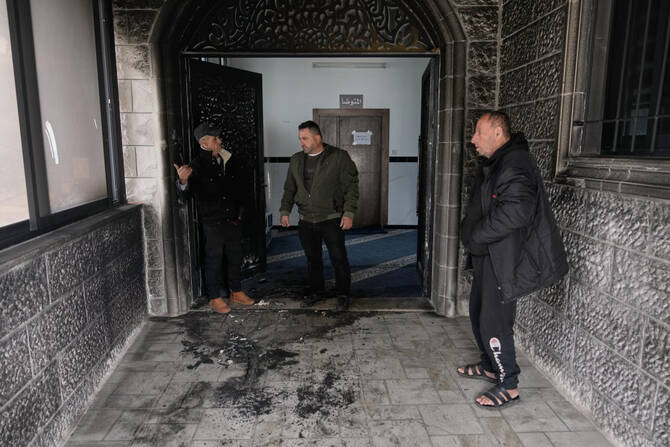
People check a fire-damaged area in the Abu Bakr Al-Siddiq Mosque following an attack by Israeli settlers on the West Bank village of Tell, near Nablus on Monday. (AP)
Short Url
Updated 23 February 2026
Follow

Israeli settlers torch West Bank mosque

  • Attacker spray-paint offensive phrases on the Abu Bakr Al-Siddiq Mosque in the town of Tell
  • Religious affairs ministry says settlers vandalized or attacked 45 mosques in the West Bank last year

TELL, West Bank: Israeli settlers vandalized a mosque in the Israeli-occupied West Bank early Monday, spray-painting offensive phrases and setting a fire, according to the Palestinian Authority’s Ministry of Religious Affairs Ministry.
Worshippers coming for the first prayers of the day found the damage and a still smoldering fire, which spewed black smoke across the entrance of the Abu Bakr Al-Siddiq Mosque in the town of Tell, near Nablus, and stained the ornate doorway.
“I was shocked when I opened the door,” said Munir Ramdan, who lives near the mosque. “The fire had been burning here in the area, the glass was broken here, and the door was broken.”
Security camera footage shows two people walking toward the mosque carrying gasoline and a can of spray paint, and running away a few minutes later, Ramdan said.
The Religious Affairs Ministry said that settlers vandalized or attacked 45 mosques in the West Bank last year. The incident came as Muslims observe the holy month of Ramadan.
“The provocation is directed especially at the person who is fasting, because you are fasting and entering a month of mercy and forgiveness from God,” said Salem Ishtayeh, a resident of Tell. “So they like to provoke you with words — it’s not that they are attacking you personally, they are attacking your religion, the Islamic faith.”
The Israeli military and police said that they responded to the incident and were searching for suspects. The military said that it “strongly condemns” harm done to religious institutions.
Palestinians and rights groups say that Israeli authorities routinely fail to prosecute settlers or hold them accountable for violence.
There has been a recent surge in violence from settlers against Palestinians in the West Bank. Last week, settlers killed a 19-year-old Palestinian-American man, Nasrallah Abu Siyam.


UN nuclear watchdog says it’s unable to verify whether Iran has suspended all uranium enrichment

Updated 27 February 2026
Follow

UN nuclear watchdog says it’s unable to verify whether Iran has suspended all uranium enrichment

VIENNA: Iran has not allowed the United Nations nuclear watchdog to access nuclear facilities affected by the 12-day war in June, according to a confidential report by the watchdog circulated to member states and seen Friday by The Associated Press.
The report from the International Atomic Energy Agency stressed that therefore it “cannot verify whether Iran has suspended all enrichment-related activities,” or the “size of Iran’s uranium stockpile at the affected nuclear facilities.”
The IAEA report on Friday warned that due to the continued lack of access to any of Iran’s four declared enrichment facilities, the agency “cannot provide any information on the current size, composition or whereabouts of the stockpile of enriched uranium in Iran.”
The report stressed that the “loss of continuity of knowledge over all previously declared nuclear material at affected facilities in Iran needs to be addressed with the utmost urgency.”
Iran long has insisted its program is peaceful, but the IAEA and Western nations say Tehran had an organized nuclear weapons program up until 2003.
Highly enriched material should be verified regularly
According to the IAEA, Iran maintains a stockpile of 440.9 kilograms (972 pounds) of uranium enriched up to 60 percent purity — a short, technical step away from weapons-grade levels of 90 percent.
That stockpile could allow Iran to build as many as 10 nuclear bombs, should it decide to weaponize its program, IAEA director general Rafael Grossi warned in a recent interview with the AP. He added that it doesn’t mean that Iran has such a weapon.
Such highly enriched nuclear material should normally be verified every month, according to the IAEA’s guidelines.
The IAEA also reported that it had observed, through the analysis of commercially available satellite imagery, “regular vehicular activity around the entrance to the tunnel complex at Isfahan.”
The facility in Isfahan, some 350 kilometers (215 miles) southeast of Tehran, was mainly known for producing the uranium gas that is fed into centrifuges to be spun and purified.
Israel has struck buildings at the Isfahan nuclear site, among them a uranium conversion facility. The US also struck Isfahan with missiles during the war last June.
The IAEA also reported that through the analysis of commercially available satellite imagery, it has observed “activities being conducted at some of the affected nuclear facilities, including the enrichment facilities at Natanz and Fordow,” but it added that “without access to these facilities it is not possible for the Agency to confirm the nature and the purpose of the activities.”
The confidential IAEA report also said Friday that Iran did provide access to IAEA inspectors “to each of the unaffected nuclear facilities at least once since the military attacks of June 2025, with the exception of Karun Nuclear Power Plan, which is in the early stages of construction and does not contain nuclear material.”
IAEA joined Geneva talks between Iran and US
The IAEA reported on Friday that Grossi attended negotiations between the US and Iran on Feb. 17 and Feb. 26 in Geneva at which he “provided advice on issues relevant to the verification of Iran’s nuclear program.” The report said that those negotiations are “ongoing.”
The Trump administration has held three rounds of nuclear talks this year with Iran under Omani mediation. Thursday’s round of talks in Geneva ended without a deal, leaving the danger of another Mideast war on the table as the US has gathered a massive fleet of aircraft and warships in the region.
Oman’s Foreign Minister Badr Al-Busaidi said technical talks involving lower-level representatives would continue next week in Vienna, the home of the IAEA. The agency is likely to be critical in any deal.
The US is seeking a deal to limit Iran’s nuclear program and ensure it does not develop nuclear weapons.
Iran says it is not pursuing weapons and has so far resisted demands that it halt uranium enrichment on its soil or hand over its stockpile of highly enriched uranium.
Similar talks last year between the US and Iran about Iran’s nuclear program broke down after Israel launched what became a 12-day war on Iran, that included the US bombing Iranian nuclear sites.
Before the June war, Iran had been enriching uranium up to 60 percent purity.