

Pakistan says it struck TTP, Daesh militant camps near Afghan border, Kabul alleges civilian deaths

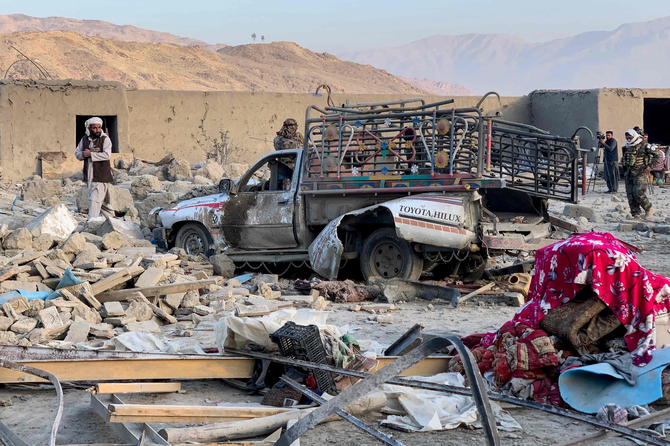
Afghan men search for victims after an overnight Pakistani airstrike hit a residential area in the Girdi Kas village of Bihsud district, Nangarhar province on February 22, 2026. (AFP)
Short Url
Updated 22 February 2026
Follow

Pakistan says it struck TTP, Daesh militant camps near Afghan border, Kabul alleges civilian deaths

  • Islamabad says it targeted seven militant hideouts in “retributive response” to attacks
  • Afghan Taliban accuse Pakistan of bombing civilians in Nangarhar and Paktika provinces

ISLAMABAD: Pakistan said on Saturday it carried out “intelligence-based selective targeting” against militant camps near the Afghan border after a series of attacks inside the country, while the Afghan Taliban accused Pakistani forces of killing civilians in the assault. 

Pakistan has faced a renewed surge in militant violence in recent months, particularly in its northwestern Khyber Pakhtunkhwa province and two major attacks in the capital, Islamabad. Authorities say many of the attacks have been carried out by the Tehreek-e-Taliban Pakistan (TTP) and allied groups that Islamabad alleges are operating from sanctuaries in Afghanistan. Kabul denies this. 

According to Pakistan’s information ministry, recent incidents included a suicide bombing at a Shiite mosque in Islamabad, separate attacks in Bajaur and Bannu, and another recent incident in Bannu during the holy month of Ramadan, which started earlier this week. The government said it had “conclusive evidence” linking the attacks to militants directed by leadership based in Afghanistan.

“Pakistan in a retributive response, has carried out intelligence based selective targeting of seven terrorist camps and hideouts belonging to Pakistani Taliban ... and its affiliates and ISKP [Daesh] at the border region of Pakistan Afghan border with precision and accuracy,” the Pakistani information ministry said in a statement on Feb. 21.

The statement, which did not specify the exact nature of the attacks, said it had hit camps of the “Fitna al Khwarij (FAK),” a term Pakistani authorities use for the TTP, as well as the Islamic State Khorasan Province (ISKP), the regional affiliate of the Daesh group.

Islamabad has repeatedly urged Afghanistan’s Taliban authorities to take action against militants it says are using Afghan territory to plan and launch attacks inside Pakistan. The latest statement said Kabul had “failed to undertake any substantive action” despite prior requests.

In an X post, Kabul government spokesperson Zabihullah Mujahid said Pakistani forces had violated Afghan territory.

“Pakistani special military circles have once again trespassed into Afghan territory,” Mujahid said. “Last night, they bombed our civilian compatriots in Nangarhar and Paktika provinces, martyring and wounding dozens of people, including women and children.”

The Afghan Taliban’s claims of civilian casualties could not be independently verified. Pakistan did not immediately comment on the allegation that civilians had been killed in the strikes.

Separately, Afghanistan’s Ministry of National Defense said the attack was in breach of international law and Islamic principles.

“In this regard, the Ministry of National Defense affirms that safeguarding the nation’s sovereignty and the security of its people are both its religious obligations and national duties, and warns that an appropriate and measured response will be taken at a suitable time, Inshallah,” the ministry wrote on social media platform X. 

Tensions between Islamabad and Kabul have escalated since the Afghan Taliban returned to power in 2021. Pakistan says cross-border militant attacks have increased since then and has accused the Taliban of failing to honor commitments under the 2020 Doha Agreement to prevent Afghan soil from being used for attacks against other countries. The Taliban deny allowing such activity and have previously rejected similar accusations.

Saturday’s exchange of accusations marks one of the most direct confrontations between the two neighbors in recent months and risks further straining already fragile ties along the volatile border.


Pakistan to maintain hard line on Afghanistan after strikes as Taliban vows military response

Updated 5 sec ago
Follow

Pakistan to maintain hard line on Afghanistan after strikes as Taliban vows military response

  • Islamabad blames Afghanistan’s ‘guerrilla mindset’ for escalating tensions between the two countries
  • Afghan Taliban spokesperson denies militant presence in his country, accuses Pakistan of hitting civilians

ISLAMABAD: Pakistan vowed on Wednesday to continue its current policy toward Afghanistan unless the Taliban leadership abandons its “guerrilla mindset,” days after Islamabad carried out airstrikes inside Afghan territory, sharply escalating tensions between the two neighbors once again.

Pakistan conducted intelligence-based strikes overnight into Sunday in Afghanistan’s eastern Nangarhar and southeastern Paktika provinces, saying it had targeted camps of the banned Tehreek-e-Taliban Pakistan (TTP), its affiliates and Daesh-linked fighters.

Islamabad has long accused Kabul of allowing militant groups to use Afghan soil to launch attacks on Pakistani civilians and security forces, a charge the Taliban deny. The two sides also clashed in October last year, leading Pakistan to close key border crossings for bilateral and transit trade.

State Minister for Interior Talal Chaudhry told Geo News that Pakistan had attempted dialogue but would now persist with practical measures if the Taliban failed to change course.

“They call themselves a state, but they have not yet emerged from their guerrilla mindset,” he said.

“Now, with the practical steps we are taking, we want to change their behavior and see them in the form of a state,” he added.

Pakistan blamed a string of recent suicide bombings in Islamabad, Bajaur and Bannu on militants operating from Afghan territory before launching the latest strikes.

Chaudhry said Afghanistan had been acting like “an irresponsible neighbor,” warning that his country’s current approach would continue if attacks inside Pakistan persisted.

“This war will be won, and all this will end,” he said. “If it is not resolved the straight way, then it will be completely ended by a hard-line approach.”

Meanwhile, Kabul has condemned the airstrikes as violations of its sovereignty and said civilians were killed.

In an interview with Al Arabiya, Taliban government spokesman Zabihullah Mujahid also pledged to respond militarily.

“It would be a military response, but its details are confidential and I cannot explain further,” he said.

Mujahid rejected Pakistan’s allegations that TTP or Daesh militants operate from Afghan soil, saying security problems inside Pakistan were domestic in nature.

“Afghan soil is not allowed to be used against anyone,” he said, adding that Kabul had carried out extensive operations against Daesh and eliminated its presence in Afghanistan.

The 2,600-kilometer border between the two countries remains a vital trade and transit route, but crossings have faced repeated closures amid rising tensions, disrupting commerce and humanitarian movement.

Several regional countries, including Saudi Arabia, Türkiye and Qatar, have sought to mediate between the two countries, though their military exchanges risk further destabilizing their ties.