

Ukraine accuses Hungary, Slovakia of ‘blackmail’ over threats to cut electricity

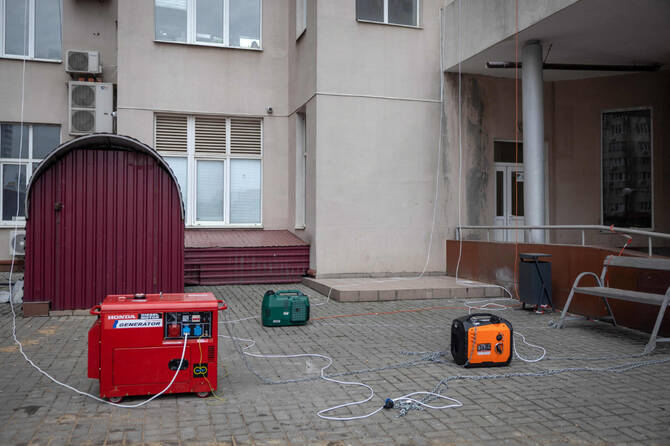
Power generators supply apartments of the Chudo-Gorod residential complex with electricity in Odesa on February 17, 2026, amid the Russian invasion of Ukraine. In the ‘Wonderful City’ residential district of Ukraine’s Odesa, life has been anything but for the hundreds of residents suffering some of the worst Russian bombardments of the entire four-year war. (AFP)
Short Url
Updated 22 February 2026
Follow

Ukraine accuses Hungary, Slovakia of ‘blackmail’ over threats to cut electricity

  • Slovakia’ has threatened to cut off emergency electricity supplies to Ukraine unless Kyiv resumes Russian oil transit to Slovakia over Ukraine’s ‌territory

KYIV: Ukraine’s Foreign Ministry condemned what it described as “ultimatums and blackmail” by the governments of Hungary and Slovakia on Saturday, after they threatened to stop electricity supplies to ​Ukraine unless Kyiv restarts flows of Russian oil.
Shipments of Russian oil to Hungary and Slovakia have been cut off since January 27, when Kyiv says a Russian drone strike hit pipeline equipment in Western Ukraine. Slovakia and Hungary say Ukraine is to blame for the prolonged outage.
Slovakia’s Prime Minister Robert Fico said on Saturday that he would cut off emergency electricity supplies to Ukraine within two days unless Kyiv resumes Russian oil transit to Slovakia over Ukraine’s ‌territory. Hungary’s Viktor ‌Orban made a similar threat days earlier.
The issue ​has ‌become ⁠one of ​the ⁠angriest disputes yet between Ukraine and two neighbors that are members of the EU and NATO but whose leaders have bucked the largely pro-Ukrainian consensus in Europe to cultivate warm ties with Moscow.
Slovakia and Hungary are the only two EU countries that still rely on significant amounts of Russian oil shipped via the Soviet-era Druzhba pipeline over Ukraine.
“Ukraine rejects and condemns the ultimatums and blackmail by the ⁠governments of Hungary and the Slovak Republic regarding energy supplies ‌between our countries,” the Ukrainian Foreign Ministry said ‌in a statement. “Ultimatums should be sent to the Kremlin, ​and certainly not to Kyiv.”

Hungary, ‌Slovakia are key for Ukraine’s electricity imports
Between them, Hungary and Slovakia ‌have been providing around half of European emergency electricity exports to Ukraine, which Kyiv increasingly relies on as Russian attacks have damaged its grid.
“If oil supplies to Slovakia are not resumed on Monday, I will ask SEPS, the state-owned joint-stock company, to stop emergency electricity ‌supplies to Ukraine,” Fico said in a post on X.
Kyiv said that such actions were “provocative, irresponsible, and threaten the energy ⁠security of ⁠the entire region.”
Throughout the war that began with the full-scale Russian invasion whose fourth anniversary falls on Tuesday, Ukraine has allowed its territory to be used for Russian energy exports to Europe, which have been sharply curtailed but not halted.
Ukraine has proposed alternative transit routes to ship oil to Europe while emergency pipeline repair works are under way.
In a letter seen by Reuters, the Ukrainian mission to the EU proposed shipments through Ukraine’s oil transportation system or a maritime route, potentially including the Odesa-Brody pipeline linking Ukraine’s main Black Sea port to the EU.
Since October last year, Russia has intensified its drone and ​missile attacks on the Ukrainian ​energy system, knocking out electricity and heat and plunging millions of Ukrainians into long blackouts during bitterly cold winter temperatures.


Lawsuit challenges Trump administration’s ending of protections for Somalis

Updated 8 sec ago
Follow

Lawsuit challenges Trump administration’s ending of protections for Somalis

  • The lawsuit cites a series of statements Trump has made describing Somalis as “garbage” and “low IQ people” who “contribute nothing.”

BOSTON: Immigrant rights advocates filed a lawsuit on Monday seeking to stop US President Donald Trump’s administration from next ​week ending legal protections that allow nearly 1,100 Somalis to live and work in the United States. The lawsuit, brought by four Somalis and two advocacy groups, challenges the US Department of Homeland Security’s decision to end Temporary Protected Status for Somali immigrants, whom Trump has derided in public remarks. Outgoing Homeland Security Secretary Kristi Noem in January announced that TPS for Somalis would end on March 17, arguing that Somalia’s conditions had improved, despite fighting continuing between Somali forces and Al-Shabab militants. The plaintiffs, who ‌include the groups ‌African Communities Together and Partnership for the Advancement ​of ‌New ⁠Americans, in the ​lawsuit filed ⁠in Boston federal court argue the move was procedurally flawed and driven by a discriminatory, predetermined agenda.
The lawsuit cites a series of statements Trump has made describing Somalis as “garbage” and “low IQ people” who “contribute nothing.”
The plaintiffs said the administration is ending TPS for Somalia and other countries due to unconstitutional bias against non-white immigrants, not based on objective assessments of country conditions.
“The termination of TPS for Somalia is racism masking as immigration policy,” ⁠Omar Farah, executive director at the legal group Muslim Advocates, said ‌in a statement.
DHS did not respond to ‌a request for comment. It has previously said TPS ​was “never intended to be a de ‌facto amnesty program.”
TPS is a form of humanitarian immigration protection that shields eligible migrants ‌from deportation and allows them to work. Under Noem, DHS has moved to end TPS for a dozen countries, sparking legal challenges. The administration on Saturday announced plans to pursue an appeal at the US Supreme Court in order to end TPS for over 350,000 Haitians. It ‌also wants the high court to allow it to end TPS for about 6,000 Syrians.

SOMALI COMMUNITY TARGETED
Somalia was first designated ⁠for TPS in ⁠1991, with its latest extension in 2024. About 1,082 Somalis currently hold TPS, and 1,383 more have pending applications, according to DHS. Somalis in Minnesota in recent months had become a target of Trump’s immigration crackdown, with officials pointing to a fraud scandal in which many people charged come from the state’s large Somali community. The Trump administration cited those fraud allegations as a basis for a months-long immigration enforcement surge in Democratic-led Minnesota, during which about 3,000 immigration agents were deployed, spurring protests and leading to the killing of two US citizens by federal agents.
In November, Trump announced he would end TPS for Somalis in Minnesota, and a month later said ​he wanted them sent “back to where they ​came from.”
The US Department of State advises against traveling to Somalia, citing crime and civil unrest among numerous factors.