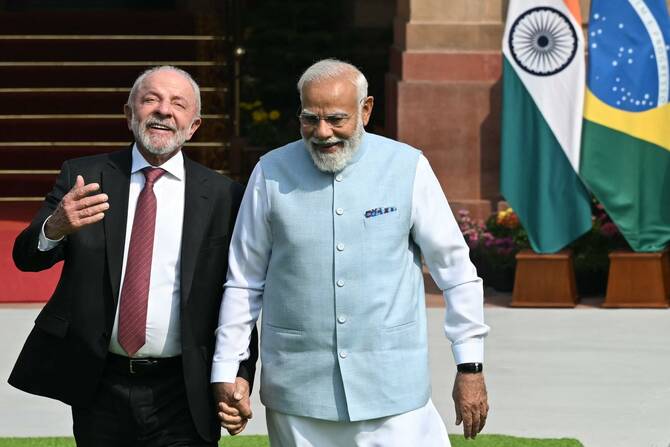

NEW DELHI: India and Brazil moved to strengthen cooperation on critical minerals and rare earths with a new agreement on Saturday, following talks between Prime Minister Narendra Modi and President Luiz Inacio Lula da Silva in New Delhi.
Brazil has one of the world’s largest reserves of critical minerals and rare earths, which are essential for clean energy, modern electronics such as smartphones and fiber-optic cables, as well as advanced military technology.
Lula arrived in the Indian capital on Wednesday for the India AI Impact Summit 2026 and was accompanied by a delegation comprising more than a dozen ministers and business leaders.
“The agreement on critical minerals and rare earths is a major step toward building resilient supply chains,” Modi said during a joint press briefing.
The critical minerals cooperation is expected to boost technology transfer, exploration, research and development, while enabling India to benefit from the Brazilian experience in processing and recycling technologies, according to a statement issued by the Indian Ministry of External Affairs.
The India-Brazil deal comes a day after Delhi signed the Pax Silica Declaration, a US-led initiative aimed at securing the global supply chain for silicon-based technologies that are crucial for AI infrastructure.
Brazil offers India a potential alternative source of supply to reduce reliance on China, as Beijing’s grip on the supply of critical minerals required for high-end manufacturing and defense has been a growing concern for countries around the world.
“Increasing investment and cooperation in matters of renewable energy and critical minerals is at the core of the pioneering agreement that we have signed today,” Lula said.
India, the world’s most populous country, is also looking to strengthen its trade ties with Brazil.
“Brazil is India’s largest trade partner in Latin America. We are committed to taking our bilateral trade beyond $20 billion in the coming five years,” Modi said.
“Our nations will also work closely in areas such as technology, innovation, Digital Public Infrastructure, AI, semiconductors and more. This will benefit the people of our nation.”
India is Brazil’s 10th largest export market, with bilateral trade valued at more than $15 billion in 2025, showcasing a 25 percent growth from the previous year.
The Indian government has listed a total of 10 outcomes from Lula’s visit, including cooperation agreements in areas such as mining for steel supply chain, health and entrepreneurship.