

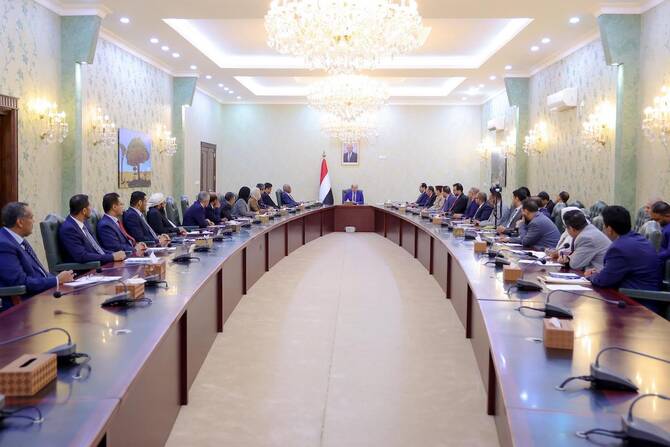
Yemen’s PM chairs first Cabinet meeting in Aden

Prime Minister Shaya Al-Zindani chairs the new Yemen government's first cabinet meeting in Aden on Thursday. (Saba)
Short Url
Updated 20 February 2026
Follow

Yemen’s PM chairs first Cabinet meeting in Aden

  • Shaya Al-Zindani’s new government gathers a day after he arrived in southern Yemen
  • Prime minister says his government will use security and stability as a cornerstone for development

LONDON: Yemen’s prime minister, Shaya Al-Zindani, chaired his new government’s first Cabinet meeting in Aden on Thursday.

He had arrived on Wednesday in the city in southern Yemen, which is controlled by forces loyal to the internationally recognized government. The country’s capital Sanaa, in the north, remains under the control of the Houthi militia, which seized the city in 2014, sparking civil war.

Yemen’s Presidential Leadership Council issued a decree this month for the formation of a new government, after the separatist Southern Transitional Council announced it would dissolve following talks in Saudi Arabia.

Al-Zindani, who also holds the office of foreign minister, assembled a 35-member Cabinet that includes strong representation from the south and east of the country, and three women. He vowed that the government, which has been based in Saudi Arabia, would return to Aden to carry out its work.

He told the meeting on Thursday that the government’s presence in Yemen would be “on the ground, living among citizens and working to improve living conditions and stabilize services,” Yemen’s state news agency, SABA, reported.

Cabinet members discussed short-term priorities, including the provision of essential services such as electricity, water, health and education, to people living in regions under its control, as well as the payment of salaries.

Al-Zindani said he was preparing a broad program covering the period until the end of the year designed to improve services and strengthen the economy of the country after more than a decade of civil war.

He added that the government would “give great attention to enhancing security and stability as a cornerstone for development.” Military and security decision-making will be unified under the supreme commander of the armed forces and the ministries of defense and interior.

The government has a “sincere commitment to a political solution” that would end the conflict with the Houthis and restore state institutions, Al-Zindani said.

He praised the Coalition to Restore Legitimacy in Yemen for the support it has provided to his government and efforts to achieve peace.

The unity of the Presidential Leadership Council and support from the coalition had proved to be pivotal in efforts by government forces to successfully regain control of areas of southern and eastern Yemen after they were seized by Southern Transitional Council forces late last year, he added.

“What has been achieved is not a passing security event nor a victory for one party over another, but a victory for the Yemeni state, its institutions, its sovereignty, and its ability to achieve security and protect civil and social peace in accordance with the law,” Al-Zindani said of the offensive.


Hamas calls for sanctions against Israel over new West Bank moves

Updated 6 sec ago
Follow

Hamas calls for sanctions against Israel over new West Bank moves

  • Israel has approved a series of initiatives this month backed by far-right ministers
  • Hamas hailed the condemnation as “a step in the right direction in confronting the occupation’s expansionist plans

GAZA CITY, Palestinian Territories: Hamas on Tuesday called for sanctions against Israel, welcoming a joint condemnation by nearly 20 countries of new Israeli measures aimed at tightening control over the occupied West Bank.
Israel has approved a series of initiatives this month backed by far-right ministers, including launching a process to register land in the West Bank as “state property” and allowing Israelis to purchase land there directly.
Late on Monday, 18 countries including regional heavyweights Saudi Arabia, Egypt, and European powers France and Spain, slammed Israel over the recent moves.
They “are part of a clear trajectory that aims to change the reality on the ground and to advance unacceptable de facto annexation,” the countries said.
“Such actions are a deliberate and direct attack on the viability of the Palestinian state and the implementation of the two-state solution.”
Hamas hailed the condemnation as “a step in the right direction in confronting the occupation’s expansionist plans, which flagrantly violate international law and relevant UN resolutions.”
The group in a statement urged the countries involved “to impose deterrent sanctions and exert pressure on the fascist occupation government to halt its policies aimed at entrenching annexation, colonial settlement and forced displacement.”
It said the Israeli measures were part of ongoing “aggression” against Palestinians in the West Bank and Gaza.
In addition to roughly three million Palestinians, more than 500,000 Israelis live in settlements and outposts in the West Bank, which are considered illegal under international law.
Israel’s current government has accelerated settlement expansion, approving a record 54 settlements in 2025, according to activists.
The West Bank, which Israel has occupied since 1967, is envisioned as the core of a future Palestinian state, but many on Israel’s religious right view it as part of Israel’s historic homeland.