


NEW YORK CITY: Migrants detained in Libya are subjected to beatings, torture, sexual violence and extortion under a systemic, profit-driven model sustained by traffickers, armed groups and state-affiliated actors, according to a newly published report by the UN’s Support Mission in Libya and the Office of the UN High Commissioner for Human Rights.
The research, covering 2024 and 2025, highlights patterns of human rights violations and abuses carried out with impunity against migrants, asylum-seekers and refugees across the country.
“We would be beaten every day,” said George, a Kenyan national who was held against his will in Al-Kufra, assaulted repeatedly, and whose family was forced to pay $10,000 for his release.
“They would call our families using different telephone numbers, asking them for money. There was a boy who rebelled; he was beaten and killed.
“We were told we would be beaten until our people paid the ransom. If they didn’t, they would kill us, abandon us or throw us into the desert.”
FASTFACT
The report is based on interviews with almost 100 migrants, asylum seekers and refugees from 16 countries in Africa, the Middle East and South Asia. They were interviewed inside and outside Libya.
George said he was among more than 300 people crammed into a small space, beaten daily, and fed just once a day with spaghetti and water. He was held captive for three months by traffickers, he added, and sustained deep scars on his back from the repeated beatings.
“It was traumatizing,” he said. “I was held in Al-Kufra. The situation there is so pathetic. They rent houses. That is the business there: it is trafficking. If you try to escape, others will capture you again for ransom. I am pleading for help … They are manhandling people and killing people.”
George said he had been working as a chef in South Sudan when he was promised a better job and traveled through war-torn Sudan to Libya. Some migrants enter Libya voluntarily, hoping eventually to reach Europe, he added.
The UN report tells how migrants, asylum-seekers and refugees passing through Libya often face danger in the form of human trafficking, arbitrary detention and repeated sales to other captors. Many are tortured or suffer other inhumane treatment as their captors attempt to extort ransom payments from relatives in other countries.
Women and girls frequently fall victim to sexual violence, including rape and sexual exploitation, while men are often tortured and mistreated in other ways. The report documents forced disappearances and cases of migrants who went missing after they were intercepted, detained or transferred to trafficking hubs, leaving families with no information about their whereabouts or fate.
It also details the discovery of mass graves, many containing unidentified bodies, in southern, eastern and western Libya, with indications that more burial sites remain undiscovered.
“These violations,” the report says, “are executed through a business model — one that turns human mobility into a supply chain, and human suffering into profit.”
Based on interviews with nearly 100 people, the authors of the report found that across Libya, migrants, asylum-seekers and refugees were forcibly rounded up, abducted, separated from their families, arbitrarily arrested or otherwise detained, then transferred, often at gunpoint, to official, unofficial or illegal detention facilities without due process.
The report says armed groups, traffickers and state-affiliated actors operate in overlapping roles, blurring the line between state authority and criminal enterprise.
Suki Nagra, the UN’s human rights representative to Libya, described the situation as “dire.”
She said: “We’re seeing waves of racist and xenophobic hate speech, and attacks against migrants, asylum-seekers and refugees, as well as interceptions at sea where people are brought back to Libya — which we do not consider a safe place for disembarkation and return.
“After their disembarkation in Libya, they are routinely held in detention centers that are breeding grounds for human rights violations and abuses.”
The report states that detention has become a revenue stream within an exploitative, profit-driven system in which survival depends on payment. Those without money are passed along, sold to others, or simply “erased.”
It makes clear that the abuses suffered by detainees are not isolated atrocities but widespread and systemic practices sustained by demand, enabled by impunity, and normalized by criminals and state actors who prey on migrants in situations of heightened vulnerability.
Individual cases documented in the report include that of Saber, a 25-year-old from Daraa in Syria who fled forced conscription and traveled through Damascus before arriving in Libya at Benina International Airport. He was detained in the country in 2023, at the age of 23.
In another case, Gloria, from Nigeria, told in a telephone interview how she was forced into marriage at 15, and described how she had been deceived, sold and forced into prostitution.
“When I went to Libya, I didn’t plan to go there,” she said. “A lady told me I would be going to Kano (a city in Northern Nigeria) to work in her restaurant. They put us on a bus, and it took us to Libya.
“When we got there, the place was very bad. They were selling people. When I arrived, they sold me … People come there to buy people, to buy human beings. They forced me into prostitution. I stayed there for a long time before I ran away.”
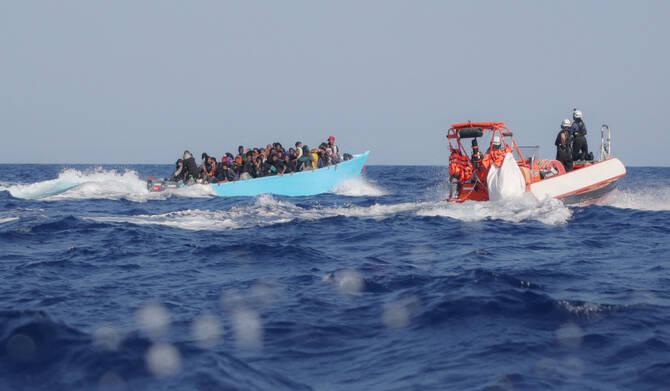
The report also documents several incidents in which individuals fell into the sea or jumped overboard during dangerous interceptions at sea carried out by Libyan authorities.
The UN’s mission in Libya and the Human Rights Office detailed cases in which gunshots were reportedly fired at or near vessels in distress. Such interceptions were attributed to the Libyan Coast Guard, the General Administration of Coastal Security, or other security forces or armed groups operating at sea.
The findings of the report point to gross violations. The UN’s Human Rights Office called for those responsible to be held accountable, and for an end to what it described as an entrenched culture of impunity.
“We recommend legal and policy changes to end the entrenched, exploitative business model driving these violations and abuses,” Nagra said.
“A key area is accountability: holding security actors, traffickers and complicit state-affiliated actors responsible. Accountability provides justice to victims and serves as a deterrent to further violations and abuses.”
The report also calls for the immediate release of all arbitrarily detained migrants, asylum-seekers and refugees, an end to the criminalization of irregular entries to, stays in and exits from Libya, and a moratorium on all interceptions and returns to the country until adequate human rights safeguards can be ensured




