Sydney man jailed for mailing reptiles in popcorn bags

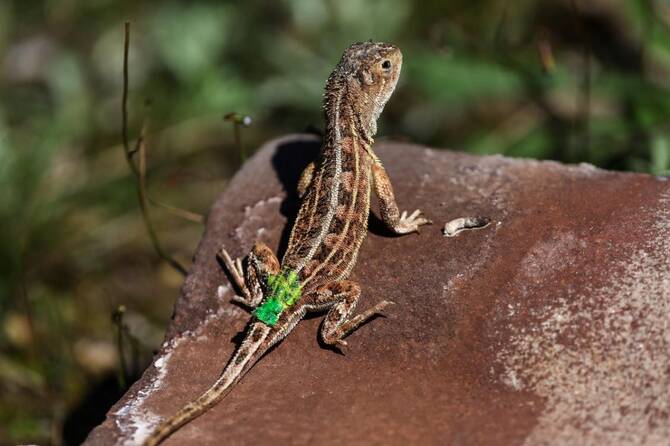
This picture taken on March 25, 2024 shows a grassland earless dragon lizard at the Tidbinbilla Nature Reserve located on the outskirts of the Australian capital city of Canberra. (FILE/AFP)
Short Url
Updated 17 February 2026
Follow

Sydney man jailed for mailing reptiles in popcorn bags

  • The eight-year term handed down on Friday was a record for wildlife smuggling, federal environment officials said

SYDNEY: A Sydney man who tried to post native lizards, dragons and other reptiles out of Australia in bags of popcorn and biscuit tins has been sentenced to eight years in jail, authorities said Tuesday.
The eight-year term handed down on Friday was a record for wildlife smuggling, federal environment officials said.
A district court in Sydney gave the man, 61-year-old Neil Simpson, a non-parole period of five years and four months.
Investigators recovered 101 Australian reptiles from seized parcels destined for Hong Kong, South Korea, Sri Lanka and Romania, the officials said in a statement.
The animals — including shingleback lizards, western blue-tongue lizards, bearded dragons and southern pygmy spiny-tailed skinks — were posted in 15 packages between 2018 and 2023.
“Lizards, skinks and dragons were secured in calico bags. These bags were concealed in bags of popcorn, biscuit tins and a women’s handbag and placed inside cardboard boxes,” the statement said.
The smuggler had attempted to get others to post the animals on his behalf but was identified by government investigators and the New South Wales police, it added.
Three other people were convicted for taking part in the crime.
The New South Wales government’s environment department said that “the illegal wildlife trade is not a victimless crime,” harming conservation and stripping the state “and Australia of its unique biodiversity.”


6 planets will parade across the night sky at the end of February

Updated 24 February 2026
Follow

6 planets will parade across the night sky at the end of February

NEW YORK: Six planets are linking up in the sky at the end of February, and most will be visible to the naked eye.
It’s what’s known as a planetary parade, which happens when multiple planets appear to line up in the sky at once. The planets aren’t in a straight line, but are close together on one side of the sun.
Skygazers can usually spot two or three planets after sunset, according to NASA. Hangouts of four or five that can be glimpsed with the naked eye are less common and occur every few years. Last year featured lineups of six and all seven planets.

When will they be visible?
On Saturday, Mercury, Venus, Jupiter and Saturn will be visible to the naked eye if clear skies allow. Uranus and Neptune can only be spotted with binoculars and telescopes.

What time is optimal for viewing?
Go outside about an hour after sunset and venture away from tall buildings and trees that will block the view. Look to the western sky and spot Mercury, Venus and Saturn close to the horizon. Jupiter will be higher up, along with Uranus and Neptune.

How to know if you’ve spied a member of the parade?
“If it’s twinkling, it’s a star. If it is not twinkling, it’s a planet,” said planetary scientist Sara Mazrouei with Humber Polytechnic in Canada.
The parade should be visible over the weekend and in the days after. Eventually, Mercury will bow out and dip below the horizon.
At least one bright planet is visible on most nights, according to NASA.
Glimpsing many in the sky at once is a fun way to connect with astronomers of centuries’ past, said planetary scientist Emily Elizondo with Michigan State University.
Ancient astronomers used to make sense of the universe “just by looking up at the stars and the planets,” Elizondo said, “which is something that we can do today.”