

Pakistan to introduce end-to-end digital Hajj system next year — IT minister

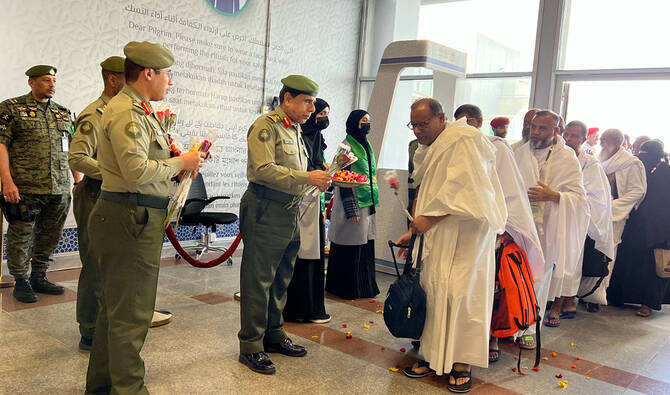
Muslim pilgrims from Bangladesh and Pakistan arrive at King Abdul Aziz International Airport in Jeddah, ahead of the Hajj pilgrimage in Mecca, on June 20, 2023. (AFP/File)
Short Url
Updated 24 February 2026
Follow

Pakistan to introduce end-to-end digital Hajj system next year — IT minister

  • Ministries of Religious Affairs and IT sign MoU to modernize Hajj operations
  • Religious affairs minister says digital shift will reduce delays and human errors

ISLAMABAD: Pakistan will introduce a fully digital, end-to-end Hajj management system next year, Information Technology Minister Shaza Fatima Khawaja said on Tuesday, covering the entire process from application to pilgrims’ return home.

The announcement followed the signing of a memorandum of understanding between the Ministry of Religious Affairs and the Ministry of IT to modernize the country’s Hajj operations.

The move comes as Pakistan pushes to digitize public services and improve administrative efficiency while managing one of the country’s largest annual overseas logistical operations.

“Next year, an end-to-end digital system will be introduced covering the entire Hajj journey from application to return home,” Khawaja said. “A simple and user-friendly online Hajj portal will be established for applicants.”

Religious Affairs Minister Sardar Muhammad Yousaf said the digital transition would improve transparency and operational efficiency.

“The digital system will eliminate unnecessary delays and human errors,” he said.

Under the agreement, authorities will upgrade the existing Pak Hajj mobile application and integrate systems to improve coordination among stakeholders and ensure compliance with Saudi timelines.

Pakistan has already made preparations for this year’s Hajj, with the Ministry of Religious Affairs announcing this week it has completed the first phase of a 10-day technical training program for 870 Khuddam-ul-Hujjaj, government facilitators who assist Pakistani pilgrims in Saudi Arabia.

Officials said the training includes digital navigation tools, emergency response modules and crowd management instruction.

More than 179,000 Pakistanis are expected to perform Hajj this year, requiring coordination across transport, accommodation, health services and regulatory compliance with Saudi authorities. Among these pilgrims, 119,210 will travel under the government scheme and 60,000 through private tour operators, according to ministry data.


Pakistan says defense pact with Saudi Arabia elevated brotherly ties to ‘new heights’

Updated 25 February 2026
Follow

Pakistan says defense pact with Saudi Arabia elevated brotherly ties to ‘new heights’

  • Pakistan, Saudi Arabia signed strategic defense pact last year pledging aggression against one will be treated as attack on both
  • Deputy PM Ishaq Dar says enduring bonds with Islamic and Arab nations form vital pillar of Pakistan’s foreign policy 

ISLAMABAD: Deputy Prime Minister Ishaq Dar said on Wednesday that Pakistan’s defense pact with Saudi Arabia elevated its brotherly ties with the Kingdom to “new heights,” stressing that close ties with Arab and Islamic nations form a key pillar of Islamabad’s foreign policy. 

Pakistan and Saudi Arabia signed a Strategic Mutual Defense Agreement on Sept. 17 last year, pledging that aggression against one country would be treated as an attack on both, enhancing joint deterrence and formalizing decades of military and security cooperation.

Both nations agreed in October 2025 to launch an economic cooperation framework to strengthen trade and investment ties. 

“In the Middle East, our landmark Strategic Mutual Defense Agreement with Saudi Arabia has elevated our brotherly ties to new heights,” Dar said while speaking at the Pakistan Governance Forum 2026 event in Islamabad. 

The Pakistani deputy prime minister was speaking on the topic “Navigating International Relations Amidst Changing Geo-Politics.”

Dar noted that Pakistan has reinforced partnerships with other Middle Eastern nations such as the UAE, Qatar, Jordan, Oman, Egypt and Bahrain. He said these partnerships have yielded “concrete agreements” in investment, agriculture, infrastructure, and energy sectors. 

“Our enduring bonds with Islamic and Arab nations form a vital pillar of our foreign policy, and we will continue to expand our partnerships across Asia, Latin America, and Africa,” he said. 

Dar pointed out that the presidents of Kazakhstan, Uzbekistan and Kyrgyzstan have undertaken visits to Pakistan in recent months, reflecting Central Asian nations’ desire to boost cooperation with Islamabad.

On South Asia, the Pakistani deputy PM said Pakistan has successfully transformed its fraternal ties with Bangladesh into “a substantive partnership.”

“Similarly, the trilateral mechanism involving China, Pakistan, and Bangladesh has been launched with a view to expanding and deepening regional cooperation and synergy,” the Pakistani minister said. 

He said Islamabad has strengthened its “all-weather” partnership with China via the second phase of the multi-billion-dollar China-Pakistan Economic Corridor agreement and “unwavering support” from both sides for each other’s core interests. 

Dar said Pakistan had also reinvigorated its partnership with the US, advancing cooperation in trade, technology, investment, and regional stability. 

“This calibrated approach has enhanced our ability to navigate complexity with skill and confidence, ensuring that our national interests are served without compromising our core foreign policy principles,” he said.