

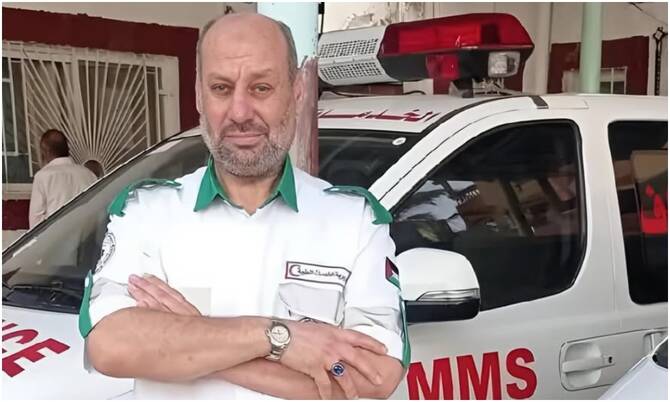
Palestinian paramedic from Gaza dies in Israeli prison

Hatem Rayan was a Palestinian paramedic at the Kamal Adwan Hospital, the largest medical facility in northern Gaza, at the time of his arrest in Dec. 2024. (Wafa)
Short Url
Updated 13 February 2026
Follow

Palestinian paramedic from Gaza dies in Israeli prison

  • Hatem Rayan had been held at the notorious Negev detention center since his arrest on Dec. 27, 2024
  • He was detained at Kamal Adwan Hospital along with his injured son, Muath, who remains in custody

LONDON: Hatem Rayan, a Palestinian paramedic from Gaza, has died at the notorious Israeli Negev detention center, the Palestinian Authority’s General Authority of Civil Affairs said on Thursday.

He had been held there since his arrest on Dec. 27, 2024, according to the Commission of Detainees and Ex-Detainees Affairs, and the Palestinian Prisoners Society.

He was arrested at Kamal Adwan Hospital along with his injured son, Muath, who remains in custody, the Palestinian WAFA news agency reported.

Rayan is one of more than 100 prisoners and detainees who have died in Israeli prisons since the start of the war in Gaza in October 2023. Only 88 of them have been officially identified, 52 of whom were from Gaza. The total number of Palestinian prisoners who have died in Israeli custody since 1967 now stands at 325, the prisoners’ rights groups added.

Rayan was detained when Israeli forces stormed the Kamal Adwan Hospital, the largest medical facility in northern Gaza. They carried out a forced evacuation of patients and staff, and arrested its director, Dr. Hussam Abu Safiya. He remains detained without charge.


Sudan now has highest number of people in need ‘anywhere in the world,’ UN warns

Updated 15 sec ago
Follow

Sudan now has highest number of people in need ‘anywhere in the world,’ UN warns

  • Spokesperson Stephane Dujarric presses states to provide urgent financial support to help meet humanitarian needs that have reached ‘extraordinary levels’
  • 34m people expected to need aid this year; UN response plan calls for $2.9bn of funding to provide food, nutrition, clean water, health and protection services, and education

NEW YORK CITY: The UN on Friday pressed member states to provide urgent financial support to help stave off further suffering in war-torn Sudan, where nearly 34 million people are now expected to need assistance this year — the highest number anywhere in the world.

Spokesperson Stephane Dujarric said that despite the “extraordinary humanitarian needs,” operations remain perilously underfunded and aid workers face mounting risks.

The UN’s 2026 Humanitarian Response Plan for Sudan calls for $2.9 billion of funding to provide more than 20 million people with life-saving food, nutrition, clean water, health and protection services, and education. But funding lags behind needs, complicating efforts to scale up deliveries of aid.

The civil war between rival military factions in the country, which will enter its fourth year in April, is driving several overlapping emergencies, including acute food insecurity and outbreaks of disease.

According to the UN’s World Food Programme, more than 21 million people in Sudan face high levels of acute hunger, and famine conditions have been confirmed, or are feared to be present, in several regions.

Humanitarian workers continue to face “grave danger,” Dujarric said. In recent months, 92 of them, mostly Sudanese, have been killed, injured, kidnapped or detained, he added, and more than 65 attacks on healthcare providers and patients have been recorded.

Aid groups also warn that conflict-related obstacles, including blockades, drone strikes, and sporadic access restrictions, continue to hamper distribution efforts.

The UN has highlighted the fact that amid the growing displacement of people in North Darfur and North Kordofan, where hundreds of thousands of civilians have been uprooted, water and sanitation services are collapsing in affected areas.

The humanitarian crisis is compounded by regional spillover. Neighboring Chad has closed its border with Sudan amid security concerns, complicating the cross-border flow of aid and threatening already fragile refugee-support systems.

Dujarric warned that without increased donor support and improved access, the skills and commitment of aid workers will not be enough to keep pace with spiraling needs.

“Delivering aid at this scale requires flexible funding and guaranteed humanitarian access, so that workers can reach people in need and they can reach them safely and rapidly and without any obstruction,” he said.