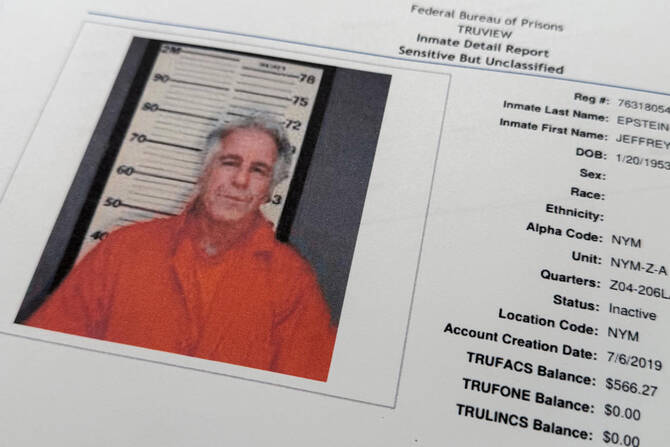
WASHINGTON: Attorney General Pam Bondi will face questions from lawmakers Wednesday over the Justice Department’s handling of files related to Jeffrey Epstein that have exposed sensitive private information about victims despite redaction efforts.
Bondi is confronting a new wave of criticism stemming from the political saga that has dogged her term after the release of millions of additional Epstein disclosures that victims have slammed as sloppy and incomplete.
It will be the first time the attorney general appears before Congress since a tumultuous hearing in October in which she repeatedly deflected questions and countered Democrats’ criticism of her actions with her own political attacks.
Democrats on the House Judiciary Committee are expected to grill Bondi on how the Justice Department decided what should and should not be made public under the Epstein Files Transparency Act, which was passed by Congress after the department abruptly announced in July that no more files would be released even though it had raised the hopes of conservative influencers and conspiracy theorists.
Bondi has continuously struggled to move past the backlash over her handling of the Epstein files since distributing binders to a group of social media influencers at the White House last February. The binders included no new revelations about Epstein, leading to even more calls from President Donald Trump’s base for the files to be released.
The hearing comes days after some lawmakers visited a Justice Department office to look through unredacted versions of the files. As part of an arrangement with the Justice Department, lawmakers were given access to the over 3 million released files in a reading room with four computers and were allowed to take handwritten notes.
Democrats have accused the Justice Department of redacting information that should have been made public, including information that could lead to scrutiny of Epstein’s associates. Meanwhile, victims have slammed the department for inconsistent or nonexistent redactions that allowed for the inadvertent release of nude photos and other private information about victims.
The department has defended the latest rollout of more than 3 million pages of documents along with more than 2,000 videos and 180,000 images. The Associated Press and other media organizations are still reviewing millions of pages of documents, many of them previously confidential.
An AP review of records shows that while investigators collected ample proof that Epstein sexually abused underage girls, they found scant evidence the well-connected financier led a sex trafficking ring serving powerful men. Videos and photos seized from Epstein’s homes in New York, Florida and the Virgin Islands didn’t depict victims being abused or implicate anyone else in his crimes, a prosecutor wrote in one 2025 memo.


Attorney General Bondi will face questions from lawmakers as fallout over Epstein files continues
https://arab.news/pp6qy
Attorney General Bondi will face questions from lawmakers as fallout over Epstein files continues

- It will be the first time the attorney general appears before Congress since a tumultuous hearing in October
- She repeatedly deflected questions and countered Democrats’ criticism of her actions during the hearing


Trump insists he struck Iran on his own terms
- “We are now a nation divided between those who want to fight wars for Israel and those who just want peace and to be able to afford their bills and health insurance,” Marjorie Taylor Greene posted on X.
- Rubio himself doubled down on Tuesday after meeting with US House and Senate members, while insisting that “No, I told you this had to happen anyway”
WASHINGTON, United States: President Donald Trump and his team scrambled Tuesday to reclaim the narrative on why he decided to attack Iran, after his top diplomat suggested the US struck only after learning of an imminent Israeli strike.
Secretary of State Marco Rubio alarmed Democrats — who say only Congress can declare war — as well as many of Trump’s MAGA supporters on Monday when he said: “We knew that there was going to be an Israeli action.”
“We knew that that would precipitate an attack against American forces, and we knew that if we didn’t pre-emptively go after them before they launched those attacks, we would suffer higher casualties,” Rubio told reporters.
Administration officials quickly backpedalled, insisting Trump authorized the strikes because Tehran was not seriously negotiating an accord on limiting its nuclear ambitions, and the United States needed to destroy Iran’s missile capabilities.
“No, Marco Rubio Didn’t Claim That Israel Dragged Trump into War with Iran,” White House Press Secretary Karoline Leavitt posted Tuesday on X.
At an Oval Office meeting later with Germany’s chancellor, Trump went further, saying that “Based on the way the negotiation was going, I think they (Iran) were going to attack first. And I didn’t want that to happen.”
“So, if anything, I might have forced Israel’s hand.”
- Had to happen? -
Rubio himself doubled down on Tuesday after meeting with US House and Senate members, while insisting that “No, I told you this had to happen anyway.”
“The president made a decision. The decision he made was that Iran was not going to be allowed to hide... behind this ability to conduct an attack.”
Critics seized on the muddied messaging to accuse Trump of precipitating the country into a war without a clear rationale, without informing Congress — and without a clear idea of how it might end.
They noted that just two weeks ago, Israel Prime Minister Benjamin Netanyahu pressed Trump again in Washington to take a hard line, in their seventh meeting since Trump’s return to power last year.
Some Republican allies rallied behind the president, with Senator Tom Cotton, chairman of the Senate Intelligence Committee, insisting that “No one pushes or drags Donald Trump anywhere.”
“He acts in the vital national security interest of the United States,” Cotton told the “Fox & Friends” morning show.
But as crucial US midterm elections approach that could see Republicans lose their congressional majority, Trump risks shedding supporters who had welcomed his pledge to end foreign military interventions.
“We are now a nation divided between those who want to fight wars for Israel and those who just want peace and to be able to afford their bills and health insurance,” Marjorie Taylor Greene, a top former Trump ally and a major figure in the populist and isolationist hard right, posted on X.


