

‘Not Winston Churchill’: Trump steps up criticism of UK’s Starmer

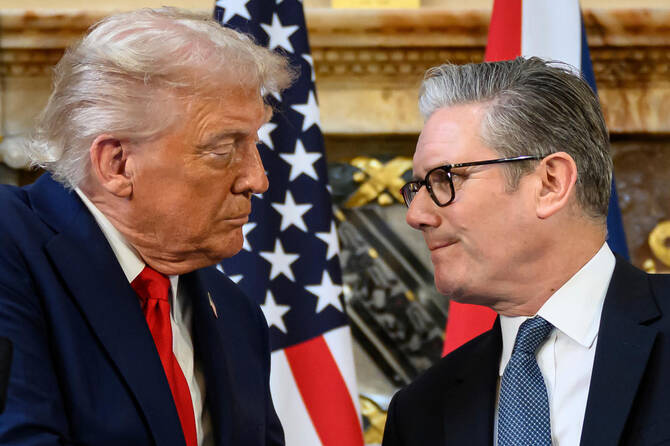
US President Donald Trump, left, and British Prime Minister Keir Starmer during a press conference at Chequers near Aylesbury, England, Sept. 18, 2025. (AP Photo)
Short Url
Updated 03 March 2026
Follow

‘Not Winston Churchill’: Trump steps up criticism of UK’s Starmer

  • Trump criticized Starmer’s decision to cede sovereignty of the Chagos Islands, ‌saying that they have ‘been very, very uncooperative with with that stupid island (Diego Garcia)’
  • Donald Trump: ‘France has been great. They’ve all been great. The UK has been much different from others’

LONDON/WASHINGTON: President Donald Trump intensified his criticism of Prime Minister Keir Starmer on Tuesday, ​saying his lack of immediate support for US strikes on Iran showed “this is not Winston Churchill we’re dealing with.”

Trump has lashed out at Starmer three times this week after he said neither the British military, or its air bases, were involved in the initial US and Israeli strikes on Tehran that killed Iranian Supreme Leader Ayatollah Ali Khamenei.

Starmer told parliament that the government had learnt from its mistakes in backing the US in the 2003 Iraq war, and said any military action must have a “viable, thought-through plan.” He also said he did not believe in “regime change from the skies.”

But ‌Starmer has since ‌allowed the US to use UK bases to launch what he ​called ‌limited ⁠and defensive ​strikes ⁠to weaken Tehran’s capabilities, after Iran hit US allies in the region with drones and missiles.

On Monday, a British base in Cyprus was hit by a drone that Cypriot officials said was likely launched by Iran-backed Lebanese group Hezbollah, prompting London to send a destroyer and more helicopters with counter-drone technology to the region.
Trump told reporters during a meeting in the Oval Office with German Chancellor Friedrich Merz that he was very disappointed with Britain.

“This is not Winston Churchill that we’re dealing with,” he said, comparing Starmer with Britain’s revered ⁠wartime leader.
Trump also criticized Starmer’s decision to cede sovereignty of the Chagos ‌Archipelago, home to the US-UK air base of Diego Garcia, ‌saying they have “been very, very uncooperative with that stupid island.”

Starmer has ‌been criticized from all sides at home for his decision, with opponents on the left calling ‌for him to condemn the military action while on the right, opposition leaders Kemi Badenoch and Nigel Farage attacked Starmer for failing to back Britain’s key security and intelligence ally.

Britain has long prided itself on its relationship with the US, aided by British leaders such as Churchill, Margaret Thatcher and Tony Blair cultivating strong relationships with their counterparts, ‌Franklin D. Roosevelt, Ronald Reagan and George W. Bush.

Starmer, a center-left former lawyer, surprised his critics when he too struck up a solid relationship ⁠with Trump, but that has ⁠been tested in the last year as the US leader became more combative on a number of fronts. Trump earlier told the Sun newspaper he never thought he would see Britain become a reluctant partner, instead heaping praise on France and Germany.

“This was the most solid relationship of all,” he said. “And now we have very strong relationships with other countries in Europe.”
“France has been great. They’ve all been great. The UK has been much different from others.”

Britain, France and Germany released a joint statement in response to Iranian attacks on Saturday, saying they were in close contact with the US, Israel and partners in the region, and were calling for a resumption of negotiations.

Starmer has defended his response, telling parliament on Monday he had to judge what was in Britain’s national interest. “That is what ​I have done, and I stand by ​it,” he said.
Polling published by YouGov on Tuesday showed people in Britain were opposed to the US strikes on Iran by 49 percent to 28 percent.


Lawsuit challenges Trump administration’s ending of protections for Somalis

Updated 10 March 2026
Follow

Lawsuit challenges Trump administration’s ending of protections for Somalis

  • The lawsuit cites a series of statements Trump has made describing Somalis as “garbage” and “low IQ people” who “contribute nothing.”

BOSTON: Immigrant rights advocates filed a lawsuit on Monday seeking to stop US President Donald Trump’s administration from next ​week ending legal protections that allow nearly 1,100 Somalis to live and work in the United States. The lawsuit, brought by four Somalis and two advocacy groups, challenges the US Department of Homeland Security’s decision to end Temporary Protected Status for Somali immigrants, whom Trump has derided in public remarks. Outgoing Homeland Security Secretary Kristi Noem in January announced that TPS for Somalis would end on March 17, arguing that Somalia’s conditions had improved, despite fighting continuing between Somali forces and Al-Shabab militants. The plaintiffs, who ‌include the groups ‌African Communities Together and Partnership for the Advancement ​of ‌New ⁠Americans, in the ​lawsuit filed ⁠in Boston federal court argue the move was procedurally flawed and driven by a discriminatory, predetermined agenda.
The lawsuit cites a series of statements Trump has made describing Somalis as “garbage” and “low IQ people” who “contribute nothing.”
The plaintiffs said the administration is ending TPS for Somalia and other countries due to unconstitutional bias against non-white immigrants, not based on objective assessments of country conditions.
“The termination of TPS for Somalia is racism masking as immigration policy,” ⁠Omar Farah, executive director at the legal group Muslim Advocates, said ‌in a statement.
DHS did not respond to ‌a request for comment. It has previously said TPS ​was “never intended to be a de ‌facto amnesty program.”
TPS is a form of humanitarian immigration protection that shields eligible migrants ‌from deportation and allows them to work. Under Noem, DHS has moved to end TPS for a dozen countries, sparking legal challenges. The administration on Saturday announced plans to pursue an appeal at the US Supreme Court in order to end TPS for over 350,000 Haitians. It ‌also wants the high court to allow it to end TPS for about 6,000 Syrians.

SOMALI COMMUNITY TARGETED
Somalia was first designated ⁠for TPS in ⁠1991, with its latest extension in 2024. About 1,082 Somalis currently hold TPS, and 1,383 more have pending applications, according to DHS. Somalis in Minnesota in recent months had become a target of Trump’s immigration crackdown, with officials pointing to a fraud scandal in which many people charged come from the state’s large Somali community. The Trump administration cited those fraud allegations as a basis for a months-long immigration enforcement surge in Democratic-led Minnesota, during which about 3,000 immigration agents were deployed, spurring protests and leading to the killing of two US citizens by federal agents.
In November, Trump announced he would end TPS for Somalis in Minnesota, and a month later said ​he wanted them sent “back to where they ​came from.”
The US Department of State advises against traveling to Somalia, citing crime and civil unrest among numerous factors.