

Israeli authorities force Palestinian family to self-demolish their houses

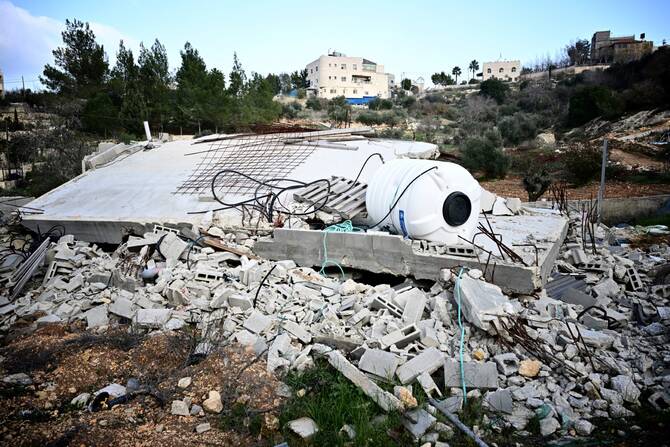
A toppled water tank and concrete debris from a flattened Palestinian home in Al-Walaja, a village in annexed East Jerusalem. (File / AFP)
Short Url
Updated 08 February 2026
Follow

Israeli authorities force Palestinian family to self-demolish their houses

  • Raed Dabash demolished the two dwellings that housed eight people
  • Israel regularly denies building permits to Palestinians in Jerusalem, while illegally expanding Jewish settlements in the city and the occupied West Bank

LONDON: Israeli authorities forced a Palestinian resident of occupied East Jerusalem to demolish his home and that of his son in Sur Baher, citing building violations as the reason.

Raed Dabash demolished the two houses that housed eight people, totaling 90 square meters. The Dabash family built their homes in 2014 without obtaining a building permit from the Israeli authorities in the city.

Israeli authorities imposed high building fines exceeding 100,000 shekels (around $32,000) on two houses, part of a policy aimed at restricting residents in Jerusalem, according to the Jerusalem Governorate.

The Palestinian Authority’s affiliated governorate emphasized that the policy of forced self-demolition is a crime of coercion and a blatant violation of international humanitarian law, the Wafa news agency reported.

Israel regularly denies building permits to Palestinians in Jerusalem, while illegally expanding Jewish settlements in the city and the occupied West Bank. The authorities often compel Palestinian residents in Jerusalem to demolish their own homes for allegedly lacking permits. Those who refuse face demolition of their homes by Israeli bulldozers and significant fines.

The Israeli government faces charges of war crimes and genocide in the Occupied Territories at the International Criminal Court and the International Court of Justice.


Sudan returns to east African bloc after two years

Updated 6 sec ago
Follow

Sudan returns to east African bloc after two years

  • Decision comes two years after Sudan froze its IGAD membership over a decision to invite rival paramilitary chief Mohamed Hamdan Dagalo to a summit
KHARTOUM: Sudan on Monday announced it was returning to east African bloc IGAD, two years after freezing its membership over a decision to invite rival paramilitary chief Mohamed Hamdan Dagalo to a summit.
“The government of the Republic of Sudan will resume its full activity in the membership” in the Djibouti-based Intergovernmental Authority on Development (IGAD), the foreign ministry said in a statement.
Sudan had suspended its membership in January 2024 after the bloc invited the head of rival paramilitary group the Rapid Support Forces (RSF) to a summit in Uganda to discuss the country’s brutal conflict.
The RSF has been at war with Sudan’s army since April 2023 in a conflict that has killed tens of thousands, displaced 11 million and caused one of the world’s worst humanitarian crises.
The foreign ministry cited a statement by IGAD which reaffirmed “its full recognition of Sudan’s sovereignty and the unity of its lands and people” and pledged “non-interference in member states’ internal affairs.”
The decision to rejoin IGAD follows a meeting in January between the bloc’s executive secretary, Workneh Gebeyehu, and Sudan’s Prime Minister Kamil Idris.
Following the meeting, the bloc issued a statement saying it “condemns all forms of violations committed by the Rapid Support Forces and reaffirms its full support for the unity and sovereignty of the Republic of the Sudan, as well as its existing national institutions.”
The nearly three-year conflict has effectively split Sudan between army-controlled areas in the north, east and center, and those controlled by the paramilitaries in the west and parts of the south.
The RSF has also formed a rival parallel administration in Nyala, the South Darfur state capital, but it has received no international recognition.
IGAD on Monday welcomed Sudan’s decision to return, describing it as “a reaffirmation of regional solidarity and collective commitment to peace, stability, and cooperation across the region.”