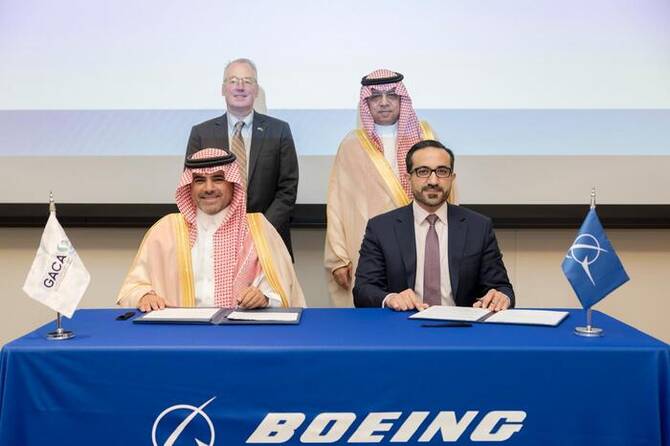

RIYADH: US aircraft manufacturer Boeing has inked an agreement with Saudi Arabia to explore partnerships and investments in the advanced air mobility sector.
A memorandum of understanding was signed in Washington, D.C. by a delegation from the Kingdom’s civil aviation sector, led by Abdulaziz Al-Duailej, president of the General Authority of Civil Aviation, according to a press statement.
Strengthening the aviation sector is one of the crucial goals outlined in Saudi Arabia’s Vision 2030 agenda, as the Kingdom is trying to position itself as a global hub of business and tourism by the end of this decade.
Saudi Arabia’s National Tourism Strategy aims to attract 150 million annual visitors by 2030, while also increasing the sector’s contribution to the Kingdom’s gross domestic product to more than 10 percent.
Commenting on the MoU with Boeing, Sulaiman Al-Muhaimidi, GACA’s executive vice president for Aviation Safety and Environmental Sustainability, said: “This partnership with Boeing reflects GACA’s commitment to creating safer, smarter skies through advanced air mobility innovation. The effort further cements Saudi Arabia at the forefront of the future of aviation.”
During the visit, the Saudi delegation visited the Federal Aviation Administration and the headquarters of Boeing in Washington, as well as the Dreamliner facility in Charleston, South Carolina, where the company builds the 787 Dreamliner.
The authority added that collaboration opportunities in civil aviation, aircraft manufacturing and maintenance services, sustainability, and advanced technologies initiatives were among the many topics discussed during the visit to the US.
GACA added that the visit also aimed to enhance cooperation with the US in knowledge exchange, technology transfer, and localization of the aviation industry, in line with the Kingdom’s goal of becoming “a global industrial and logistics hub in aviation as part of its economic diversification.”
Saudi Arabia’s National Aviation Strategy targets doubling passenger capacity to 330 million annually from over 250 global destinations and increasing cargo handling to 4.5 million tonnes by 2030.
“By engaging with global aviation regulators and manufacturers, GACA is supporting Vision 2030 objectives to strengthen Saudi Arabia’s role as a hub connecting three continents, delivering greater connectivity and travel experiences for the Kingdom’s passengers,” said Al-Duailej.
He added: “With new Saudi airlines being launched, record aircraft orders, and a focus on innovation and sustainability, the visit highlights the unprecedented opportunities being created by the Kingdom and underscores the strong Saudi–US aviation partnership.”
Saudi Arabia’s Riyadh Air, the second flag carrier of the Kingdom, is expected to commence its operations by this year.
Announced in 2023 by Crown Prince Mohammed bin Salman, Riyadh Air is expected to contribute over $20 billion to the non-oil gross domestic product and create more than 200,000 direct and indirect jobs.
In June, the airline’s CEO, Tony Douglas, told Bloomberg that it plans to launch a new international destination every two months once operations begin, as it prepares to take delivery of its first Boeing 787 Dreamliner.
The carrier currently has four Boeing 787 Dreamliners in different stages of assembly at Boeing’s facility in Charleston, South Carolina.
In addition, Riyadh Air announced at the Paris Air Show in June that it will purchase up to 50 Airbus A350 long-range aircraft, with deliveries expected to start in 2030.