

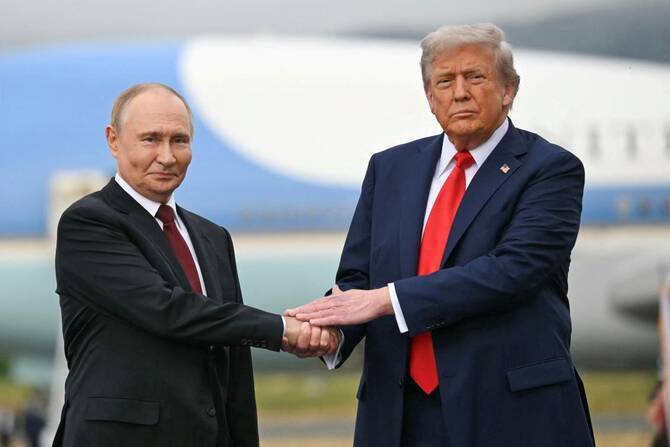

WASHINGTON/MOSCOW: US President Donald Trump on Thursday rejected an offer from his Russian counterpart to voluntarily extend the caps on strategic nuclear weapons deployments after the treaty that held them in check for more than two decades expired.
“Rather than extend “New START ... we should have our Nuclear Experts work on a new, improved and modernized Treaty that can last long into the future,” Trump wrote in a post on his Truth Social platform.
Arms control advocates warn that the expiration of the treaty will fuel an accelerated nuclear arms race, while US opponents say the pact constrained the US ability to deploy enough weapons to deter nuclear threats posed by both Russia and China.
Trump’s post was in response to a proposal by Russian President Vladimir Putin for the sides to adhere for a year to the 2010 accord’s limit of 1,550 warheads on 700 delivery systems — missiles, aircraft and submarines.
New START was the last in a series of arms control treaties between the world’s two largest nuclear weapons powers dating back more than half a century to the Cold War. It allowed for only a single extension, which Putin and former US President Joe Biden agreed to for five years in 2021.
Negotiations had been taking place over the past 24 hours in Abu Dhabi but an agreement had not been reached, Axios reported Thursday, citing sources.
The US military’s European Command said on Thursday the US and Russia had agreed in Abu Dhabi to resume a high-level military-to-military dialogue.
Also, Ukrainian President Volodymyr Zelensky said peace talks with Russia, backed by the US, would continue in the near future after negotiators ended a second round of discussions in Abu Dhabi.
The Axios report on New START said it was unclear whether the agreement to observe the treaty’s terms for an additional period of time, possibly six months, would be enshrined in any formal way.
In his post, Trump called New START “a badly negotiated deal” that he said “is being grossly violated,” an apparent reference to Putin’s 2023 decision to halt on-site inspections and other measures designed to reassure each side that the other was complying with the treaty.
Putin cited US support for Ukraine’s battle against Russia’s 2022 full-scale invasion as the reason for his decision.
White House spokeswoman Karoline Leavitt told reporters that the US would continue talks with Russia.
Both sides signal openness to talks
Earlier, Kremlin spokesman Dmitry Peskov said Russia was still ready to engage in dialogue with the US if Washington responded constructively to Putin’s proposal.
“Listen, if there are any constructive replies, of course we will conduct a dialogue,” Peskov told reporters.
The UN has urged both sides to restore the treaty.
Besides setting numerical limits on weapons, New START included inspection regimes experts say served to build a level of trust and confidence between the nuclear adversaries, helping make the world safer.
If nothing replaces the treaty, security analysts see a more dangerous environment with a higher risk of miscalculation. Forced to rely on worst-case assumptions about the other’s intentions, the US and Russia would see an incentive to increase their arsenals, especially as China plays catch-up with its own rapid nuclear build-up.
Trump has said he wants to replace New START with a better deal, bringing in China. But Beijing has declined negotiations with Moscow and Washington. It has a fraction of their warhead numbers — an estimated 600, compared to around 4,000 each for Russia and the US
Repeating that position on Thursday, China said the expiration of the treaty was regrettable, and urged the US to resume dialogue with Russia on “strategic stability.”
Uncertainty over treaty expiry date
There was confusion over the exact timing of the expiry, but Peskov said it would be at the end of Thursday.
Russia’s Foreign Ministry said Moscow’s assumption was that the treaty no longer applied and both sides were free to choose their next steps.
It said Russia was prepared to take “decisive military-technical countermeasures to mitigate potential additional threats to national security” but was also open to diplomacy.
That warning was in apparent response to the possibility that Trump could expand US nuclear deployments by reversing steps taken to comply with New START, including reloading warheads on intercontinental ballistic missiles and submarine-launched missiles from which they were removed.
A bipartisan congressionally appointed commission in 2023 recommended that the US develop plans to reload some or all of its reserve warheads, saying the country should prepare to fight simultaneous wars with Russia and China.
Ukraine, which has been at war with Russia since Moscow’s 2022 invasion, said the treaty’s expiry was a consequence of Russian efforts to achieve the “fragmentation of the global security architecture” and called it “another tool for nuclear blackmail to undermine international support for Ukraine.”
Strategic nuclear weapons are the long-range systems that each side would use to strike the other’s capital, military and industrial centers in the event of a nuclear war. They differ from so-called tactical nuclear weapons that have a lower yield and are designed for limited strikes or battlefield use. If left unconstrained by any agreement, Russia and the US could each, within a couple of years, deploy hundreds more warheads, experts say.
“Transparency and predictability are among the more intangible benefits of arms control and underpin deterrence and strategic stability,” said Karim Haggag, director of the Stockholm International Peace Research Institute.


