

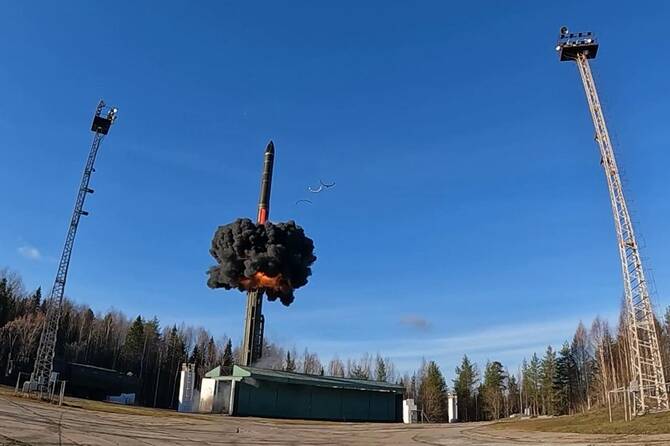
The last US-Russia nuclear pact expires, prompting fears of a new arms race

The termination of the New START Treaty could set the stage for what many fear could be an unconstrained nuclear arms race. (FILE/AFP)
Short Url
Updated 05 February 2026
Follow

The last US-Russia nuclear pact expires, prompting fears of a new arms race

  • China says expiration of US-Russia nuclear arms treaty regrettable

MOSCOW: The last remaining nuclear arms pact between Russia and the United States expired Thursday, removing any caps on the two largest atomic arsenals for the first time in more than a half-century.
The termination of the New START Treaty could set the stage for what many fear could be an unconstrained nuclear arms race.
Russian President Vladimir Putin last year declared readiness to stick to the treaty’s limits for another year if Washington follows suit, but US President Donald Trump has been noncommittal about extending it.
Putin discussed the pact’s expiration with Chinese leader Xi Jinping on Wednesday, Kremlin adviser Yuri Ushakov said, noting Washington hasn’t responded to his proposed extension.
Russia “will act in a balanced and responsible manner based on thorough analysis of the security situation,” Ushakov said.
Russia’s Foreign Ministry on Wednesday night said in a statement that “under the current circumstances, we assume that the parties to the New START Treaty are no longer bound by any obligations or symmetrical declarations within the context of the Treaty, including its core provisions, and are fundamentally free to choose their next steps.”
New START, signed in 2010 by then-President Barack Obama and his Russian counterpart, Dmitry Medvedev, restricted each side to no more than 1,550 nuclear warheads on no more than 700 missiles and bombers — deployed and ready for use. It was originally supposed to expire in 2021 but was extended for five more years.
The pact envisioned sweeping on-site inspections to verify compliance, although they stopped in 2020 because of the COVID-19 pandemic and never resumed.
In February 2023, Putin suspended Moscow’s participation, saying Russia couldn’t allow US inspections of its nuclear sites at a time when Washington and its NATO allies have openly declared Moscow’s defeat in Ukraine as their goal. At the same time, the Kremlin emphasized it wasn’t withdrawing from the pact altogether, pledging to respect its caps on nuclear weapons.
In offering in September to abide by New START’s limits for a year to buy time for both sides to negotiate a successor agreement, Putin said the pact’s expiration would be destabilizing and could fuel nuclear proliferation.
New START followed a long succession of US-Russian nuclear arms reduction pacts. Those have been terminated, as well.

China says expiration of US-Russia arms treaty regrettable

The Chinese foreign ministry said on Thursday that the expiration of the US-Russia arms treaty was regrettable, and urged the US to resume dialogue with Russia on “strategic stability.”

“China regrets ‌the ⁠expiration ​of ‌the New START Treaty, as the treaty is of great significance to maintaining global strategic stability,” Chinese foreign ministry spokesperson Lin Jian said.

“The international community is generally concerned that the expiration of the treaty will have a negative impact on the international nuclear arms control system and the global nuclear order.”

“China calls on ‌the United States to respond positively, handle ‍the treaty’s follow-up arrangements responsibly, ‍and resume strategic stability dialogue with Russia as soon as possible. This ‍is also the general expectation of the international community,” Lin said.

The Chinese foreign ministry reiterated that it adheres strictly to a self-defense nuclear strategy.

“China has consistently adhered to a self-defense nuclear strategy, abided by the policy of ​no first use of nuclear weapons and has made unconditional commitments not to use or threaten to use nuclear ⁠weapons against non-nuclear-weapon states or nuclear-weapon-free zones,” Lin said, adding that China keeps its arsenal at the minimum level needed for national security.

Lin added that its nuclear forces are far smaller than those of Washington and Moscow and reiterated it would not join their bilateral arms-reduction talks.

“China’s nuclear forces are not on the same level as those of the United States and Russia, and China will not participate in disarmament negotiations at this stage,” Lin said.


Tug of war: how US presidents battle Congress for military powers

Updated 5 sec ago
Follow

Tug of war: how US presidents battle Congress for military powers

  • The last official declaration of war by Congress was as far back as World War II

WASHINGTON, United States: Donald Trump’s unleashing of operation “Epic Fury” against Iran has once more underscored the long and bitter struggle between US presidents and Congress over who has the power to decide on foreign military action.
In his video address announcing “major combat” with the Islamic republic, Trump didn’t once mention any authorization or consultation with the US House of Representatives or Senate.
In doing so he sidelined not only Democrats, who called for an urgent war powers vote, but also his own Republican party as he asserts his dominance over a largely cowed legislature.
A US official said Secretary of State Marco Rubio had called top congressional leaders known as the “Gang of Eight” to give them a heads up on the Iran attack — adding that one was unreachable.
Rubio also “laid out the situation” and consulted with the same leaders on Tuesday in an hour-long briefing, the US official said.
According to the US Constitution, only Congress can declare war.
But at the same time the founding document of the United States first signed in 1787 says that the president is the “commander in chief” of the military, a definition that US leaders have in recent years taken very broadly.
The last official declaration of war by Congress was as far back as World War II.
There was no such proclamation during the unpopular Vietnam War, and it was then that Congress sought to reassert its powers.
In 1973 it adopted the War Powers Resolution, passed over Richard Nixon’s veto, to become the only lasting limit on unilateral presidential military action abroad.
The act allows the president to carry out a limited military intervention to respond to an urgent situation created by an attack against the United States.
In his video address on Saturday, Trump evoked an “imminent” threat to justify strikes against Iran.

- Sixty days -

Yet under this law, the president must still inform Congress within 48 hours.
It also says that if the president deploys US troops for a military action for more than 60 days, the head of state must then obtain the authorization of Congress for continued action.
That falls short of an official declaration of war.
The US Congress notably authorized the use of force in such a way after the September 11, 2011 attacks on the United States by Al-Qaeda. Presidents have used it over the past two decades for not only the 2001 invasion of Afghanistan but a series of operations in several countries linked to the “War on Terror.”
Trump is far from the first US president to launch military operations without going through Congress.
Democrat Bill Clinton launched US air strikes against Kosovo in 1999 as part of a NATO campaign, despite the lack of a green light from skeptical lawmakers.
Barack Obama did the same for airstrikes in Libya in 2011.
Trump followed their example in his first term in 2018 when he launched airstrikes in Syria along with Britain and France.
But since his return to power the 79-year-old has sought to push presidential power to its limits, and that includes in the military sphere.
Trump has ordered strikes on alleged drug trafficking boats in Latin America without consulting Congress, and in June 2025 struck Iran’s nuclear facilities.
Perhaps the most controversial act was when he ordered the capture of Venezuelan president Nicolas Maduro in a lightning military raid on January 3.
Republicans however managed to knock down moves by Democrats for a rare war powers resolution that would have curbed his authority over Venezuela operations.
Trump has meanwhile sought to extend his powers over the home front. Democrats have slammed the Republican for deploying the National Guard in several US cities in what he calls a crackdown on crime and immigration.