

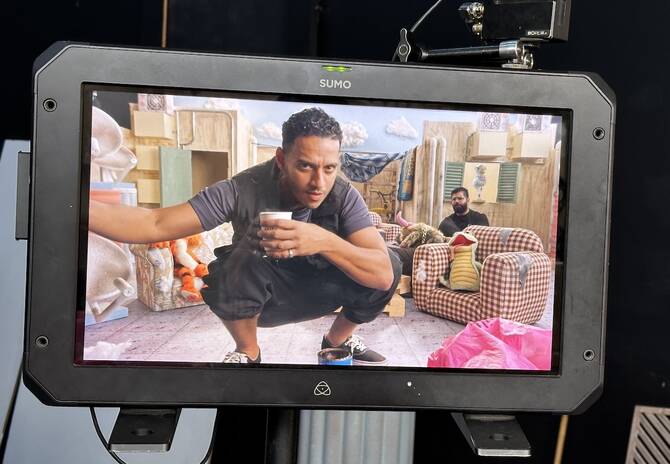

DUBAI: An AI-powered robot learning to pass as human — with guidance from a gang of misfit stray animals — is the focus of Saudi filmmaker Mohammed Hammad’s new dark-comedy series “Yallah, Yallah Beenah! The Official, Unofficial Guide Of How To Live In The Modern World.”
The show, slated for release early next year (a platform has still to be confirmed), leans into satire to examine everyday behavior, social performance and the pressure to keep up with trends, while keeping its tone playful.
Hammad tells Arab News the show evolved from a “short experimental art film” of the same name that he created for a group show — “Amakin” — organized by the Saudi Art Council in 2022.

Mohammed Hammad (in black top) on set. (Supplied)
“It was a mix of documentary, comedy, horror and satire,” he explains. “While making the film, through its experimental nature, something clicked, and I got the idea to turn this experimental film into something more commercially viable and suited for mass audiences, while still sharing the film’s satirical and experimental spirit.”
Hammad describes the series as “a mixed-media pop-cultural examination of how to live in the modern Saudi, inspired by meme culture and old-school cable TV.”
For Hammad, that mashup creates room for the show to move between moods — from goofy to unsettling — while still remaining grounded in real life.
At the center of the series is a robot being taught how to live as a human, which allows the story to reflect on the changes happening in Saudi society.

Rapper Slow Mo makes a cameo appearance in 'YYB.' (Supplied)
“As Saudi has gone through a major socio-economic shift in the past few years, it’s mainly about teaching the robot about how to keep up with the times in a light-hearted and fun satire about our past, present and future,” Hammad says. The robot becomes a stand-in for anyone trying to decode new rules, new language and new expectations, while the animals’ guidance pushes the comedy in unexpected directions.
Hamad co-wrote the show with Omar Bahabri. “Omar and I share a very similar humor and have great chemistry when it comes to writing the show,” he says. “We usually start generating ideas in a writer’s room for each episode with a few more collaborators. I would usually do a first pass at weaving the narrative together and arranging the structure of the episode. Omar would then revise and build on the first draft.”
The pair continue revising the scripts through filming, adding improvised lines on set as they work with the actors.
Comedy plays a central role in how Hammad approaches storytelling. “When we stop taking ourselves so seriously, we realize that a lot of human behavior is actually funny,” he says. “It’s OK to laugh at ourselves from time to time. It allows us to see where our flaws are.”

Cast members Salim Al-Attas, Najla Al-Abdullah, Yousef Al-Sheikh, Maria Al-Bar and Amro Al-Sabban on set in Wadi Al Naam. (Supplied)
The show is designed to connect with Saudi audiences while remaining accessible to those from outside of the country and the region.
“The show speaks to local audiences through the content and topics we explore, while it lends itself to a more global audience through the mixed media and aesthetics,” Hammad says.
Hammad’s time in cities including London, Paris, Dubai and Jeddah shaped both the writing and the worldview of the series.
“I’m very grateful to have lived in the places that I have. I’ve been exposed to a lot of film, art, music and life experiences that have not only shaped me as an artist but as a man,” he says. “‘YYB!’carries a bit of everything in that. It’s a compilation of my 15-plus years in the TV and film industry as well as life experience.
“The writing comes from lived experiences. A lot of the sketches are literally pulled from situations from family gatherings and just hanging out with friends,” Hammad adds.
The show shifts between different settings. “The pop-cultural inspiration of the show allows for the writing and content to travel naturally, as it’s inspired a lot by internet culture, which, in itself, is quite boundless,” the filmmaker says. The latest episode, for example, was filmed partly in Paris and AlUla.
“I couldn’t be happier to film an episode in AlUla, as the landscape is so picturesque and really added so much production value to the show,” he says.
Additional seasons of “YYB!” are already in production, according to Hammad. And as Saudi Arabia’s creative scene expands, he is motivated by the opportunity to do his part to shape its future.
“I’m excited just to be able to add my own perspective to the ever-growing identity of the scene,” he says. “Adding to the creative community here, and being able to collaborate with so many amazing, talented peers, and making something we can be proud of, is truly a privilege.”


