

China’s Xi calls for ‘equal, multipolar world’ as he meets Uruguay leader

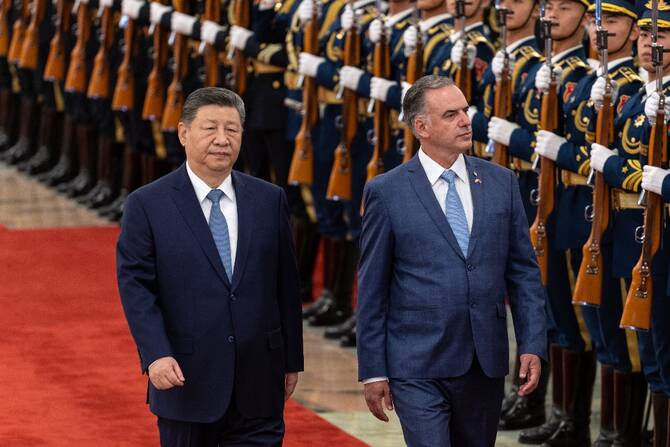
Uruguay's President Yamandu Orsi walks with Chinese President Xi Jinping during his state visit in Beijing, China. (AP)
Short Url
Updated 03 February 2026
Follow

China’s Xi calls for ‘equal, multipolar world’ as he meets Uruguay leader

  • Orsi’s visit is the first by a South American leader to the Chinese capital since the United States invaded Venezuela in January and captured then President Nicolas Maduro in a raid

BEIJING: China and Uruguay should should work together to advance an “equal and orderly multipolar world,” President Xi Jinping told his counterpart Yamandu Orsi on Tuesday, according to a media pool report.
Orsi’s visit is the first by a South American leader to the Chinese capital since the United States invaded Venezuela in January and captured then President Nicolas Maduro in a raid.
China and Uruguay should “work together to advance an equal and orderly multipolar world and an inclusive, universally beneficial economic globalization,” Xi said in ‌his remarks, aiming ‌to build a community with a shared future for ‌mankind.
The ⁠meeting ​comes ‌in the wake of a flurry of visits to China by Western leaders this year, from Britain’s Prime Minister Keir Starmer to Canadian Prime Minister Mark Carney and Finland’s Prime Minister Petteri Orpo.
Orsi said his visit aimed to “empower Uruguay in the world and generate opportunities, investment and development” in a Facebook comment on Sunday, following his arrival in Beijing.
He is leading a delegation of 150, including business leaders, on a visit that runs until February 7, which will ⁠also take in the commercial capital of Shanghai.
The timing is symbolically important for China, said Francisco Urdinez, a professor at ‌the Pontifical Catholic University of Chile.
“For Beijing, hosting Orsi ... signals ‍that South American countries remain eager to ‍engage, despite the increasingly polarized geopolitical environment.”
China was the top destination for Uruguayan exports ‍in 2025, taking agricultural products from wood pulp to soybeans and beef. Uruguay ran a trade surplus of $187.1 million with China in the first half of 2025.
The South American nation imports machinery, electronics and chemicals from China.

AGREEMENTS SIGNED, DEEPER COOPERATION PLEDGED
China and Uruguay signed a joint declaration to ​deepen a strategic partnership on Tuesday as well as 12 cooperation documents covering science, technology, environmental cooperation, exports and imports of meat and intellectual property.
Orsi said Uruguay ⁠would like to intensify “trade in goods, especially through diversification, and to invest much more strongly in the area of ​​trade in services and investment,” according to the pool report.
China and Uruguay’s strategic partnership “is going through its best moment,” he said, adding that it was the responsibility of both countries to “commit to raising it to a new level.”
While traditional export sectors like meat and soy have played a central role in the relationship, others such as dairy present considerable potential, said Dr. Diego Telias, a professor at the Universidad ORT Uruguay and an associate researcher at ICLAC, an institute that studies the impact of Chinese capital in Latin America.
A gap also remains in the area of service exports, he said, “an area in which Uruguay ‌has successfully engaged with markets such as the United States, the United Kingdom and Europe, but not yet with China.”


US military boards sanctioned oil tanker in Indian Ocean

Updated 3 sec ago
Follow

US military boards sanctioned oil tanker in Indian Ocean

  • Tanker tracking website says Aquila II departed the Venezuelan coast after US forces captured then-President Nicolás Maduro
  • Pentagon says it 'hunted' the vessel all the way from the Caribbean to the Indian Ocean
WASHINGTON: US military forces boarded a sanctioned oil tanker in the Indian Ocean after tracking the ship from the Caribbean Sea, the Pentagon said Monday.
The Pentagon’s statement on social media did not say whether the ship was connected to Venezuela, which faces US sanctions on its oil and relies on a shadow fleet of falsely flagged tankers to smuggle crude into global supply chains.
However, the Aquila II was one of at least 16 tankers that departed the Venezuelan coast last month after US forces captured then-President Nicolás Maduro, said Samir Madani, co-founder of TankerTrackers.com. He said his organization used satellite imagery and surface-level photos to document the ship’s movements.
According to data transmitted from the ship on Monday, it is not currently laden with a cargo of crude oil.
The Aquila II is a Panamanian-flagged tanker under US sanctions related to the shipment of illicit Russian oil. Owned by a company with a listed address in Hong Kong, ship tracking data shows it has spent much of the last year with its radio transponder turned off, a practice known as “running dark” commonly employed by smugglers to hide their location.
US Southern Command, which oversees Latin America, said in an email that it had nothing to add to the Pentagon’s post on X. The post said the military “conducted a right-of-visit, maritime interdiction” on the ship.
“The Aquila II was operating in defiance of President Trump’s established quarantine of sanctioned vessels in the Caribbean,” the Pentagon said. “It ran, and we followed.”
The US did not say it had seized the ship, which the US has done previously with at least seven other sanctioned oil tankers linked to Venezuela.
A Navy official, who spoke on condition of anonymity to discuss military operations, would not say what forces were used in the operation but confirmed the destroyers USS Pinckney and USS John Finn as well as the mobile base ship USS Miguel Keith were operating in the Indian Ocean.
In videos the Pentagon posted to social media, uniformed forces can be seen boarding a Navy helicopter that takes off from a ship that matches the profile of the Miguel Keith. Video and photos of the tanker shot from inside a helicopter also show a Navy destroyer sailing alongside the ship.
Since the US ouster of Maduro in a surprise nighttime raid on Jan. 3, the Trump administration has set out to control the production, refining and global distribution of Venezuela’s petroleum products. Officials in President Donald Trump’s Republican administration have made it clear they see seizing the tankers as a way to generate cash as they seek to rebuild Venezuela’s battered oil industry and restore its economy.
Trump also has been trying to restrict the flow of oil to Cuba, which faces strict economic sanctions by the US and relies heavily on oil shipments from allies like Mexico, Russia and Venezuela.
Since the Venezuela operation, Trump has said no more Venezuelan oil will go to Cuba and that the Cuban government is ready to fall. Trump also recently signed an executive order that would impose a tariff on any goods from countries that sell or provide oil to Cuba, primarily pressuring Mexico because it has acted as an oil lifeline for Cuba.