

Khartoum sees second commercial flight land since conflict began

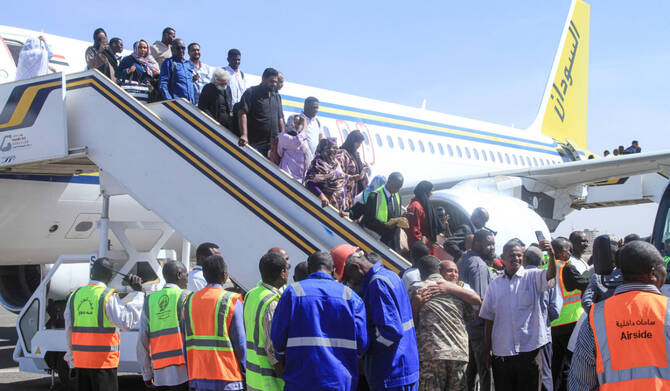
Passengers disembark from the first domestic Sudan Airways flight arriving from Port Sudan, after landing at Khartoum International Airport following a three-year hiatus, on February 1, 2026. (AFP)
Short Url
Updated 02 February 2026
Follow

Khartoum sees second commercial flight land since conflict began

  • The flight took off on Sunday morning from the eastern Red Sea city of Port Sudan, which had served as an interim seat for the government until the administration moved back to Khartoum earlier this year, SUNA said

CAIRO: A commercial flight landed in the Sudanese capital on Sunday for the second time since a devastating war broke out in the northeastern African country nearly three years ago.

The domestic flight, operated by the national flag carrier SudanAir, landed at the Khartoum International Airport on Sunday afternoon, according to the SUNA news agency.

The flight took off on Sunday morning from the eastern Red Sea city of Port Sudan, which had served as an interim seat for the government until the administration moved back to Khartoum earlier this year, SUNA said.

The reopening of the Khartoum International Airport was a crucial step in the government’s efforts to normalize life in the capital, which has been wrecked during the ongoing war between the military and the powerful paramilitary Rapid Support Forces.

Sunday’s flight was the second commercial flight to arrive in Khartoum since a flight operated by the privately owned Badr Airlines landed at the airport in October last year. At the time, the RSF launched drones at the airport to disrupt the government’s efforts to reopen the facility. The military retook Khartoum from the RSF earlier last year.

The war in Sudan began in April 2023 when a power struggle between the military and the RSF exploded into open fighting in Khartoum and elsewhere in the country. 

BACKGROUND

The reopening of the Khartoum International Airport was a crucial step in the government’s efforts to normalize life in the capital.

The airport was severely damaged in the first weeks of the war.

The devastating war has killed more than 40,000 people, according to UN figures, but aid groups say that is an undercount and the true number could be many times higher.

It created the world’s largest humanitarian crisis with over 14 million people forced to flee their homes.

It fueled disease outbreaks and pushed parts of the country into famine.


Sudan paramilitary advances near Ethiopia border

Updated 04 February 2026
Follow

Sudan paramilitary advances near Ethiopia border

  • Sudan’s Kordofan region, where the SPLM-N has its other foothold in the Nuba Mountains, is currently the war’s fiercest battleground

KHARTOUM: Sudanese paramilitary forces have advanced on army positions near the southeastern border with Ethiopia, according to the group and an eyewitness who spoke to AFP Wednesday.
Control over Sudan’s southeastern Blue Nile State, bordering both Ethiopia and South Sudan, is split between the army and a faction of the Sudan People’s Liberation Movement-North, allies of the paramilitary Rapid Support Forces.
In a statement released Tuesday, the SPLM-N, led by Abdelaziz Al-Hilu, said they had “liberated the strategic city of Deim Mansour and areas of Bashir Nuqu and Khor Al-Budi.”
Since April 2023, the Sudanese army has been at war with the RSF. In February of last year, the RSF announced a surprise alliance with the SPLM-N, securing experienced fighters, land and border access.
Deim Mansour lies between the SPLM-N stronghold Yabus, birthplace of their deputy commander Joseph Tuka, and the army-held town of Kurmuk, which hosts a large army contingent.
Babiker Khaled, who fled to Kurmuk, told AFP that SPLM-N fighters began amassing in the forests around Deim Mansour on Sunday.
“The shelling began on Monday, they entered the city on Tuesday,” he said, adding that “some people fled into Ethiopia, others arrived in Kurmuk.”
From its foothold in the southern Blue Nile, a thin strip of land jutting south between Ethiopia and South Sudan, the SPLM-N maintains reported supply lines from both countries, building on decades-old links.
Close to three years of war in Sudan have left tens of thousands dead and around 11 million displaced, creating the world’s largest hunger and displacement crises.
It has also torn the country apart, with the army holding the center, north and east of Sudan while the RSF and its allies dominate the west and parts of the south.
Sudan’s Kordofan region, where the SPLM-N has its other foothold in the Nuba Mountains, is currently the war’s fiercest battleground.
On Tuesday, the army broke a paramilitary siege on South Kordofan state capital Kadugli, days after breaking another on the nearby city of Dilling.