Pakistan urged to shift climate finance to local level as weather risks intensify

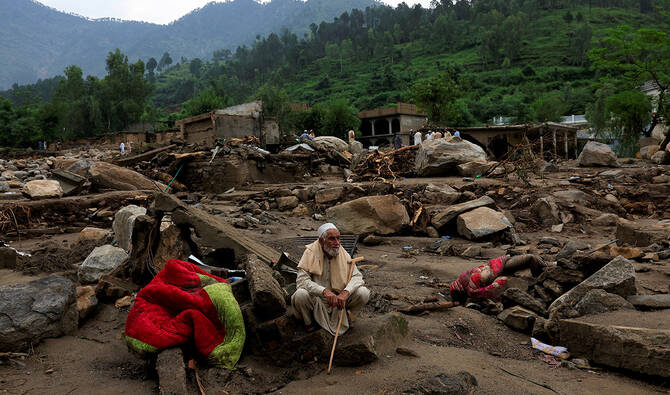
Nasir Khan, 81, sits amid the remains of damaged houses following a storm that caused heavy rains and flooding, in Bayshonai Kalay, Buner district, Khyber Pakhtunkhwa province, Pakistan, August 17, 2025. (Reuters/File)
Short Url
Updated 31 January 2026
Follow

Pakistan urged to shift climate finance to local level as weather risks intensify

  • Khurram Schehzad says climate governance must be brought closer to vulnerable communities
  • Pakistan faces mounting climate shocks despite contributing less than 1% to global emissions

KARACHI: Pakistan needs to move climate finance closer to local governments to protect communities from increasingly severe weather shocks, a senior government adviser said on Saturday, as policymakers warned that centralized approaches were failing to reach those most exposed.

Pakistan has been facing increasingly erratic weather patterns, including frequent heatwaves, unprecedented rains, storms, cyclones, floods and droughts.

The country has stepped up efforts to strengthen national climate resilience following devastating floods in 2022 and 2025 that displaced millions, destroyed infrastructure and farmland and caused multibillion-dollar economic losses.

Khurram Schehzad, adviser to the finance minister, emphasized the importance of decentralizing climate action by examining the role of local governments in climate finance during a panel discussion held at the Institute of Business Administration in Karachi.

“There is an urgent need to shift climate governance and climate finance closer to the communities most exposed to climate risks,” he said, according to a statement circulated after the discussion.

“While global climate discourse often focuses on pledges and frameworks, climate resilience is ultimately built through execution, access to finance and delivery at the local level,” he added.

The discussion focused on how cities and districts could be empowered to design and bankroll locally grounded adaptation projects and bridge gaps between national climate commitments and on-the-ground delivery.

Panelists said Pakistan’s climate response must move beyond strategy documents toward practical financing mechanisms that enable households, farmers, small businesses and local administrations to invest in resilience.

Schehzad highlighted several pathways, including climate-smart agricultural lending for smallholders, energy transition finance for households and micro-enterprises, affordable climate-resilient housing, results-based financing instruments and risk-sharing frameworks to de-risk private investment.

Participants also pointed to structural challenges, including planning bottlenecks and limited fiscal space at the local level, calling for reforms to simplify approval processes for small-scale adaptation projects.


Pakistan Air Force conducts ‘Exercise Golden Eagle’ to test combat readiness, agility

Updated 10 February 2026
Follow

Pakistan Air Force conducts ‘Exercise Golden Eagle’ to test combat readiness, agility

  • The exercise follows an intense, four-day Pakistan-India military conflict in May 2025
  • It focused on AI-enabled operations integrating disruptive technologies, military says

ISLAMABAD: The Pakistan Air Force (PAF) has conducted “Exercise Golden Eagle” that successfully validated its combat readiness and operational agility through synchronized employment of the PAF’s complete combat potential, the Pakistani military said on Tuesday.

It comes months after Pakistan’s four-day military conflict with India in May, with Islamabad claiming victory in the standoff after the PAF claimed to have shot down at least six Indian fighter aircraft, including the French-made Rafale. New Delhi acknowledged some losses but did not specify a number.

The exercise was conducted on a Two-Force construct, focusing on AI-enabled, net-centric operations while integrating indigenous niche, disruptive and smart technologies in line with evolving regional security dynamics, according to the Inter-Services Public Relations (ISPR), the Pakistani military’s media wing.

Operating within a robust Integrated Air Defense System, friendly forces shaped the battlespace through seamless fusion of kinetic operations with cyber, space and electro-magnetic spectrum operations.

“The kinetic phase featured First-Shoot, First-Kill swing-role combat aircraft equipped with long-range BVR air-to-air missiles, extended-range stand-off weapons and precision strike capabilities, supported by Airborne Early Warning & Control platforms and Air-to-Air Refuelers,” the ISPR said in a statement.

“A key highlight of the exercise was Manned–Unmanned Teaming, with deep-reach killer drones and loitering munitions operating in a highly contested, congested and degraded environment, validating PAF’s capability to conduct high-tempo operations in modern warfare.”

In recent months, many countries have stepped up defense engagement with Pakistan, while delegations from multiple nations have proposed learning from the PAF’s multi-domain air warfare capabilities that officials say were successfully employed during the May conflict.

“The successful conduct of Exercise Golden Eagle reaffirms Pakistan Air Force’s unwavering commitment to maintaining a high state of operational preparedness, leveraging indigenous innovation and effectively countering emerging and future security challenges,” the ISPR added.