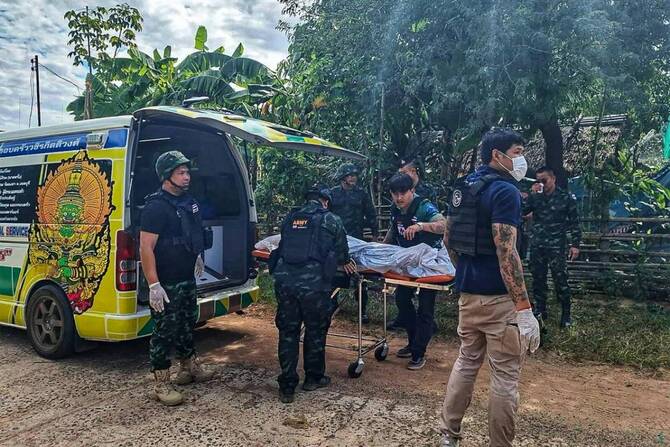
BANGKOK: A military plane crashed in a forested area of northern Thailand during a training flight on Thursday, killing the two pilots on board, the air force said.
“Two pilots died in an aircraft accident involving a light attack aircraft AT-6TH this morning during training,” air force spokesman Jackkrit Thammanvichai said.
The two-seater plane crashed in Chiang Mai province at around 10:20 am (0320 GMT) during a combat search and rescue training mission, the air force said in a statement.
The crash “did not affect local residents or cause damage to civilian property,” the statement said.
Authorities were investigating the cause of the crash and had deployed to the scene, it added.
Six Thai police officers were killed in April last year when a small plane crashed into the sea during a parachute training drill near a resort town south of the capital Bangkok.

Thai military plane crash kills two pilots
Short Url
https://arab.news/gf8qd
Thai military plane crash kills two pilots
- The two-seater plane crashed in Chiang Mai province
Palestinian protester, detained for nearly a year, says ‘inhumane’ jail conditions prompted seizure
A Palestinian woman who has been held in an immigration jail for nearly a year after she attended a protest in New York City said she suffered a seizure after fainting and hitting her head last week, an episode she linked to “filthy” and “inhumane” conditions inside the privately run detention facility.
Leqaa Kordia, 33, was hospitalized for three days following the seizure, which she said was the first of her life. She has since returned to the Prairieland Detention Facility in Texas, where she has been held since March.
In a statement released through her lawyers on Thursday, Kordia said she was shackled the entire time she was hospitalized and prevented from calling family or meeting with her lawyers.
“For three days in the emergency room, my hands and legs were weighed down by heavy chains as they drew my blood and gave me medications,” Kordia said. “I felt like an animal. My hands are still full of marks from the heavy metal.”
Her doctors, she said, told her the seizure may have been the result of poor sleep, inadequate nutrition and stress. Her lawyers previously warned that Kordia, a devout Muslim, had lost 49 pounds (22 kilograms) and fainted in the shower, in part because the jail had denied her meals that comply with religious requirements.
“I’ve been here for 11 months, and the food is so bad it makes me sick,” the statement continued. “At Prairieland, your daily life — whether you can have access to the food or medicine you need or even a good night’s sleep — is controlled by the private, for-profit business that runs this facility.”
Department of Homeland Security spokesperson Tricia McLaughlin didn’t immediately respond to a request for comment from The Associated Press, but said in a statement to The New York Times that Kordia wasn’t being mistreated and was receiving proper medical care.
A resident of New Jersey who grew up in the West Bank, Kordia was among around 100 people arrested outside Columbia University during protests at the school in 2024.
The charges against her were dismissed and sealed. But information about her arrest was later given to the Trump administration by the New York City police department, which said it was told the records were needed as part of a money laundering investigation.
Last year, Kordia was among the first pro-Palestinian protesters arrested in the Trump administration’s crackdown on noncitizens who had criticized Israel’s military actions in Gaza. She is the only one who remains jailed.
She has not been accused of a crime and has twice been ordered released on bond by an immigration judge. The government has challenged both rulings, an unusual step in cases that don’t involve serious crimes, which triggers a lengthy appeals process.
Kordia was taken into custody during a March 13 check-in with US Immigrations and Customs Enforcement. At the time, federal officials touted her arrest as part of the sweeping crackdown on pro-Palestinian campus activists, pointing to her 2024 arrest outside of Columbia as proof of “pro-Hamas” activities.
Kordia said she joined the demonstration after Israel killed scores of her relatives in Gaza, where she maintains deep personal ties. “My way of helping my family and my people was to go to the streets,” she told The Associated Press in October.
Federal officials have accused Kordia of overstaying her visa, while casting scrutiny on payments she sent to relatives in the Middle East. Kordia said the money was meant to help family members whose homes were destroyed in the war or were otherwise suffering.
An immigration judge later found “overwhelming evidence” that Kordia was telling the truth about the payments. Attorneys for Kordia say she was previously in the US on a student visa, but mistakenly surrendered that status after applying to remain in the country as the relative of a US citizen.
In her statement on Thursday, Kordia said the detention facility was “built to break people and destroy their health and hope.”
“The best medicine for me and everyone else here is our freedom,” she added.
Leqaa Kordia, 33, was hospitalized for three days following the seizure, which she said was the first of her life. She has since returned to the Prairieland Detention Facility in Texas, where she has been held since March.
In a statement released through her lawyers on Thursday, Kordia said she was shackled the entire time she was hospitalized and prevented from calling family or meeting with her lawyers.
“For three days in the emergency room, my hands and legs were weighed down by heavy chains as they drew my blood and gave me medications,” Kordia said. “I felt like an animal. My hands are still full of marks from the heavy metal.”
Her doctors, she said, told her the seizure may have been the result of poor sleep, inadequate nutrition and stress. Her lawyers previously warned that Kordia, a devout Muslim, had lost 49 pounds (22 kilograms) and fainted in the shower, in part because the jail had denied her meals that comply with religious requirements.
“I’ve been here for 11 months, and the food is so bad it makes me sick,” the statement continued. “At Prairieland, your daily life — whether you can have access to the food or medicine you need or even a good night’s sleep — is controlled by the private, for-profit business that runs this facility.”
Department of Homeland Security spokesperson Tricia McLaughlin didn’t immediately respond to a request for comment from The Associated Press, but said in a statement to The New York Times that Kordia wasn’t being mistreated and was receiving proper medical care.
A resident of New Jersey who grew up in the West Bank, Kordia was among around 100 people arrested outside Columbia University during protests at the school in 2024.
The charges against her were dismissed and sealed. But information about her arrest was later given to the Trump administration by the New York City police department, which said it was told the records were needed as part of a money laundering investigation.
Last year, Kordia was among the first pro-Palestinian protesters arrested in the Trump administration’s crackdown on noncitizens who had criticized Israel’s military actions in Gaza. She is the only one who remains jailed.
She has not been accused of a crime and has twice been ordered released on bond by an immigration judge. The government has challenged both rulings, an unusual step in cases that don’t involve serious crimes, which triggers a lengthy appeals process.
Kordia was taken into custody during a March 13 check-in with US Immigrations and Customs Enforcement. At the time, federal officials touted her arrest as part of the sweeping crackdown on pro-Palestinian campus activists, pointing to her 2024 arrest outside of Columbia as proof of “pro-Hamas” activities.
Kordia said she joined the demonstration after Israel killed scores of her relatives in Gaza, where she maintains deep personal ties. “My way of helping my family and my people was to go to the streets,” she told The Associated Press in October.
Federal officials have accused Kordia of overstaying her visa, while casting scrutiny on payments she sent to relatives in the Middle East. Kordia said the money was meant to help family members whose homes were destroyed in the war or were otherwise suffering.
An immigration judge later found “overwhelming evidence” that Kordia was telling the truth about the payments. Attorneys for Kordia say she was previously in the US on a student visa, but mistakenly surrendered that status after applying to remain in the country as the relative of a US citizen.
In her statement on Thursday, Kordia said the detention facility was “built to break people and destroy their health and hope.”
“The best medicine for me and everyone else here is our freedom,” she added.
© 2026 SAUDI RESEARCH & PUBLISHING COMPANY, All Rights Reserved And subject to Terms of Use Agreement.