

Survival in Gaza ‘on the edge,’ living conditions ‘brutal’ despite easing of hunger, UN officials warn

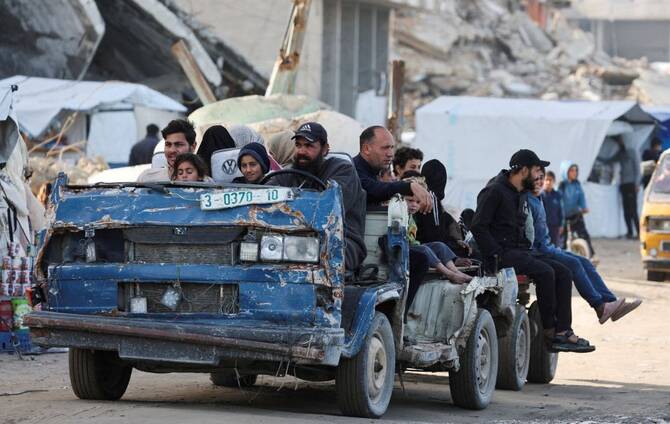
Hussein Liwa, a displaced Palestinian, transports residents in his war-damaged vehicle, Gaza City, Jan. 25, 2026. (Reuters)
Short Url
Updated 26 January 2026
Follow

Survival in Gaza ‘on the edge,’ living conditions ‘brutal’ despite easing of hunger, UN officials warn

  • ‘The situation remains extremely precarious … Having an entire population living on the brink is just not acceptable,’ says UNICEF deputy executive director
  • ‘Hundreds of thousands of people are shivering in fabric tents that don’t keep the heat in or the rain out,’ adds World Food Programme deputy executive director

NEW YORK CITY: Survival in Gaza remains “on the edge” and the conditions there are “extremely brutal,” senior UN officials said on Monday, despite some easing of the situation compared with last year.

They warned that the entire population of the battered enclave is living on the brink, in what they described as an unacceptable situation. Urgent decisions are needed to ensure humanitarian access remains open, and to prevent fragile gains from being reversed they added.

“The situation remains extremely precarious, with survival at the edge,” the deputy executive director of UNICEF, Ted Chaiban, told reporters after returning from a visit to Gaza and the West Bank.

“Having an entire population living on the brink is just not acceptable.”

Carl Skau, the World Food Programme’s deputy executive director, who accompanied Chaiban on the visit, said the living conditions for hundreds of thousands of displaced people were “just brutal,” with families sheltering in flimsy tents or heavily damaged buildings in Gaza as winter storms batter the territory.

“Hundreds of thousands of people are shivering in fabric tents that don’t keep the heat in or the rain out,” Skau said.

“I met a woman, who had given birth just 10 days earlier, sitting on a wet mattress in a cold tent on the beach. It was absolutely brutal.”

Both officials said the situation had improved compared with a year ago, when Gaza was on the brink of famine, but stressed that the gains were fragile and could easily be reversed.

“The ceasefire has allowed us to rein in famine,” Skau said. “Most people I spoke to were eating at least once a day. But there is still a very long way to go. The situation is extremely fragile.”

Chaiban said that more aid and commercial goods were entering Gaza and the availability of food had improved, but he warned that the humanitarian crisis remained deadly, for children in particular.

“More than 100 children have been reported killed since the ceasefire,” he said, adding that about 100,000 youngsters are still acutely malnourished and require long-term care.

About 1.3 million people, many of them children, still lack proper shelter, Chaiban added, as families continue to live in flimsy tents or bombed-out buildings, exposed to heavy rain, strong winds and freezing temperatures.

At least 10 children reportedly have died of hypothermia since winter began.

“It really is miserable in those tents,” Chaiban said.

Skau said hundreds of thousands of people remain displaced, unable to return to homes that had been reduced to rubble, and struggling to survive with little protection from the elements.

“I spoke to a woman who had lost her husband, most of her relatives and her home,” he said. “She was left with four children and absolutely nothing.”

Both officials highlighted moments of resilience amid the devastation, including children who had returned to learning and families who were attempting to rebuild fragments of normal life, but said such signs of hope should not obscure the sheer scale of the ongoing suffering.

“The gains we’ve made can easily be reversed,” Skau said. “So much more needs to be done now.”

Both of the officials said further progress would depend on the continuation of the ceasefire agreement and predictable humanitarian access, including the opening and sustained operation of multiple border crossings, and routes into and within Gaza. Aid workers need safe conditions in which to operate at scale, they added.

Shelter remains the most urgent need as winter storms continue; Skau said the immediate priority was to “flood the strip with shelter,” while Chaiban said decisions were urgently needed to ensure access for essential supplies and to restore basic services.

The coming weeks will be critical, Chaiban said, adding: “We have a window to change the trajectory for children in Gaza. We can’t waste it.”


Trump says change of power in Iran would be ‘best thing’

Updated 35 min 31 sec ago
Follow

Trump says change of power in Iran would be ‘best thing’

  • Trump’s comments were his most overt call yet for the toppling of Iran’s clerical establishment
  • USS Gerald R. Ford — the world’s largest warship — would be “leaving very soon” for the Middle East

WASHINGTON: US President Donald Trump said Friday that a change of government in Iran would be the “best thing that could happen,” as he sent a second aircraft carrier to the Middle East to ratchet up military pressure on the Islamic republic.

Trump’s comments were his most overt call yet for the toppling of Iran’s clerical establishment, and came as he pushes on Washington’s arch-foe Tehran to make a deal to limit its nuclear program.

At the same time, the exiled son of the Iranian shah toppled in the 1979 Islamic revolution renewed his calls for international intervention following a bloody crackdown on protests by Tehran.

“Seems like that would be the best thing that could happen,” Trump told reporters at the Fort Bragg military base in North Carolina when a journalist asked if he wanted “regime change” in Iran.

Trump declined to say who he would want to take over in Iran from supreme leader Ayatollah Ali Khamenei, but he added that “there are people.”

He has previously backed off full-throated calls for a change of government in Iran, warning that it could cause chaos, although he has made threats toward Khamenei in the past.

Speaking earlier at the White House, Trump said that the USS Gerald R. Ford — the world’s largest warship — would be “leaving very soon” for the Middle East to up the pressure on Iran.

“In case we don’t make a deal, we’ll need it,” Trump said.

The giant vessel is currently in the Caribbean following the US overthrow of Venezuela’s Nicolas Maduro. Another carrier, the USS Abraham Lincoln, is one of 12 US ships already in the Middle East.

‘Terribly difficult’

When Iran began its crackdown on protests last month — which rights groups say killed thousands — Trump initially said that the United States was “locked and loaded” to help demonstrators.

But he has recently focused his military threats on Tehran’s nuclear program, which US forces struck last July during Israel’s unprecedented 12-day war with Iran.

The protests have subsided for now but US-based Reza Pahlavi, the son of Iran’s last shah, urged international intervention to support the Iranian people.

“We are asking for a humanitarian intervention to prevent more innocent lives being killed in the process,” he told the Munich Security Conference.

It followed a call by the opposition leader, who has not returned to his country since before the revolution, for Iranians at home and abroad to continue demonstrations this weekend.

Videos verified by AFP showed people in Iran this week chanting anti-government slogans as the clerical leadership celebrated the anniversary of the Islamic revolution.

Iran and the United States, who have had no diplomatic relations since shortly after the revolution, held talks on the nuclear issue last week in Oman. No dates have been set for new talks yet.

The West fears the program is aimed at making a bomb, which Tehran denies.

The head of the UN nuclear watchdog, Rafael Grossi, said Friday that reaching an accord with Iran on inspections of its processing facilities was possible but “terribly difficult.”

Reformists released

Trump said after talks with Israeli Prime Minister Benjamin Netanyahu earlier this week that he wanted to continue talks with Iran, defying pressure from his key ally for a tougher stance.

The Israeli prime minister himself expressed skepticism at the quality of any agreement if it didn’t also cover Iran’s ballistic missiles and support for regional proxies.

According to the US-based Human Rights Activists News Agency, 7,008 people, mostly protesters, were killed in the recent crackdown, although rights groups warn the toll is likely far higher.

More than 53,000 people have also been arrested, it added.

The Norway-based Iran Human Rights (IHR) NGO said “hundreds” of people were facing charges linked to the protests that could see them sentenced to death.

Figures working within the Iranian system have also been arrested, with three politicians detained this week from the so-called reformist wing of Iranian politics supportive of President Masoud Pezeshkian.

The three — Azar Mansouri, Javad Emam and Ebrahim Asgharzadeh — were released on bail Thursday and Friday, their lawyer Hojjat Kermani told the ISNA news agency.
