

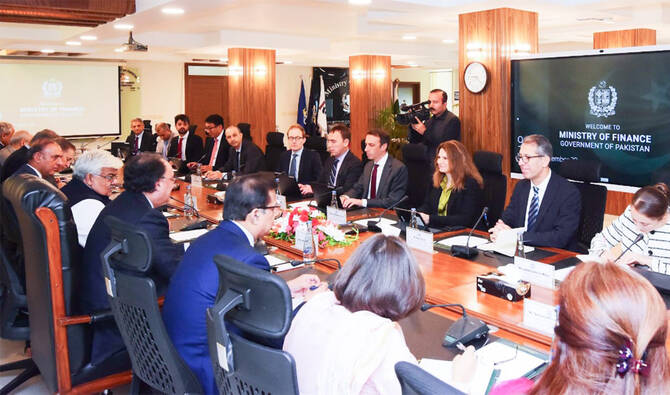
IMF discussing electricity tariffs revisions with Pakistan

Pakistan’s finance minister Muhammad Aurangzeb (fourth in left row) holds a meeting with the visiting IMF delegation in Islamabad, Pakistan, on September 29, 2025. (Finance Ministry/File)
Short Url
Updated 14 February 2026
Follow

IMF discussing electricity tariffs revisions with Pakistan

  • Pakistan announced proposed tariff overhaul which analysts said would lift inflation while easing pressure on industry
  • The talks come as Islamabad seeks to meet conditions under its $7 billion bailout with ⁠another review of program ‌approaching

KARACHI: The International Monetary Fund is discussing proposed electricity tariff revisions with ​Pakistan authorities, the fund said in a statement to Reuters on Saturday, adding that the burden of the revisions should not fall on middle- or lower-income households.

“The ongoing discussions with the authorities will assess whether the proposed tariff revisions are ‌consistent with these commitments ‌and evaluate their ​potential ‌impact ⁠on ​macroeconomic stability, including ⁠inflation,” it said in its statement.

Pakistan announced proposed tariff overhaul which analysts said would lift inflation while easing pressure on industry, as it seeks to meet conditions under its $7 billion Extended Fund Facility (EFF) as ⁠another review of the program ‌approaches.

The EFF is ‌a longer-term IMF loan program ​designed to help countries ‌address deep-seated economic weaknesses and medium-term balance-of-payments ‌problems.

Electricity carries significant weight in Pakistan’s consumer price index, making tariff adjustments highly sensitive at a time when inflation, though sharply lower than ‌its near-40 percent peak in 2023, remains a key political and economic pressure point.

Pakistan’s ⁠power ⁠sector has long been weighed down by circular debt — a chain of unpaid bills and subsidies that builds up across generation companies, distributors and the government — prompting repeated tariff increases under IMF-backed reforms since 2023.

The accumulation of power sector circular debt has been contained within program targets, supported by improved performance on recoveries and ​loss prevention, the ​Fund added.


Pakistan weekly inflation rises 5.19% year on year as Ramadan begins

Updated 10 sec ago
Follow

Pakistan weekly inflation rises 5.19% year on year as Ramadan begins

  • Out of 51 items, prices of 17 items increased, 12 items decreased and 22 remained stable
  • The Sensitive Price Index for the week ending on Feb. 19 increased by 1.16 percent, data shows

KARACHI: Short-term inflation, measured by the Sensitive Price Index (SPI), rose 5.19 percent year-on-year in the week ending Feb 19, the statistics bureau said on Friday, reflecting higher prices of perishable food items at the start of Ramadan.

The SPI, which comprises 51 essential items collected from 50 markets in 17 cities, is computed on a weekly basis to assess the price movement of essential commodities at a shorter interval of time to review the price situation in the country.

The SPI for the week ending on Feb. 19 increased by 1.16 percent, the year-on-year trend depicted an increase of 5.19 percent, according to the Pakistan Bureau of Statistics (PBS) data.

The development came as the holy fasting month of Ramadan began in the South Asian country on Feb. 19, which often sees an increase of prices of fruit, vegetables and other necessary items.

“During the week, out of 51 items, prices of 17 (33.33%) items increased, 12 (23.53%) items decreased and 22 (43.14%) items remained stable,” the PBS said.

Major increase was observed in the prices of Bananas (16.05%), Electricity Charges for Q1 (15.41%), Garlic (5.86%), Chicken (5.49%), Onions (3.83%), Tomatoes (3.82%), Diesel (2.69%), Petrol (1.93%), Beef (1.03%), LPG (0.75%), Mutton (0.69%) and Long Cloth (0.28%), according to the PBS.

The items whose prices decreased included Eggs (11.78%), Potatoes (2.24%), Wheat Flour (2.02%), Pulse Masoor (1.47%), Sugar (0.96%), Vegetable Ghee 2.5Kg (0.72%), Pulse Gram (0.58%), Cooking Oil 5 Litre (0.19%), Gur (0.16%), Vegetable Ghee 1Kg (0.11%), Rice (0.08%) and Mustard Oil (0.07%).