

Bangladesh Islamist party concedes defeat in election

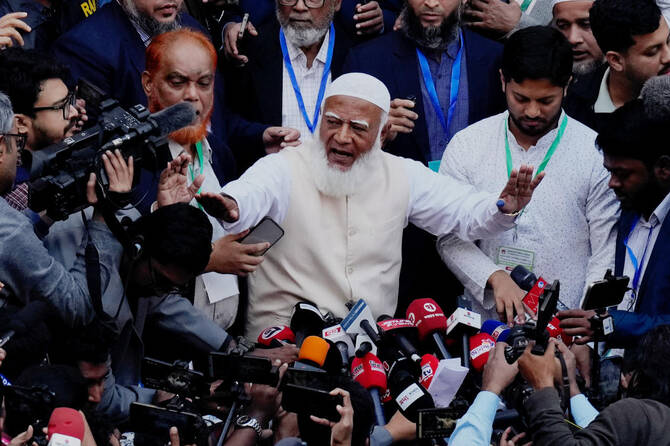
Jamaat-e-Islami leader Shafiqur Rahman, center, meets the press after casting his vote the national parliamentary election in Dhaka, Bangladesh on Feb. 12, 2026. (AP)
Short Url
Updated 14 February 2026
Follow

Bangladesh Islamist party concedes defeat in election

  • Jamaat chief Shafiqur Rahman: ‘We recognize the overall outcome, and we respect the rule of law’
  • Bangladesh interim leader congratulates Tarique Rahman on ‘landslide victory’

DHAKA: Bangladesh’s largest Islamist party Jamaat-e-Islami said Saturday it had accepted the “overall outcome” of the election won by the rival nationalist party, despite earlier having alleged problems with the vote count.

The elections on Thursday were the first since the deadly 2024 uprising, and Election Commission figures showed the Bangladesh Nationalist Party (BNP) had won a landslide victory.

Jamaat chief Shafiqur Rahman, 67, had said on Friday he would “seek redress” from the commission, with his party alleging “inconsistencies and fabrications.”

But on Saturday, he conceded defeat.

“In any genuine democratic journey, the true test of leadership is not only how we campaign, but how we respond to the verdict of the people,” Rahman said in a statement.

“We recognize the overall outcome, and we respect the rule of law.”

Interim leader Muhammad Yunus congratulated BNP leader Tarique Rahman on “the landslide victory of his party” as he prepared to step down and hand over power to the elected government.

The 85-year-old Nobel Peace Prize winner, who has led Bangladesh as its “chief adviser” since the August 2024 uprising, said in a statement that Tarique Rahman “would help guide the country toward stability, inclusiveness, and development.”

The BNP alliance won 212 seats compared with 77 for the Jamaat-led alliance, according to the Electoral Commission.

Shafiqur Rahman said Jamaat would take part in parliament.

“We will serve as a vigilant, principled, and peaceful opposition, holding the government to account,” he said.

“Our commitment to principled, peaceful politics remains unshaken.”

He noted the huge leap in seats the Islamists had won compared to past elections — including when they were crushed under the autocratic tenure of ousted former prime minister Sheikh Hasina.

“Our movement has never been about a single election. It is about strengthening democratic culture, protecting citizens’ rights, and building a just and accountable state,” Jamaat’s Rahman added.

“With 77 seats, we have nearly quadrupled our parliamentary presence and become one of the strongest opposition blocs in modern Bangladeshi politics. That is not a setback. That is a foundation.”

South Korea calls for resuming dialogue with North

Updated 51 min 30 sec ago
Follow

South Korea calls for resuming dialogue with North

  • President Lee Jae Myung has sought to mend ties with the nuclear-armed North since taking office in June
  • North Korean leader Kim Jong Un last week dashed hopes of a diplomatic thaw with Seoul

SEOUL: South Korean President Lee Jae Myung called on Sunday for dialogue with North Korea to resume, after Pyongyang last week shunned the prospect of diplomacy with its neighbor.
Since taking office in June, a dovish Lee has sought to mend ties with the nuclear-armed North, which reaffirmed its anti-Seoul approach during a party meeting last week.
“As my administration has repeatedly made clear, we respect the North’s system and will neither engage in any type of hostile acts, nor pursue any form of unification by absorption,” Lee said in a speech marking the anniversary of a historical campaign against Japan’s colonial rule.
“We will also continue our efforts to resume dialogue with the North,” he said.
North Korean leader Kim Jong Un last week dashed hopes of a diplomatic thaw with Seoul, describing its overtures as “clumsy, deceptive farce and a poor work.”
Speaking at the party congress in Pyongyang, Kim said North Korea has “absolutely no business dealing with South Korea, its most hostile entity, and will permanently exclude South Korea from the category of compatriots.”
But he also said the North could “get along well” with the United States if Washington acknowledges its nuclear status.
Speculation has mounted over whether US President Donald Trump will seek a meeting with Kim during planned travels to China.
Last year, Trump said he was “100 percent” open to a meeting.
Previous Trump-Kim summits during the US president’s first term fell apart after the pair failed to agree over sanctions relief — and what nuclear concessions North Korea might make in return.