

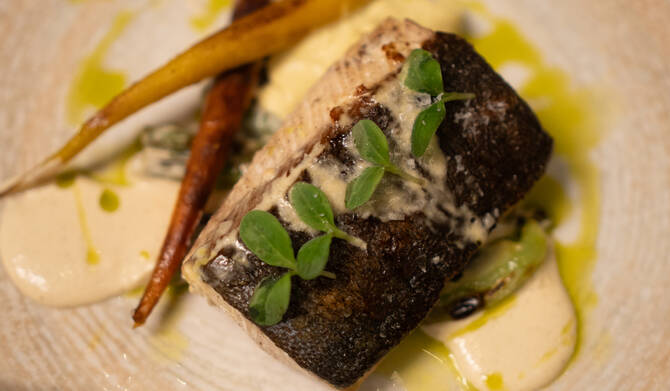
The grilled seabass was simple but cleanly prepared, with a subtle saffron emulsion that didn’t overpower the fish
Updated 26 January 2026
Afshan Aziz
Orient Restaurant at Rixos Obhur Resort & Villas brings a new dining perspective to the city, drawing on Turkiye’s culinary heritage and the history of the Silk Road.
The concept is evident from the moment guests enter the restaurant, where traditional Turkish flavors are presented with a contemporary touch, and the ambiance reflects the region’s history of trade and cultural exchange.
The menu is broad, featuring cold starters such as haydari, strained yogurt with herbs, and babaganus, smoked aubergine with tahini and olive oil. These dishes are straightforward and well-prepared, with fresh flavors and a clear attention to balance.
For the hot starters, we tried items like halloumi with pomegranate molasses and fried calamari with garlic aioli, which felt original and consistent with the cold dishes in preparation. Some items, however, such as the spiced beef borek, can feel heavy if ordered in multiple quantities.
For the main courses, I tried a range of meats and seafood. The testi kebabi — a clay-pot lamb stew with apricot and thyme — was carefully cooked, with the lamb tender and well-flavored.
The grilled seabass was simple but cleanly prepared, with a subtle saffron emulsion that didn’t overpower the fish.
I also ordered the ali nazik and kuzu sis, both of which were nicely seasoned and had good texture, though the adana kebab was less flavorful than I expected and could have used more spice.
The side dishes were straightforward. We opted for the bulgur pilaf and butter rice to accompany the mains, though they didn’t particularly add anything to the meal.
After finishing the savory dishes, although we were full, we decided to try the desserts. We went with baklava, kunefe, and sutlac, all executed consistently, though they offered few surprises in flavor or presentation.
This is a good place to celebrate a special occasion with its fine-dining setting or simply spend some quality time, enjoying cocktails or traditional Turkish coffee.
ALKHOBAR: Sourdough has started to shift from a niche interest into a mainstream feature of home kitchens, cafes and specialty bakeries across the Kingdom.
The rise of sourdough is part of a wider shift in Saudi Arabia’s food landscape, where artisanal production and slower preparation methods are gaining traction.
Specialty coffee seems to have set the early template for this transition, normalizing premium pricing, craftsmanship and an interest in process.
The rise of sourdough is part of a wider shift in Saudi Arabia’s food landscape, where artisanal production and slower preparation methods are gaining traction. (Supplied/creativecommons)
Bread is now undergoing a similar shift, with fermentation replacing extraction and roasting as the central point of differentiation.
In both cases, the appeal is rooted in the product’s perceived authenticity, reduced additives, and a clearer link between raw ingredients and final consumption.
Home bakers in Riyadh, Jeddah and the Eastern Province have adapted natural yeast cultures to the Saudi environment, adjusting feeding schedules, hydration ratios, and fermentation times to accommodate higher temperatures and lower humidity in the summer months.
HIGHLIGHTS
• Home bakers in Riyadh, Jeddah and the Eastern Province have adapted natural yeast cultures to the Saudi environment.
• They adjust feeding schedules, hydration ratios, and fermentation times to accommodate higher temperatures and lower humidity in the summer months.
Cafes and specialty bakeries have responded by adding sourdough loaves, baguettes and focaccia to their menus, often positioned as premium alternatives to conventional commercial bread.
For younger home bakers, the appeal lies in the craft and the learning curve rather than nostalgia. “It feels more real and more intentional,” home baker Sarah Al-Almaei told Arab News. She began experimenting with natural yeast at home after watching starter tutorials online.
The technical aspect — hydration percentages, fermentation control and starter maintenance — has become content in its own right, with TikTok and Instagram compressing trial-and-error learning into short videos and recipe cards.
But the practice of maintaining a natural yeast culture is not new in Saudi Arabia. Long before sourdough became a global trend, Saudi households kept what was commonly referred to as the “mother dough,” a natural yeast starter fed and used daily.
“We used to maintain it every day and bake with it,” said Hessa Al-Otaibi, 56, a Saudi home baker with more than four decades’ experience. “People today call it sourdough. For us, it was simply bread.”
Her comment highlights a cultural continuity that has remained largely unrecognized, partly because the practice was not framed as artisanal or health-oriented, but as a routine household function.
The modern sourdough trend differs in its market positioning. While the older model was practical and domestic, the current model is commercial, aesthetic and often health-coded. Bakeries justify higher pricing through longer fermentation times, higher ingredient costs and smaller batch production.
Consumers justify their purchases through digestibility, perceived health benefits, flavor and product integrity.
“Once you get used to it, it’s hard to go back,” said Amina Al-Zahrani, a regular buyer of sourdough from specialty bakeries in Alkhobar.
Digestibility and texture are often cited as reasons for substitution, especially among buyers who report discomfort from standard commercial bread.
Another consumer, Majda Al-Ansari, says sourdough has become part of her weekly routine, noting that availability and quality have improved significantly in the past year.
The social media component has played an outsized role in accelerating adoption. Home bakers document starter feeding cycles, cold proofing and first bakes, turning a once-private domestic process into visible public content.
This has also created micro-markets of home-based sellers, where individual bakers offer loaves to local buyers, often fulfilling orders through direct messaging.
What remains to be seen is how far the trend will scale. If specialty bakeries continue to expand and consumers maintain willingness to pay premium prices, sourdough could establish a long-term place in Saudi food culture.
If not, it may revert to a smaller niche of committed home bakers and specialty cafes. For now, however, sourdough occupies an unusual position: both a newly fashionable trend and a quiet continuation of an older Saudi baking practice.
