

Ivory Coast cocoa growers rue ‘curse of brown gold’

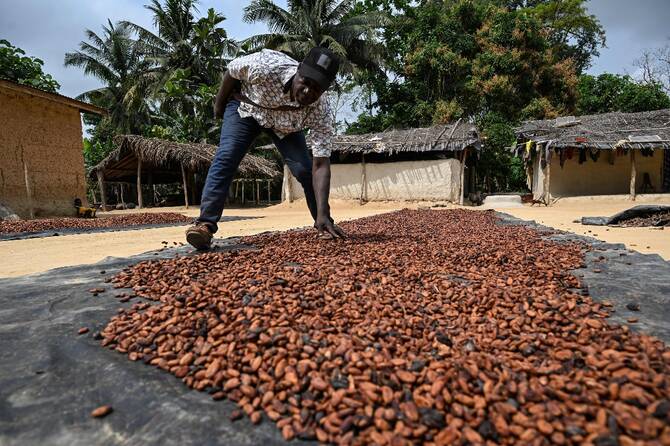
A cocoa producer sun-dries beans in Betykro, a camp of cocoa producers living in precarious conditions 20 km from Guiglo, Ivory Coast. (AFP)
Short Url
Updated 26 January 2026
Follow

Ivory Coast cocoa growers rue ‘curse of brown gold’

  • In its last report on the sector in 2019, the World Bank estimated that more than half (54.9 percent) of cocoa producers lived on less than 757 CFA francs ($1.36) a day

GUIGLO: Laurent Kone’s wattle-and-daub house, with its tarpaulin roof and no electricity, lies down a bumpy red-earth track in western Ivory Coast.
For 30 years, he has been growing cocoa and is typical of the smallholders who have been the backbone in making the west African country the world’s leading producer of the crop.
But the country currently faces major difficulties in selling its cocoa, hit by a slowdown in exports amid buyers’ liquidity problems and a drop in global prices.
For growers who were already battling to eke out a living, the situation has only added to their plight.
In its last report on the sector in 2019, the World Bank estimated that more than half (54.9 percent) of cocoa producers lived on less than 757 CFA francs ($1.36) a day.
“I started planting in 1996 and I still don’t have a roof because there’s no money,” 54-year-old Kone told AFP at his home, 20 kilometers (12 miles) from the city of Guiglo.
“It’s not dignified,” he said.
The Ivorian government insists that conditions for growers are a priority and, following a rise in global prices, increased the amount it pays to producers to a record 2,800 CFA francs per kilogramme.
“Producers are standing tall and are able to eat their fill, find housing, get medical treatment, enjoy the benefits of electricity and drinking water, and send their children to school and university,” said in October the country’s agriculture minister, Kobenan Kouassi Adjoumani, who was replaced in a government reshuffle on Friday.
But, with the recent fall in exports, the hike in the price paid to producers has not had the desired effect.
Some growers say they have not been paid in months.

- ‘Increasingly vulnerable’ -

Near Kone’s house in Betykro, about 50 families live without electricity or a mobile phone network and share a single pump for water.
The nearest medical clinic is 10 km away along a rough track and, according to many growers, the universal health coverage put in place by the state does not adequately cover health care costs.
“We’re disappointed,” said 64-year-old village chief Boniface Djabia, sounding dejected.
“The farmers are the poorest people in Ivory Coast,” he added, showing his threadbare clothes.
Farmers are “increasingly vulnerable,” said Oscar Toukpo, a sociologist at Felix Houphouet Boigny University in Abidjan.
He blamed lower yields due to soil exhaustion and the rising cost of living.
“Smallholders run up debts with cooperatives and sellers of crop protection products to try to improve production” and this worsens the cycle of poverty, he added.
In his field, just a stone’s throw from his house, Kone still works only with a machete and wears open-toed shoes.
“A bag of fertilizer costs 22,000 CFA francs but there’s no money,” he said.
Maintaining production volume still depends on expanding plantations.
But the strategy is limited, as Ivory Coast has already lost 90 percent of its forest cover in 60 years.

- Despondency -

According to the World Bank, productivity in Ivorian cocoa groves has stagnated in the past 20 years, at about 450 to 550 kilograms per hectare.
The global lender said the cocoa sector was not fulfilling its role as a driver of economic development and suggested that some see “brown gold” as a “curse” due to the destruction of forests and persistent poverty.
Additionally, Ivory Coast receives only six percent of the profits from the global cocoa industry.
In recent years, the government has invested in cocoa processing facilities to transform the raw material on site.
To get by, some producers are diversifying by planting oil palms or hevea trees used to make rubber, which, unlike cocoa’s seasonal harvest, produce 11 months of the year.
“We manage with the rubber plantations,” said Alidou Traore, a 24-year-old farmer who has taken over his father’s land.
In his village, a few kilometers from Kone’s, the houses look sturdier.
But despondency is setting in. “The current situation with cocoa doesn’t give me any motivation,” he added.
“I don’t want my children to be planters like me,” added Kone. “It’s a life of suffering.”


Anger as branch of ICE to help with security at Winter Olympics

Updated 27 January 2026
Follow

Anger as branch of ICE to help with security at Winter Olympics

ROME: A branch of the US Immigration and Customs Enforcement (ICE) will help with security for the Winter Olympics in Italy, it confirmed Tuesday, sparking anger and warnings they were not welcome.
Reports had been circulating for days that the agency embroiled in an often brutal immigration crackdown in the United States could be involved in US security measures for the February 6-22 Games in northern Italy.
In a statement overnight to AFP, ICE said: “At the Olympics, ICE’s Homeland Security Investigations (HSI) is supporting the US Department of State’s Diplomatic Security Service and host nation to vet and mitigate risks from transnational criminal organizations.
“All security operations remain under Italian authority.”
It’s not known whether the HSI has in the past been involved in the Olympics, or whether this is a first.
According to the ICE website, the HSI investigates global threats, investigating the illegal movement of people, goods, money, contraband, weapons and sensitive technology into, out of, and through the United States.
ICE made clear its operations in Italy were separate from the immigration crackdown, which is being carried out by the Enforcement and Removal Operations (ERO) department.
“Obviously, ICE does not conduct immigration enforcement operations in foreign countries,” it said.
The protection of US citizens during Olympic Games overseas is led by the State Department’s Diplomatic Security Service (DSS).
Yet the outrage over ICE immigration operations in the United States is shared among many in Italy, following the deaths of two civilians during an immigration crackdown in Minneapolis.
The leftist mayor of Milan, which is hosting several Olympic events, said ICE was “not welcome.”
“This is a militia that kills... It’s clear that they are not welcome in Milan, there’s no doubt about it, Giuseppe Sala told RTL 102.5 radio.
“Can’t we just say no to (US President Donald) Trump for once?“
Alessandro Zan, a member of the European Parliament for the center-left Democratic Party, condemned it as “unacceptable.”
“In Italy, we don’t want those who trample on human rights and act outside of any democratic control,” he wrote on X.

Monitoring Vance 

Italian authorities initially denied the presence of ICE and then sought to downplay any role, suggesting they would help only in security for the US delegation.
US Vice President JD Vance and Secretary of State Marco Rubio are attending the opening ceremony in Milan on February 6.
On Monday, the president of the northern Lombardy region, said their involvement would be limited to monitoring Vance and Rubio.
“It will be only in a defensive role, but I am convinced that nothing will happen,” Attilio Fontana told reporters.
However, his office then issued a statement saying he did not have any specific information on their presence, but was responding to a hypothetical question.
Interior Minister Matteo Piantedosi was quoted as saying late Monday that “ICE, as such, will never operate in Italy.”
The International Olympic Committee when contacted by AFP about the matter replied: “We kindly refer you to the USOPC (the United States Olympic and Paralympic Committee).”
Thousands of ICE agents have been deployed by President Donald Trump in various US cities to carry out a crackdown on illegal immigration.
Their actions have prompted widespread protests, and the recent killings of US citizens Renee Good and Alex Pretti, both 37, on the streets of Minneapolis sparked outrage.