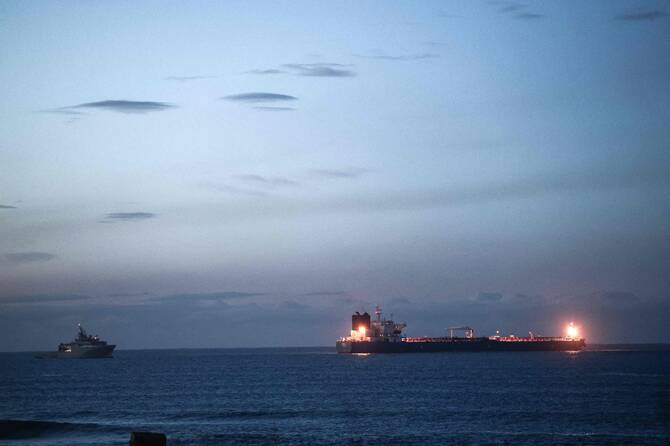
MARTIGUES: An oil tanker seized by France in the Mediterranean and suspected of being part of Russia’s sanction-busting “shadow fleet” lay anchored Sunday near a southern French port and guarded by the French navy.
The Grinch was intercepted Thursday morning in international waters between Spain and North Africa.
The French navy escorted it to the Gulf of Fos in southern France, the regional maritime prefecture said in a statement on Saturday.
The vessel will be kept at the disposal of the Marseille public prosecutor as part of a preliminary investigation for failure to fly a flag, it added. The captain and crew will also be questioned, according to a source close to the case.
The tanker was at anchor about 500 meters off the town of Martigues, an AFP photographer observed on Sunday morning. A French navy ship and two gendarmerie patrol boats were stationed nearby.
The prefecture said nautical and air exclusion zones had been established around the anchorage site.
Some 598 vessels suspected of belonging to the shadow fleet are under European Union sanctions.
Authorities said the 249 meter long Grinch appears under that name on a UK sanctions list of Russian shadow fleet vessels, but as Carl on lists compiled by the EU and the United States.
The operation is the second of its kind in recent months.
France in late September detained a Russian-linked ship called the Boracay, a vessel claiming to be flagged in Benin, a move Russian President Vladimir Putin condemned as “piracy.”
The Boracay’s Chinese captain is to stand trial in France in February.

Suspected Russia shadow tanker anchored off French coast
https://arab.news/c36ht
Suspected Russia shadow tanker anchored off French coast
- Authorities said the 249 meter long Grinch appears under that name on a UK sanctions list of Russian shadow fleet vessels
Only 4% women on ballot as Bangladesh prepares for post-Hasina vote
- Women PMs have ruled Bangladesh for over half of its independent history
- For 2026 vote, only 20 out of 51 political parties nominated female candidates
DHAKA: As Bangladesh prepares for the first election since the ouster of its long-serving ex-prime minister Sheikh Hasina, only 4 percent of the registered candidates are women, as more than half of the political parties did not field female candidates.
The vote on Feb. 12 will bring in new leadership after an 18-month rule of the caretaker administration that took control following the student-led uprising that ended 15 years in power of Hasina’s Awami League party.
Nearly 128 million Bangladeshis will head to the polls, but while more than 62 million of them are women, the percentage of female candidates in the race is incomparably lower, despite last year’s consensus reached by political parties to have at least 5 percent women on their lists.
According to the Election Commission, among 1,981 candidates only 81 are women, in a country that in its 54 years of independence had for 32 years been led by women prime ministers — Hasina and her late rival Khaleda Zia.
According to Dr. Rasheda Rawnak Khan from the Department of Anthropology at Dhaka University, women’s political participation was neither reflected by the rule of Hasina nor Zia.
“Bangladesh has had women rulers, not women’s rule,” Khan told Arab News. “The structure of party politics in Bangladesh is deeply patriarchal.”
Only 20 out of 51 political parties nominated female candidates for the 2026 vote. Percentage-wise, the Bangladesh Socialist Party was leading with nine women, or 34 percent of its candidates.
The election’s main contender, the Bangladesh Nationalist Party, whose former leader Zia in 1991 became the second woman prime minister of a predominantly Muslim nation — after Pakistan’s Benazir Bhutto — was the party that last year put forward the 5 percent quota for women.
For the upcoming vote, however, it ended up nominating only 10 women, or 3.5 percent of its 288 candidates.
The second-largest party, Jamaat-e-Islami, has not nominated a single woman.
The 4 percent participation is lower than in the previous election in 2024, when it was slightly above 5 percent, but there was no decreasing trend. In 2019, the rate was 5.9 percent, and 4 percent in 2014.
“We have not seen any independent women’s political movement or institutional activities earlier, from where women could now participate in the election independently,” Khan said.
“Real political participation is different and difficult as well in this patriarchal society, where we need to establish internal party democracy, protection from political violence, ensure direct election, and cultural shifts around female leadership.”
While the 2024 student-led uprising featured a prominent presence of women activists, Election Commission data shows that this has not translated into their political participation, with very few women contesting the upcoming polls.
“In the student movement, women were recruited because they were useful, presentable for rallies and protests both on campus and in the field of political legitimacy. Women were kept at the forefront for exhibiting some sort of ‘inclusive’ images to the media and the people,” Khan said.
“To become a candidate in the general election, one needs to have a powerful mentor, money, muscle power, control over party people, activists, and locals. Within the male-dominated networks, it’s very difficult for women to get all these things.”


