

‘Many killed’ as fresh conflict in South Sudan displaces 180,000

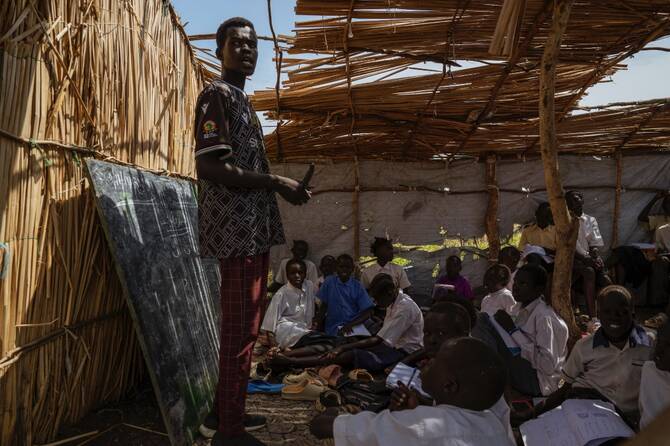
Students attend a lesson in a classroom outside the Renk Transit Center in Renk, South Sudan. (AFP)
Short Url
Updated 25 January 2026
Follow

‘Many killed’ as fresh conflict in South Sudan displaces 180,000

  • Violence is once again on the rise between rival factions, currently focused on Jonglei state north of the capital Juba

JUBA: Renewed fighting in South Sudan has displaced more than 180,000 people, with witnesses describing indiscriminate use of barrel bombs and civilians fleeing into swamps as the country’s fragile peace unravels.
The world’s youngest country has been beset by war, poverty and massive corruption since it was formed in 2011, but violence is once again on the rise between rival factions, currently focused on Jonglei state north of the capital Juba.
“I am stuck and if worse comes, the only safe place for me to go is the swamps,” said Daniel Deng, 35, one of thousands displaced by fighting in Jonglei, speaking to AFP by phone.
He described heavy fighting last week in Duk county where he lives, after opposition forces took control only to be driven out by government troops.
“Many people were killed,” said Deng, estimating the number at around 300 fighters, which could not be verified by AFP.
A power-sharing agreement between the two main factions is all but dead after President Salva Kiir moved against his vice president and long-time rival, Riek Machar, who was arrested last March and is now on trial for “crimes against humanity.”
Their forces have fought several times over the past year, but the most sustained clashes began in late December in Jonglei.
South Sudanese authorities estimate the number of displaced at more than 180,000 across four counties of Jonglei, the UN humanitarian agency OCHA said this week.
“Most people are settling under trees. Their homes and health facilities have been looted or burned and there is a lot of hunger,” said Deng.

- ‘Indiscriminate attacks’ -

Kiir and Machar fought a five-year war shortly after independence that claimed 400,000 lives. A 2018 power-sharing deal kept the peace for some years, but plans to hold elections and merge their armies did not materialize.
The fighting in Jonglei began in December in an area called Piri, said an NGO source in Juba, speaking on condition of anonymity.
He said the government responded with “indiscriminate” air attacks, including the use of barrel bombs on civilians. It considers the local population “hostile” and has ordered them to leave areas under opposition control, he said.
Another NGO source said barrel bombs had landed within 100-200 meters of health facilities.
“There have been different kinds of threats coming from both sides,” the source said.
Many have fled to the state capital, Bor.
Much of Jonglei has been “designated as red zones meaning no humanitarian access, no flights... People continue to flee and the number in Bor keeps on increasing day and night,” a local civil society leader, Bol Deng Bol, said by phone.
“We are seeing mobilization and build-up of military from both sides, a sign that escalation is imminent,” he added.
Estimating the death toll is impossible, he said, because many locals were still hiding “in the bush.”
“Looting and confiscation of humanitarian assets, reportedly by both parties, have forced the suspension of essential health services for thousands,” the UN’s OCHA said in a situation report.

- ‘Kids will die’ -

South Sudan has major oil reserves, but vast corruption has left it among the poorest countries in the world, with nearly 7.7 million of its estimated 12 million citizens in a state of hunger, according to World Food Programme figures last April.
Doctors Without Borders (MSF) has struggled to supply teams on the ground in Jonglei, leading to “catastrophic” shortages, said operations manager Gul Badshah, based in Nairobi.
“We don’t have the supplies... Kids will die, it’s as simple as that,” he said.
Clashes have also been reported in the Upper Nile and Central Equatoria states in recent months.
Senior opposition leader Wisley Welebe Samsona called Monday for a march on Juba to “remove the anti-peace regime.”
“What we are witnessing in Jonglei is not an isolated security incident; it is a dangerous escalation which is manifesting in other parts of the country as well,” said Barney Afako, a member of the UN Commission on Human Rights in South Sudan, in a statement.
“The actions in Jonglei could put the country into another dangerous spiral of violence,” he warned.


Thailand heads to polls with voters demanding ‘real change’

Updated 4 sec ago
Follow

Thailand heads to polls with voters demanding ‘real change’

  • Millennials, Generation Z make up around 46.5 percent of Thailand’s eligible voters
  • Voters will also decide on whether to rewrite current military-backed constitution

BANGKOK: Thai voters will head to the polls on Sunday after cycling through three prime ministers in less than three years, with the three-way contest of major parties set to decide the leader of the Southeast Asian nation over the next four years.

For the first time in the country’s history, nearly 53 million eligible voters in the kingdom of 71 million people will choose 500 lawmakers and also decide whether to rewrite the constitution.

The snap election was called in December by Anutin Charnvirakul, Thailand’s third premier since the 2023 election, who dissolved the House of Representatives to preempt a looming no-confidence vote.

More than 5,000 candidates from 57 parties are registered to take part in the polls, which will directly elect 400 lawmakers based on constituencies, while 100 others will be chosen from “party list” nominees, who gain seats according to each party’s proportional share of the vote.

Together, they will constitute the 500 members of the House of Representatives who will select the prime minister.

“This election is a gamble on the future of Thailand. Over the past decade, I have never seen the country move backward as much as it has,” Lawan Sarovat, a 60-year-old resident of Bangkok, told Arab News.

Thailand has been struggling with prolonged political uncertainty and a series of challenges, including an economy stuck at about 2 percent growth for the past five years and a border conflict with Cambodia last year that killed more than 100 people and cost at least $436 million.

“We want to see change. We had hoped that the previous election would bring about real change, but that did not happen. This time, people must try to make their voices heard in every possible way,” Sarovat said.

Main contenders

Sunday’s vote pits incumbent Prime Minister Charnvirakul’s Bhumjaithai party, which is backed by Thailand’s royalist conservative establishment, with the progressive youth-led People’s Party and Pheu Thai, a once-dominant party associated with now-jailed former premier Thaksin Shinawatra.

A nationwide survey by the National Institute of Development Administration put People’s Party leader Natthaphong Ruengpanyawut in first place for prime minister at over 29 percent, followed by Anutin at more than 22 percent.

The People’s Party was also a leading choice in terms of party preference, chosen by more than 33.5 percent of the January survey’s 2,500 respondents, while Bhumjaithai and Pheu Thai came second and third with about 22.7 percent and 16.9 percent, respectively.

The People’s Party is the successor to the group that won the last election — Move Forward — but was blocked from power, despite winning the greatest number of seats in the House of Representatives with the support of 14 million Thais.

It was eventually dissolved by the Constitutional Court over its proposals to revise the country’s strict royal insult laws.

“Elections in Thailand are not simply about citizens voting to choose a government. They are surrounded by multiple factors,” Thai senator Tewarit Maneechai told Arab News.

Even after securing popular support, Thai political parties must gain acceptance from a network of independent bodies established under the current constitution, including the Senate, the Constitutional Court, and the National Anti-Corruption Commission.

These institutions, Maneechai said, continue to function as mechanisms of the old power structure that has dominated Thailand’s political direction since the 2014 military coup.

Under this system, even an elected government can be removed from office at any time. Maneechai pointed to the case of Paetongtarn Shinawatra, ex-premier from the Pheu Thai Party, who was removed from office in August 2025 following a ruling by the Constitutional Court — a decision that raised public concerns over the expanding authority of independent agencies.

“There are surrounding factors that determine whether a government can actually be formed. Political parties that are able to govern are those that operate within the rules designed by the group that came to power through the coup,” Maneechai said.

Constitutional referendum

On Sunday, voters will also decide if a new constitution should replace a military-backed 2017 charter.

The ballot will simply ask voters if they “approve that there should be a new constitution,” with options of “Yes,” “No,” or “No opinion.”

The referendum needs more than 17 million votes in favor to become “a mandate that the entire country must heed,” Maneechai said.

“The referendum matters because even if a party wins the election, its ability to remain in power ultimately depends on independent mechanisms under the current constitution, which have the authority to remove a prime minister and destabilize a government.”

Though a majority “Yes” would kickstart a multi-stage drafting process, it will require two more referendums before a new charter could be adopted.

Change vs. status quo

Jamza Jongkham is among many Thai voters hoping that the election will lead to a constitutional reform.

“Right now, Thai politics is operating under rules controlled by an authoritarian camp that dominates the entire system, overriding political parties elected by the people,” he told Arab News.

The 27-year-old said what happened to the Move Forward party in 2023 was “fundamentally unfair,” and despite anger at how powerful politicians misuse power, he still has hopes in the younger generation.

Together, millennials and Generation Z make up around 46.5 percent of Thailand’s eligible voters.

“I still believe that people’s voices matter. If we choose to remain silent and do not exercise our right to vote, I believe Thailand will only become worse. There are still many people who want to see this country move in a better direction,” he said.

“If we can change the system so that everyone can participate in politics on an equal footing, I believe Thailand would become a far more just society.”

Puangthong Pawakapan, a political scientist at Chulalongkorn University, said Sunday’s vote is unlikely to serve as a decisive turning point in Thai politics, but rather reflect “an increasingly intense political struggle” between the public and entrenched power structures.

“This election has divided both those in power and the public into two clear sides — those who want change and those who want to preserve the status quo,” she told Arab News.

“Today, the public clearly sees that Thailand’s political and economic problems are rooted in an old power structure that is extremely difficult to change.”