

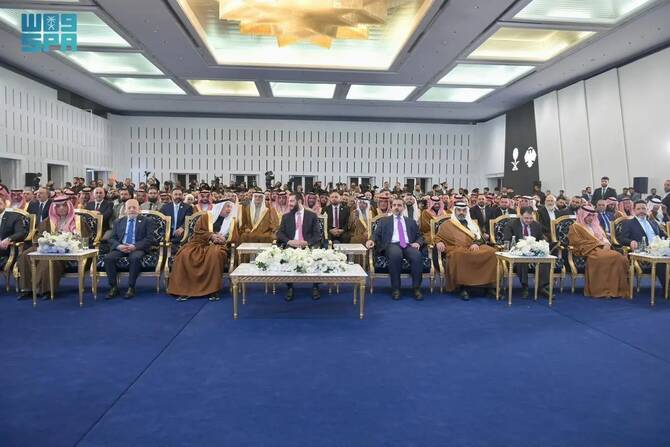

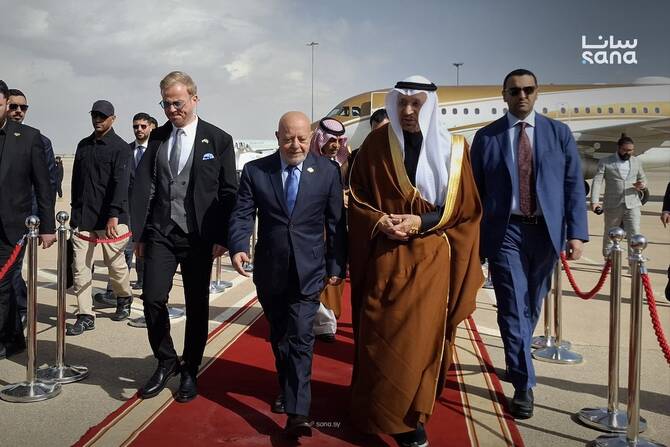


DAMASCUS: Minister of Investment Khalid Al-Falih led a high-level Saudi delegation from the public and private sectors to a ceremony marking the signing of a series of strategic contracts between leading Saudi companies and Syrian government entities.
The agreements aim to strengthen economic cooperation between the two countries and were signed during an official visit to Damascus.
Syrian President Ahmed Al-Sharaa received the Saudi delegation at the outset of the visit. In addition to the Minister of Investment, the delegation included Minister of Communications and Information Technology Abdullah Alswaha, President of the General Authority of Civil Aviation (GACA) Abdulaziz Al-Duailej, as well as representatives from Saudi ministries and companies. The meeting underscored the importance of strengthening bilateral relations and enhancing economic and investment cooperation to serve mutual interests and advance sustainable development.
The visit witnessed the signing of several strategic contracts in aviation, communications, infrastructure, and development initiatives. A series of high-level meetings was also held to discuss investment prospects and strengthen partnerships in priority sectors.
Al-Falih affirmed that the agreements mark a new phase in economic cooperation between Saudi Arabia and Syria. He said they reflect the commitment of both leaderships to moving investment partnerships from understanding to implementation, thereby supporting shared interests and sustainable growth.
He explained that the projects will contribute to developing Syria’s strategic infrastructure, expanding quality investment opportunities across key sectors, supporting economic development, creating jobs, and stimulating private-sector participation. He reiterated the Kingdom’s commitment to advancing investment partnerships that promote stability and prosperity in both countries.
During the signing ceremony, Al-Falih delivered a speech in the presence of the Syrian President, stating: “What we are witnessing today in economic relations between Saudi Arabia and Syria is the result of a long history of reciprocal visits and continuous engagement at both the governmental and private levels. These efforts have consolidated the foundations of partnership, built mutual trust, and paved the way for this pivotal moment in the history of economic relations.”
Among the most prominent agreements was the Aleppo Airport Project Agreement between the Syrian Civil Aviation Authority and a Saudi investment consortium led by BinDawood Holding Group. The agreement marks the Elaf Fund’s first investment and aims to develop the new Aleppo International Airport, operate and upgrade the existing airport during the development phase, and finance an integrated navigation radar system covering Syrian airspace.
The aviation sector also saw the signing of an agreement to establish a Saudi-Syrian airline between the Syrian Civil Aviation Authority and Saudi Arabia’s Flynas. The agreement aims to launch commercial and cargo services.
In telecommunications, a Telecommunications Infrastructure Agreement was signed between the Syrian Ministry of Communications and Information Technology and the Saudi Telecom Company (stc). The agreement aims to upgrade Syria’s infrastructure through fiber-optic expansion and data-center development, enhance internet services, and position Syria as a regional hub for data transmission and international connectivity.
In the water sector, the Syrian Ministry of Energy signed an agreement with Saudi companies ACWA Power and Water Transmission Company. The agreement provides for conducting economic, technical, and financial studies and identifying solutions for a seawater desalination project with an estimated capacity of 1.2 million cubic meters per day, along with associated water transport facilities.
In the industry, the Syrian Sovereign Fund and Riyadh Cables Group signed an agreement to operate and develop the Syrian Modern Cables Company. The agreement focuses on modernizing factories, localizing technical expertise, and building capacity in the energy and electrical cable sectors.
Another agreement was signed to develop the national platform for vocational, technical, and technological training and rehabilitation. The agreement was signed between the Syrian Ministry of Economy and Industry and the e-learning and training company Semanoor. It aims to strengthen training systems and enhance workforce readiness to meet labor-market needs.
A framework agreement was also signed between the charity and development committee of the Saudi-Syrian Business Council and the Syrian Development Fund.
The visit began with the Saudi delegation opening the Saudi-Syrian Business Council meeting. The Syrian Ministry of Economy and Industry also announced the formation of the Syrian representation to the council, including its executive and private-sector coordination structure.
The visit concluded with an affirmation of continued joint efforts to explore new sectoral opportunities and enhance the investment environment, serving mutual interests and strengthening the strategic partnership between the Saudi Arabia and Syria.


