


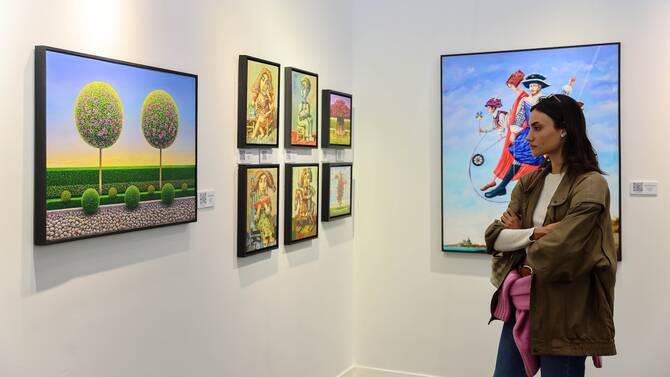

CAIRO: Staged at the Grand Egyptian Museum, Art Cairo has returned with a stellar showcase of galleries from the Middle East and beyond.
This year’s edition is running under the theme “Arab. Art. Here,” inspired by Palestinian poet Mahmoud Darwish’s words: “This is my language, my miracle, my magic wand.”
Set to run from Jan. 23-26, the fair features a strong showing from galleries in Egypt, the Levant and the Gulf, with a handful of booths from Europe.

Art Cairo is set to run from Jan. 23-26. (Supplied)
From Egypt, exhibitors include Zamalek Art Gallery, Mashrabia Gallery of Contemporary Art, Gallery Misr, Villa Azad, Le Lab. by Mark Hachem, Maya Art Space, Arame Art Gallery, and ZAAT.
KAF Art Gallery will represent the Lebanese art scene, while Jordan’s participating galleries include Wadi Finan Art Gallery and Orfali Art Gallery.
Gulf-based galleries taking part in Art Cairo include Salwa Zeidan Gallery from Abu Dhabi, Fann A Porter from Dubai and Folk Art Space from Bahrain, while northern Europe’s showing includes Galerie SANAA from the Netherlands and Quartum Galleri from Norway.

The fair features a strong showing from galleries in Egypt, the Levant and the Gulf, with a handful of booths from Europe. (Supplied)
Set across three halls, the fair features a mix of wall-based canvas works and sculptures, with Cairo-based Zahwa Art Gallery showcasing both.
One standout, large-scale work at the gallery’s booth comes courtesy of Egyptian artist Ali Hassan and his “Poorly Made” series of works.
“The concept behind the exhibition started three years before the exhibition,” Ghada Hassan, founder and manager of Zahwa Art Gallery, told Arab News of the 2024 artwork.

Artist Ali Hassan showcased one of a series of works titled 'Poorly Made.' (Supplied)
“At this time he was becoming fascinated with what we call mawlid, which is a folklore celebration that happens in different cities around Egypt … people come from all around Egypt and there is usually children, toys,” she added, recounting how the artist witnessed a young girl cut her finger on a toy she had won at a mawlid fair.
The brightly colored painting featured a centralized figure of a young girl surrounded by oversized, slightly garish toys, with symbols painted in the background that represent the pain caused by poorly constructed products, including a coiled snake and small bird that preys on fish.
From mawlids to Arab cinema icons, iconography associated with the Middle East is laced throughout the fair.

The Salwa Zeidan gallery showcased work by Yervant Harwarian. (AN Photo)
Abu Dhabi’s Salwa Zeidan Gallery exhibits work by Syria-born artist Yervant Harwarian, a Lebanese-Syrian painter of Armenian decent who was born in 1949.
His career began in the early 1960s as a cinema-affiche painter who produced large movie posters for theaters across Lebanon. Since the early 2000s, the artist has been reinterpreting the golden era of Arab cinema through large-format acrylic canvases with immediately recognizable images of stars from Arab film’s heyday.
The gallery also showcases work by up-and-coming Egyptian artist Passant Kirdy, whose paintings are informed by ancient Egyptian iconography.

Passant Kirdy uses ancient iconoghraphy in her work. (Supplied)
“My work focuses on Egyptian heritage in general, including pharaonic and Islamic art. These influences are always present in what I create. This symbol you’re looking at is a pharaonic scara … I’m very attached to this symbol. I love it and I use it throughout my work because I feel it represents me as a person,” she said.
“In ancient Egypt and to the pharaohs, the scarab symbolized good luck and goodness, and people used it in accessories and gifts. They would give it to one another as a sign of wishing someone well,” she explained of a wall-mounted work featuring mashrebiya-style patterns with oversized scarabs drawing attention in the foreground.
The influence of history is overwhelmingly apparent at the fair, with artists from across the region looking back in time for inspiration.
Beirut’s KAF Art Gallery presents works by Lebanese artist Mikhael Fadel, whose tapestry-like canvases invite close inspection due to their tiny detail, with horses, trees and symbols etched in grid-like formations across canvases.
According to the artist, his paint-and-grattage work is rooted in Levantine heritage and draws from Persian carpets, Damascene crafts, and Byzantine geometry.

Mikhael Fadel was inspired by the Levant region's artistic heritage. (AN photo)
Egypt’s Art Talks gallery presents works by Marwan Sabra, who also looked to the past when creating his fable-like paintings.
Born in 1991, the painter hails from Alexandria and offers up almost surreal depictions of mythological figures.
“He is a master storyteller,” gallery representative Fawkia Hammouda said. “His themes are centered on pharaonic tales, and then he brings them to life mainly in gouache and acrylic.”

Marwan Sabra staged an exhibition at Art Talks gallery. (Supplied)
Titled “Berba: The Dance of Heaven & Earth,” his exhibition features deftly realized ancient figures alongside deities in richly imagined tableaus.
Across the fair, depictions of golden age icons such as 1950s superstar Mohamed Mohamed Fawzy — offered up against a daring red background, laden with exaggerated instruments by painter Adel El-Siwi — jostle for attention alongside ancient iconography and pop culture references from the Arab world.
All in all, the fair boasts a distinctly regional flavor — and it is all the better for it.
“Art Cairo stands apart from other art fairs in the region as the only platform dedicated exclusively and intentionally to Arab art within its cultural and human context. While many regional fairs present a broad, globalized perspective, Art Cairo emerges from a different vision — one rooted in presenting Arab art from within, through its own language, narratives, histories, and contemporary transformations,” Mohammed Younis, founder of Art Cairo, concurred.
The Arab focus of the curation is part of an effort to bill Art Cairo as a “long-term cultural project,” he added.
“The fair goes beyond the presentation of artworks to foster genuine dialogue between artists, galleries, collectors, and audiences, addressing what it means to create Arab art today and how it can engage with the world without losing its roots.
“Ultimately, Art Cairo is not simply an art fair, it is a long-term cultural project. It exists to support Arab artists, contribute to building a sustainable art market, and articulate an authentic Arab narrative within the regional and international art landscape.”


