‘The Secret Agent’ — Brazilian political thriller lives up to the awards hype

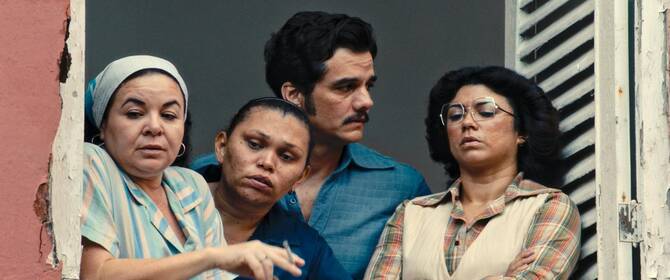
Brazilian director Kleber Mendonca Filho’s political thriller is set during his homeland’s turbulent 1970s. (Supplied)
Short Url
Updated 13 February 2026
Follow

‘The Secret Agent’ — Brazilian political thriller lives up to the awards hype

DUBAI: Brazilian director Kleber Mendonca Filho’s political thriller may be set during his homeland’s turbulent 1970s — under a military dictatorship that committed extensive human rights abuses — but this ambitious, layered, and beautifully realized movie is loaded with timely reminders of what happens when political violence and moral turpitude are normalized, and — in one memorable fantastical scene — when fake news turns into mass hysteria.

The film follows Marcelo (the compelling Wagner Moura), an academic working in engineering, who discovered that a government minister was shutting down his university department in order to funnel its research into a private company in which the minister owned shares. When Marcelo points out the corruption, he becomes a marked man and must go on the run, leaving his young son with the parents of his late wife. He is moved to a safe house in Recife, run by the sweet-but-steely Dona Sebastiana (an effervescent Tania Maria) on behalf of a resistance group. They find him a job in the government department responsible for issuing ID cards.

Here he meets the despicable Euclides (Roberio Diogenes) — a corrupt cop whose department uses a carnival as cover to carry out extrajudicial murders — and his goons. He also learns that the minister with whom he argued has hired two hitmen to kill him. Time is running out. But soon he should have his fake passport and be able to flee.

“The Secret Agent” is much more than just its plot, though. It is subtle — sometimes oblique, even. It is vivid and darkly humorous. It takes its time, allowing the viewer to wallow in its vibrant colors and equally vibrant soundtrack, but always building tension as it heads towards an inevitable and violent climax. Filho shows such confidence, not just in his own skills, but in the ability of a modern-day audience to still follow stories without having to have everything neatly parceled and dumbed-down.

While the director deserves all the plaudits that have already come his way — and there will surely be more at the Oscars — the cast deserve equal praise, particularly the bad guys. It would’ve been easy to ham it up as pantomime villains. Instead, their casual cruelty is rooted in reality, and all the more sinister for it. Like everything about “The Secret Agent,” they are pitch perfect.


Robert Duvall: understated actor’s actor, dead at 95

Updated 16 February 2026
Follow

Robert Duvall: understated actor’s actor, dead at 95

  • One of his most memeorable characters was the maniacal, surfing-mad Lt. Gen. William Kilgore in Francis Ford Coppola’s 1979 Vietnam War epic ‘Apocalypse Now’
  • One regret was turning down the lead part in ‘Jaws’ (which went to Roy Scheider) because he instead wanted to play the salty fisherman, a role that went to Robert Shaw

LOS ANGELES: Robert Duvall, a prolific, Oscar-winning actor who shunned glitz and won praise as one of his generation’s greatest and most versatile artists, has died at age 95.
Duvall’s death on Sunday was confirmed by his wife Luciana Duvall in a statement posted Monday on Facebook.
Duvall shone in both lead and supporting roles, and eventually became a director over a career spanning six decades. He kept acting in his 90s.
His most memorable characters included the soft-spoken, loyal mob lawyer Tom Hagen in the first two installments of “The Godfather” and the maniacal, surfing-mad Lt. Gen. William Kilgore in Francis Ford Coppola’s 1979 Vietnam War epic “Apocalypse Now.”
The latter earned Duvall an Oscar nomination and made him a bona fide star after years playing lesser roles. In it he utters what is now one of cinema’s most famous lines.
“I love the smell of napalm in the morning,” his war-loving character — bare chested, cocky and sporting a big black cowboy hat — muses as low-flying US warplanes strafe a beachfront tree line with the incendiary gel.
That character was originally created to be even more over the top — his name was at first supposed to be Col. Carnage — but Duvall had it toned down in a show of his nose-to-the-grindstone approach to acting.
“I did my homework,” Duvall told veteran talk show host Larry King in 2015. “I did my research.”
Duvall was a late bloomer in the profession — he was 31 when he delivered his breakout performance as the mysterious recluse Boo Radley in the 1962 film adaptation of Harper Lee’s novel “To Kill a Mockingbird.”
He would go on to play myriad roles — a bullying corporate executive in “Network” (1976), a Marine officer who treats his family like soldiers in “The Great Santini” (1979), and a washed-up country singer in “Tender Mercies” (1983), for which he won the Oscar for best actor. Duvall was nominated for an Oscar six other times as well.
Duvall often said his favorite role, however, was one he played in a 1989 TV mini-series — the grizzled, wise-cracking Texas Ranger-turned-cowboy Augustus McCrae in “Lonesome Dove,” based on the novel by Larry McMurtry.
Film critic Elaine Mancini once described Duvall as “the most technically proficient, the most versatile, and the most convincing actor on the screen in the United States.”
In her statement Luciana Duvall said, “to the world, he was an Academy Award-winning actor, a director, a storyteller. To me, he was simply everything. His passion for his craft was matched only by his deep love for characters, a great meal, and holding court.”

‘A lot of crap’ 

Born in 1931, the son of a Navy officer father and an amateur actress mother, Duvall studied drama before spending two years in the US Army.
He then settled in New York, where he shared an apartment with Dustin Hoffman. The pair were friends with Gene Hackman as all three worked their way up in showbiz. These were lean times for the future stars.
“Hoffman, me, my brother, three or four other actors and singers had a place on 107th and Broadway in Manhattan, uptown,” Duvall told GQ in 2014.
Duvall said he had few regrets in his career.
But one was turning down the lead part in “Jaws” (which went to Roy Scheider) because he instead wanted to play the salty fisherman, a role that went to Robert Shaw.
Director Steven Spielberg told Duvall he was too young for that part.
Duvall also admitted he took some jobs just for the money.
“I did a lot of crap,” he told The Wall Street Journal in 2017. “Television stuff. But I had to make a living.”
Duvall made his home far from the glitz and chatter of Hollywood — in rural Virginia, where his family had roots.
He and his fourth wife, Argentine-born Luciana Pedraza, 40 years his junior, lived in a nearly 300-year-old farmhouse. Duvall never had children.
He said he went to New York and Los Angeles only when necessary.
“I like a good Hollywood party,” he told the Journal. “I have a lot of friends there. But I like living here.”
And of all his storied roles, Duvall says his favorite was indeed that of the soft-hearted cowboy McCrae in “Lonesome Dove.”
“That’s my ‘Hamlet,’” he told The New York Times in 2014.
“The English have Shakespeare; the French, Moliere. In Argentina, they have Borges, but the Western is ours. I like that.”