

Debris removal steps up at Karachi fire-hit plaza as death toll nears 60

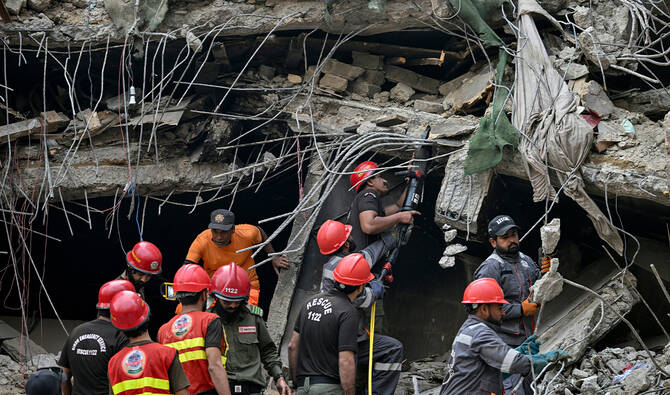
Rescue workers search amid the debris after a massive fire at a shopping mall in Karachi on January 19, 2026. (AFP)
Short Url
Updated 22 January 2026
Follow

Debris removal steps up at Karachi fire-hit plaza as death toll nears 60

  • KMC teams remove debris under safety precautions as search for the missing continues
  • Authorities are keeping agencies on alert amid rain forecast as the site remains unstable

ISLAMABAD: Municipal and rescue teams stepped up debris removal operations at a fire-hit shopping plaza in Pakistan’s largest city of Karachi on Wednesday, as officials said the death toll from the blaze has climbed to nearly 60 and the search for missing victims continues.

Teams from the Karachi Metropolitan Corporation (KMC) are clearing rubble from Gul Plaza, a multi-story shopping complex where a fire broke out late Saturday, under strict safety measures, with debris being transported to a designated ground in the city’s Meva Shah area, an official statement said.

“Rescue teams are continuously engaged in search and clearance operations to locate any remaining victims,” the statement circulated by the KMC said, adding that authorities were aiming to complete the process as soon as possible while ensuring safety.

Located in Karachi’s densely populated Saddar district, the fire at Gul Plaza burned for more than 24 hours before being brought under control. The blaze gutted more than 1,200 shops, triggered partial structural collapse and left dozens of people trapped inside.

With rain forecast in the coming days, authorities have placed all relevant departments on alert and are making contingency preparations to prevent further risks at the site, the KMC statement said.

The disaster at the shopping mall has renewed scrutiny of fire safety standards in Karachi’s commercial buildings, where overcrowding, illegal construction and weak enforcement have repeatedly contributed to deadly incidents.

Following the Gul Plaza fire, the Sindh Building Control Authority has warned developers and building owners to address fire safety violations or face legal action.

Deadly fires remain a recurring threat in the city of more than 20 million people, despite periodic crackdowns ordered after major disasters.


Italian PM pledges to deepen cooperation with African states

Updated 4 sec ago
Follow

Italian PM pledges to deepen cooperation with African states

  • The plan, launched in 2024, aims to promote investment-led cooperation rather than traditional aid

ADDIS ABABA: Italy pledged to deepen cooperation with African countries at its second Italy-Africa summit, the first held on African soil, to review projects launched in critical sectors such as energy and infrastructure during Italy’s first phase of the Mattei Plan for Africa.

The plan, launched in 2024, aims to promote investment-led cooperation rather than traditional aid.

Italy’s Prime Minister Giorgia Meloni addressed dozens of African heads of state and governments in Ethiopia’s capital, Addis Ababa, and reiterated that a successful partnership would depend on Italy’s “ability to draw from African wisdom” and ensure lessons are learned.

“We want to build things together,” she told African heads of state.  “We want to be more consistent with the needs of the countries involved.”

Ethiopian Prime Minister Abiy Ahmed said Italy had provided Africa with a gateway to Europe through these partnerships.

“This is a moment to move from dialogue to action,” he said. 

“By combining Africa’s energetic and creative population with Europe’s experience, technology, and capital, we can build solutions that deliver prosperity to our continents and beyond.”

After the Italy-Africa summit concluded, African leaders remained in Addis Ababa for the annual African Union Summit.

Kenyan writer and political analyst Nanjala Nyabola said tangible results from such summits depend on preparations made by countries.

African governments often focus on “optics instead of actually making summits a meaningful engagement,” she said.

Instead of waiting for a list of demands, countries should “present the conclusions of an extended period of mapping the national needs” and engage in dialogue to determine how those needs can be met.

Since it was launched two years ago, the Mattei Plan has directly involved 14 African nations and has launched or advanced around 100 projects in crucial sectors, including energy and climate transition, agriculture and food security, physical and digital infrastructure, healthcare, water, culture and education, training, and the development of artificial intelligence, according to the Italian government.