

Israeli strike kills 3 journalists in Gaza, as media watchdog reports near-record number in jail

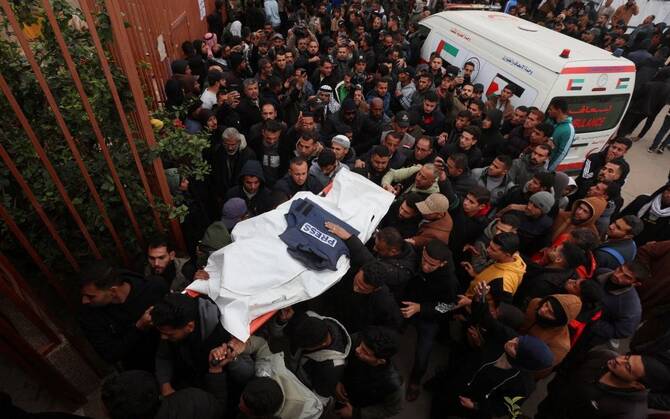
Mourners carry the body of one of the Palestinian journalists killed in an Israeli airstrike, Khan Younis, southern Gaza Strip, Jan. 21, 2026. (Reuters)
Short Url
Updated 21 January 2026
Follow

Israeli strike kills 3 journalists in Gaza, as media watchdog reports near-record number in jail

  • Mohammed Salah Qashta, Abdul Raouf Shaat and Anas Ghneim were using a drone camera to document aid distribution when a vehicle was targeted
  • Deaths coincide with publication of a Committee to Protect Journalists report that reveals 330 journalists are imprisoned worldwide

LONDON: An Israeli airstrike killed three journalists in Gaza on Wednesday, the territory’s civil defense agency said. Their deaths came as a report revealed the number of journalists imprisoned worldwide remains close to a record high.

The agency said the bodies of Mohammed Salah Qashta, Abdul Raouf Shaat and Anas Ghneim were taken to Al-Aqsa Martyrs Hospital in Deir Al-Balah following the airstrike in Al-Zahra, southwest of Gaza City.

Shaat had regularly contributed photographs and video footage to Agence France-Presse, though he was not on assignment at the time, the news agency said.

The Israeli military said its troops had identified “several suspects who operated a drone affiliated with Hamas” in central Gaza and attacked them because of the threat they posed. The details were under review, it added.

An eyewitness said the journalists were using a drone to document the distribution of aid by the Egyptian Relief Committee in the Gaza Strip when a strike hit one of the committee’s vehicles.

“A vehicle belonging to the Egyptian Committee was targeted during a humanitarian mission, resulting in the martyrdom of three individuals,” said Mohammed Mansour, a spokesperson for the organization.

All vehicles belonging to the committee bear its logo, he added, and he accused Israeli soldiers of “criminally” targeting the vehicle.

Meanwhile, a newly published report by the Committee to Protect Journalists stated that as of Dec. 1, 2025, 330 journalists were imprisoned worldwide, down from a record 384 at the end of 2024 but still close to historic highs.

Israel, which is holding 29 journalists, all of them Palestinians, ranked third on the list of countries with the most detained media workers, after China (50) and Myanmar (30). Nearly one in five jailed journalists reported they had been subjected to torture or beatings.

“Autocracies and democracies alike are locking up journalists to quash dissent and stifle independent reporting,” the committee’s CEO, Jodie Ginsberg, said.

The Hamas-run health ministry in Gaza said Israeli forces had killed at least 466 Palestinians since the ceasefire agreement took effect in November. The Committee to Protect Journalists reported that 127 journalists and other media workers were killed in the course of their work during 2025, the vast majority of them in Gaza.

* With agencies


How media reshapes the rules of diplomacy

Updated 03 February 2026
Follow

How media reshapes the rules of diplomacy

  • International envoys discuss influence diplomacy, misinformation, and the growing need for credible storytelling
  • Dya-Eddine Said Bamakhrama: The Saudi Media Forum itself is a tool of influence diplomacy, projecting the Kingdom’s image and soft power to the world

RIYADH: As dialogue surrounding the media’s influence across all sectors continues at the fifth edition of the Saudi Media Forum, some of the Kingdom’s ambassadors took to the stage to discuss diplomacy in an age of greater transparency.

A major topic on the panelists’ minds was “influence diplomacy,” an evolution of traditional diplomacy shaped by modern realities, said Ambassador of Djibouti to the Kingdom and Dean of the Diplomatic Corps Dya-Eddine Said Bamakhrama.

Influence diplomacy draws on soft power, he said. It uses tools such as arts and culture, sports, education, and humanitarian work to serve political interests and enhance credibility.

According to Bamakhrama, Saudi Arabia harnesses that influence through international forums, cultural initiatives, and a growing global sports presence.

“The Saudi Media Forum itself is a tool of influence diplomacy, projecting the Kingdom’s image and soft power to the world,” he said. “When a child in Africa or Latin America wears the jersey of a Saudi football club, that is influence diplomacy reaching far beyond borders.”

South African Ambassador to the Kingdom Mogobo David Magabe added that every country seeks to project an image that accurately reflects its culture, values, and identity to the world through food, music, cinema, civil society engagement, and cultural exchange.

However, Magabe warned that influence diplomacy must respect legal frameworks, avoid interfering in internal affairs, and operate transparently and ethically.

Spain’s Ambassador to the Kingdom Javier Carbajosa Sanchez echoed those remarks in saying that influence diplomacy can be a positive tool when it is ethical, disciplined, and grounded in facts.

Media has historically played a generally positive role in shaping public opinion, he said. But the rise of digital platforms requires a more responsible hand.

Diplomatic communication must follow rules, training, and ethical limits. “Propaganda may work temporarily, but credibility is what endures,” Sanchez said.

The ambassadors also highlighted that media today, particularly digital media, was a key actor in diplomacy, not just an observer.

While credibility depends on truthful and consistent narratives, digital platforms also enable the rapid spread — and exposure — of falsehoods.

“In today’s connected world, lies are exposed faster than ever,” Bamakhrama added.

Propaganda-based diplomacy no longer survives in the age of digital transparency. Instead, an effective diplomatic narrative relies on diplomats and policymakers’ understanding of the audience’s mindset, honest and clear communication of facts, and giving the necessary context for events.

Truth, he said, does not always require full disclosure, but it does not tolerate deception.

And the truth is especially paramount during times of crisis. The ambassadors agreed that false narratives collapse during conflict, and unchecked narratives can escalate crises beyond control.

“During conflict, responsibility must be shared between governments and media institutions,” Sanchez said.

Misinformation, the speed of news cycles, and the pressure to respond instantly were cited by the South African ambassador as the biggest challenges facing influence diplomacy today.

Accurate storytelling weighed heavily on speakers’ minds in the forum, especially in an era when messages can diverge between digital and traditional media.

Many of the same concerns surfaced in “Television and Streaming Platforms: Conflict or Opportunity?”, a panel focused on journalism and broadcasting, where media leaders examined how misinformation and competition are reshaping television.

Tareq Al-Ibrahim, director of MBC 1 and MBC Drama Channels and chief content officer at MBC Shahid platform, said that social media is both a bridge and competitor to television.

“It allows us to reach wider and more diverse audiences, but it also competes for people’s time,” he said.

In addition to audiences being larger, more fragmented, and more demanding, news organizations must now not only compete with other newsrooms, but with every other form of content on social platforms.

Despite this, professional journalism still holds great value and reaches wide audiences — if it adapts.

Al-Ibrahim added that competition was essential, not just for platforms, but for the entire value chain: “From writers to cameramen to directors, competition raises everyone’s standards.”

He also pointed to the evolution of Arabic content over the last decade as driven by competition from Netflix, Shahid, and other regional and global platforms.

Amjad Samhan, head of social media at Al Arabiya news network, described what the network’s transition was like from television to social media.

The challenge, he said, was figuring out how to deliver news to people who are not actively looking for news.

One solution was to transform long-form TV content into fast, digital formats. “We built a parallel digital newsroom with the same standards and principles,” Samhan shared.

When the question of social media influencers was brought up, Samhan argued: “The real competition is not with influencers. It’s with low-quality content. Credibility is what distinguishes news institutions from content creators.”

Journalism is built on trust, resources, and responsibility while influencers often lack verification and accountability, he said.

Reflecting on what the rise of digital platforms means for television, Al-Ibrahim said they are not alternatives, but complementary partners.

“Television creates shared moments; platforms create personalized experiences,” and the average consumer could greatly benefit from both.